The Abbey

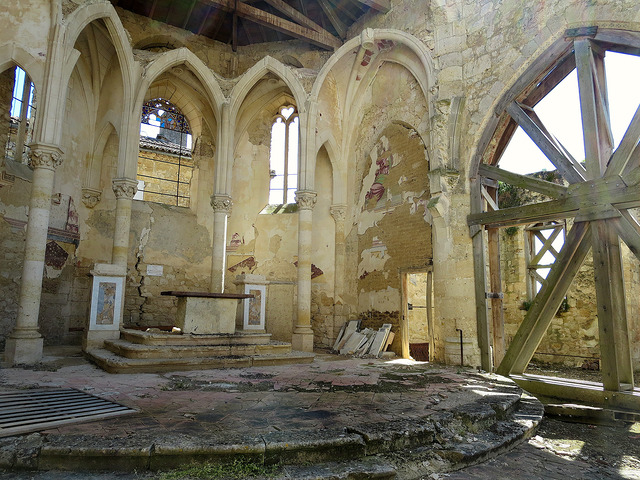
The photos last week caught my attention. The chapel, covered in snow. The lone pilgrim, covered in a poncho but soldiering on.

I knew this place, and the people who guarded pilgrims along this stretch of road. Although when I’d passed by, the sky was grey and full of rain, not snow.

From Walking to the End of the World:

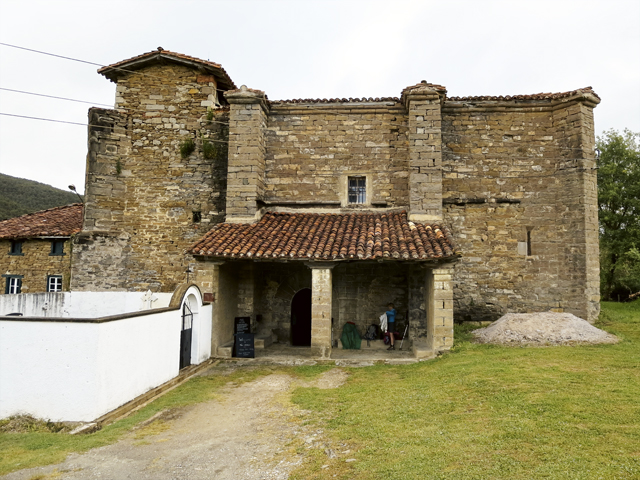
As we left Zubiri, Marieke and The Dane each split off to walk alone, but Eric and I plodded forward together through the steady drizzle. Just past Larrasoaña, we noticed a crumbling church by the road. The doors were open, so we went to check it out and see if there was a guest book to sign.
IMG_1923

When we got to the doorway, we realized that this wasn’t an active church at all, but a restoration project in progress. The interior of the chapel was gutted, and there were huge holes in the brick floor and the plaster walls. But there were also candles lit near where the altar used to be, and I could make out the edges of a simple fresco on the wall above it.

A man emerged from the choir loft and introduced himself as Neil, from South Africa. This was his project.

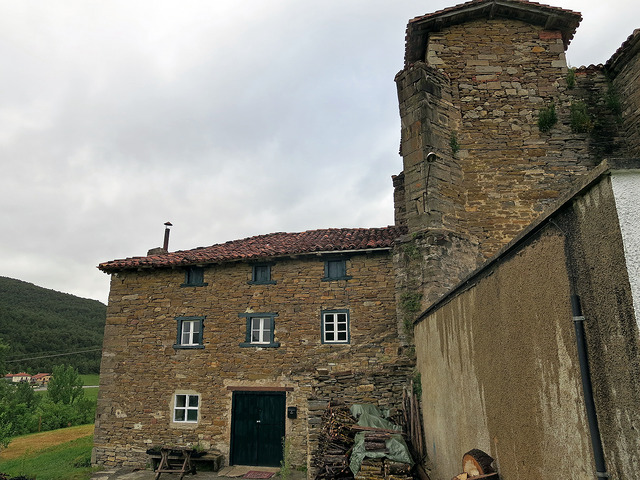
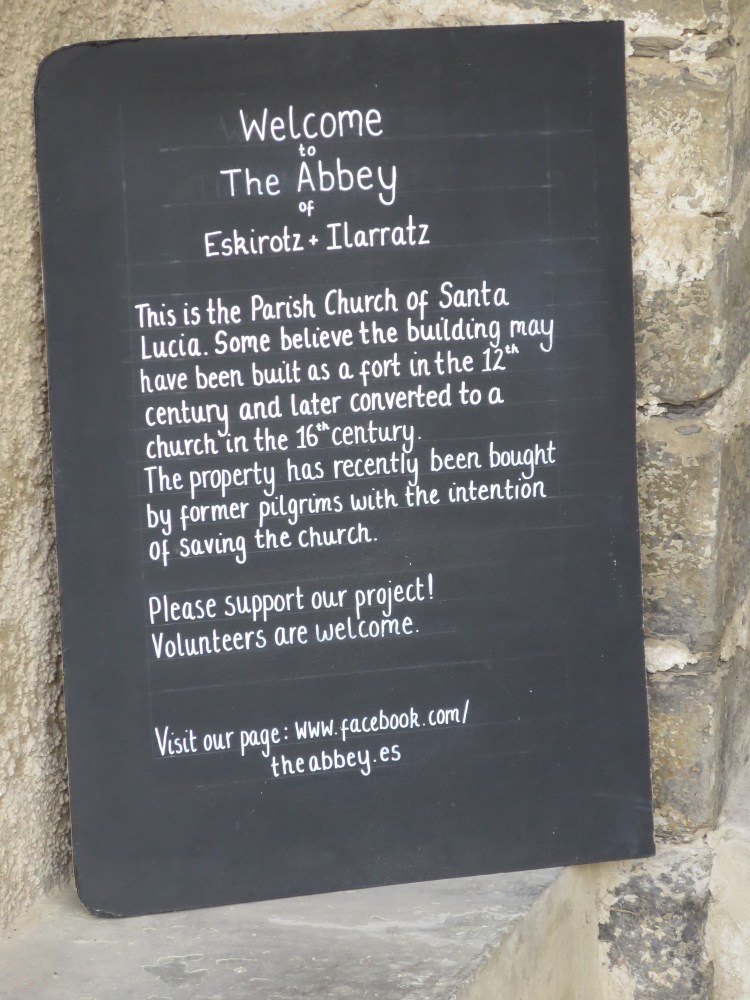
With great enthusiasm, he showed us around the abbey chapel, parts of which he said dated back to a twelfth-century fort, which was converted to a chapel for the Knights Templar. The Templars hadn’t been active since the fourteenth century, though, and the size and coffers of the Spanish church had been steadily declining for centuries. The Abbey of Eskirotz & Ilarratz had sat empty, abandoned for decades before Neil and his wife, Catherine, purchased it from the Archdiocese of Pamplona.

I stopped him. “You just bought a nine-hundred-year-old abbey? A person can do that?”

They can, he assured me, although it takes a lot of work. Spain’s bureaucracy is notoriously inefficient, but the church couldn’t sustain all of its aging buildings, and for them it was better to sell it to Neil than to leave it to rot.
20510580213_e9c4af855e_z

“Gypsies,” Neil told us, waving at the belfry. “They come and steal everything — the wires in the walls, the bells from the belfries. I have to sleep here every night for now, to let them see that the place is inhabited again.”

Templars and gypsies, belfries and frescoes…I started to see past the modern Camino and into the corners of Spain. Eric, too, looked interested for the first time since we crossed the border.

We lingered at the abbey for an hour or so, and The Dane decided to stay and volunteer for a week. Neil and Catherine were the talk of the albergues for days. We were all intrigued by a pilgrim who stayed. This idea of living on the Camino forever was something most pilgrims dreamed about over dinner, of course. Let’s just buy one of these abandoned towns! Let’s just run an albergue! Let’s be part of this story forever!

Well, Neil and Catherine had actually done it. They were our heroes.

Since then, I’ve stayed loosely connected to Neil and The Abbey through social media and email. Their program continues to grow, with new pilgrims discovering it every day and then telling their friends.
IMG_1922

On their Facebook page, The Abbey describes their story this way:

Our vision is to crowd-source the skills, the means and the resources needed to restore this neglected 12th century church. The church is rumoured to be a Templar church and symbols contained in and around the building seem to confirm this. Our research is ongoing but given that few records exist piecing the building’s story together is a challenge. Our vision for the church is that it will become a museum to itself. The building has lived through so much – the invasion of the Moors, The Spanish Inquisition, Napoleon’s crossing of the Pyrenees, two world wars, and the Spanish Civil War to name but a few… Our plan is to create a not for profit establishment where pilgrims can take refuge under shady oaks from the scorching summer sun. A place where they can relax in hammocks alongside the stream that flows through the garden or sleep out under the stars at night. We dream of creating a space where the commercialism of the Camino can be held at bay for a little while longer… to create a space where the true spirit of the Camino will be fostered. If you have any spare time, a particular skill set, knowledge specialisation, or any financial / material resources with which to help, we would love to hear from you. So many historical buildings on the Camino have been allowed to go to ruin – our hope is that by saving this one we’ll be able to create a ‘home from home’ for fellow pilgrims travelling on the Camino de Santiago.

For more information, check out their Facebook page. And if you want to support them, there’s a GoFundMe site.

If you’re walking the Camino Frances: The Abbey of Eskirotz & Ilarratz is situated on The Way of St. James (Camino de Santiago) shortly after Zubiri and before you reach Pamplona, in the Valley of Esteribar. The church is on the right-hand side of the road 150 meters past the village of Ilarratz on the way to Larrasoana.

(Also, if you’re independently wealthy and want to support a couple of Americans who dream about preserving parts of the Camino, my contact information is on the About page. 🙂 )

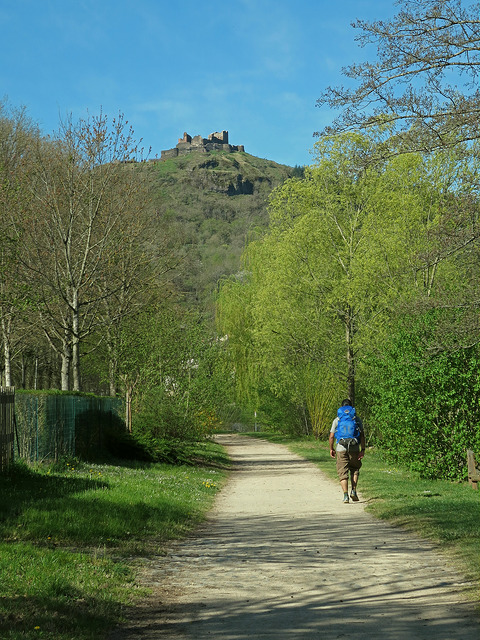
Progress (Almost Wordless Wednesday)
19774388510_9e11c9c190_z

“If you’re walking down the right path and you’re willing to keep walking, eventually you’ll make progress.” 

— Barack Obama


When Eric and I set out from Le Puy, Santiago de Compostela seemed impossibly far away.

A thousand miles? It was easy to get discouraged and believe I couldn’t do it.

But the thing was, on any given day I didn’t walk a thousand miles. I walked twelve (or eight or sixteen or whatever). And most days, twelve miles was possible.

Over time, those twelves added up. The cathedral in the distance got closer, until one day, there it was, right in front of me.

This winter, I’ve been walking a different kind of impossible journey, and once again, it’s been tempting to think that it’s too big, too long, too hard. But that’s only if I think about everything it will take to get to the end, way out in the future.

Today, I don’t need to do it all. I just need to stay on the right path and walk my twelve. And eventually, I’ll get there.

The Ugly American

I’ve been thinking a lot recently about a story that will be in Walking to the End of the World.

Linda, my developmental editor who was generally right about everything, expressed some concern about keeping this anecdote in the final book. She worried that it would make me seem too critical and would turn readers off. I opted to keep it in, though. For the sake of the narrative, I think it sets up some of the challenges Eric and I had as we transitioned from the Via Podiensis (the Camino route from Le Puy to Saint Jean Pied-de-Port) to the Camino Frances (from SJPP to Santiago).

More than that, it was an important experience for me, a reminder of how thoughtless words can affect others, especially when you’re engaging with people from other places, other cultures, and other backgrounds. I know I had my own moments, especially at the end of a long day, when my words got ahead of my perception. These moments happen, and not just on the Camino.

So what do you think? How would you/do you handle the careless comments of a thoughtless person?

Note: this happened in Roncevalles, after the grueling climb over the Pyrenees and just a few hours after my Camino Miracle. For most people walking the Camino Frances, this is the end of their first day. For us, this was Day 36.

IMG_1755
This Camino pilgrim would never say the wrong thing at the wrong time

There were tired, awkward, happy pilgrims everywhere, waiting in lines for showers and getting in each other’s way in the hallways. It would take time for them all to find their routines, and we decided the best thing to do until then was stay out of the way. Eric and I got settled as quickly as possible and then left in search of a bar and a celebratory drink.

We found The Dane and Caroline at an outdoor table, surrounded by their group of French admirers. We greeted one another, even the French guys we’d barely met before, like old friends. Beers were passed and stories shared. The group kept the conversation mostly in English for our sake.

I noticed that a man sitting alone at the table behind us was clearly eavesdropping. He was probably in his fifties, with a button-down shirt stretched tight over a sizable paunch. When I heard him talking to the server with an American accent, I smiled and said hello. It was still so novel to meet an American.

So yes, what happened next is all my fault.

Without more of an invitation, the man — we’ll call him John* — pulled his chair up to our table and started to talk. And talk. And talk.

Have you heard the stereotype of the “ugly American” abroad? You know, the uncomfortably loud, arrogant, ethnocentric, insensitive clod with the white knee socks and the loud opinions?

That was John.

He told the group he was from northern California, and how perfect it was there compared to everywhere else in the world. This had been his first day on the Camino, yet he lectured us on the best gear to carry and the right food to eat. He told us about all of the other long-distance hikes he’d done in different parts of the world. “Those were real hikes,” he said, waving a hand dismissively around him. “This Camino thing is a walk in the park.”

I laughed and challenged him a bit, telling him about the 500 miles that everyone else at the table had already walked, through mud and over roller coaster hills. “Hell of a park,” I said.

“Six weeks in France?” John not only didn’t take the hint, but he picked up a shovel and dug himself deeper. “I wouldn’t want to do that. I’ve been to Paris.” He puffed up a bit at this, and I wondered if he understood that several of the people at the table lived in Paris. “I don’t get what the big deal is. Just a lot of people too interested in what clothes they’re wearing. The language is terrible. The whole place isn’t that great.”

There was a long, awkward pause. Not all of our friends spoke English fluently, but they understood enough. I saw a few quick glances in our direction. Would we defend him?

Hell, no.

Eric turned and said something to Caroline in French. I had no idea what, but it didn’t matter. Our allegiance was declared. Without another beat, the conversation switched exclusively to French. I could follow enough to laugh at the right places and throw in a word here and there.

Effectively shut out, after a few awkward minutes John got up and moved away. When we tried to apologize for his behavior, our friends waved us off. Every culture has someone like him.


*I have no memory of what his real name was. I really hope it’s not John.

Is There a New American Pilgrimage Trail?

A few years ago, if you’d asked me about pilgrimages, I would have had to dig back into history. The word pilgrimage seemed archaic, more appropriate for Chaucer than the twenty-first century, and carrying a backpack for days wasn’t my thing.

After I fell in love with the Camino de Santiago, though, the Baader-Meinhof Phenomenon* kicked in, and suddenly people were talking about spiritual or historical pilgrimage walks all over the world.

The Skikoku Pilgrimage to 88 Temples in Japan

The Via Francigena to Rome

Peru’s Inca Trail to Machu Pichu

The Lycian Way in Turkey

I know a guy who’s helping to organize a new “contemplative trail” called the Camino Salvado in Australia.

These are different than the traditional long-distance hiking trails that seem to wind across every beautiful place in the world (though some of them sound pretty spectacular, too). Pilgrimage trails, I came to understand, are journeys bound to the spiritual history of a place, and established for the mind as well as the body.

Now, it seems, we can add a new one to the list. According to this article in Backpacker Magazine, America is now the host of a 200-mile “interfaith pilgrimage trail” in Montana, created for “grieving, healing, and honoring life’s major transitions.”

It’s called The Sacred Door Trail.

According to Backpacker writer Elisabeth Kwak-Hefferan:

Inspired by a hike on Spain’s Camino de Santiago, in 2009 Weston started piecing together existing trails (including part of the CDT) into a loop route with the help of a coalition of local faith-based and indigenous groups. The trail officially “opened” in 2012 with a multi-faith ceremony, as well as a guidebook and website. But unlike many of the most famous pilgrimage sites—such as the Camino or the Hajj to Mecca—this trail is explicitly nondenominational. And it gets its sacredness not from the grave of an apostle or footprints of a prophet, but basically because Weston declared it so.

Which, to be fair, strikes me as quintessentially American. The Sacred Door Trail appears to be a melting pot of ideas, derived and adapted from the histories and cultures of others but without a unique origin story. There’s no destination; the trail is a loop. It draws its spiritual authority from its own self-determination. It is a pilgrimage trail because it says it is a pilgrimage trail.

Does that count? What makes something a pilgrimage? I’ll leave that to others to decide.

Because there’s something else The Sacred Door Trail lacks: beds and bathrooms. This is a camping trip, at its core more like the AT or Pacific Crest (or, by distance, the Sunshine Coast Trail in BC) than the cultural trips of other continents.

tumblr_mn8b8sLRb61rkz363o1_1280
Photo: The Sacred Door Trail website

And there are some things I’m loathe to give up, even for an inward exploration of self and beliefs.

I may be in the minority, though. According to The Sacred Door Trail’s Facebook page, they received so much attention after the Backpacker article came out, that they ran out of hiking guides.


What do you think? Would you walk The Sacred Trail? What appeals to you, and what doesn’t?


*Baader-Meinhof Phenomenon: “when the thing you’ve just noticed, experienced or been told about suddenly crops up constantly. It gives you the feeling that out of nowhere, pretty much everyone and their cousin are talking about the subject — or that it is swiftly surrounding you.”

Cows of the Camino

When our thousand-mile Camino trek ended, Eric and I took a train east, from Santiago to Irun. The hills of Galicia and then the plains of the Meseta sped by in a blur of landscapes without details.

This was the only way I’d seen the world for years, I realized, from moving metal boxes that were climate controlled, comfortable, and going too fast for me to notice much.

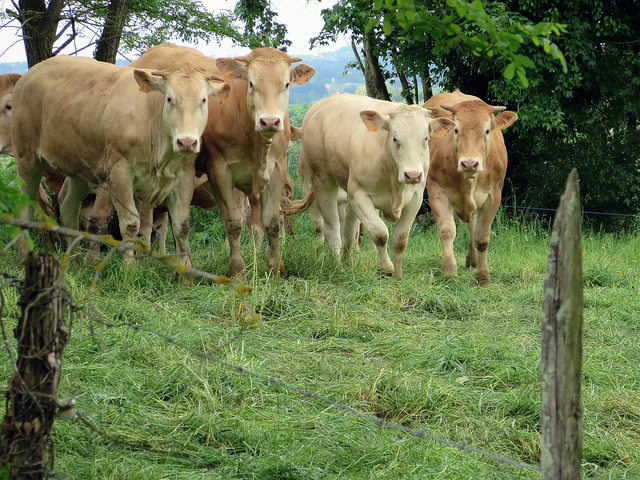
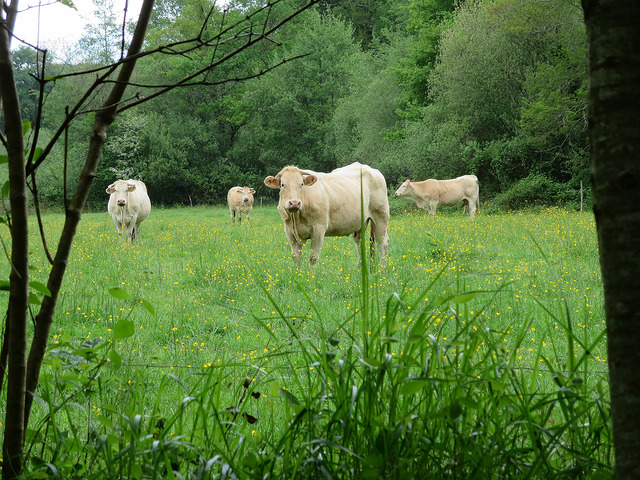
For seventy-nine days, though, my only climate control had been a sun hat and rain jacket. I was rarely comfortable, and I moved so slowly that I could watch the seasons changing day by day and make solemn eye contact with cows.

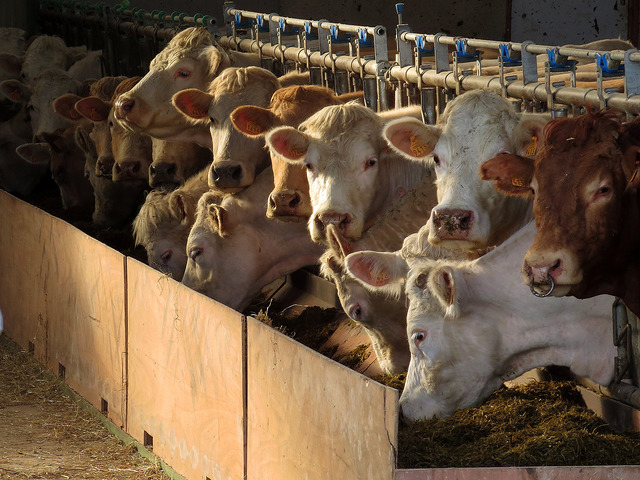
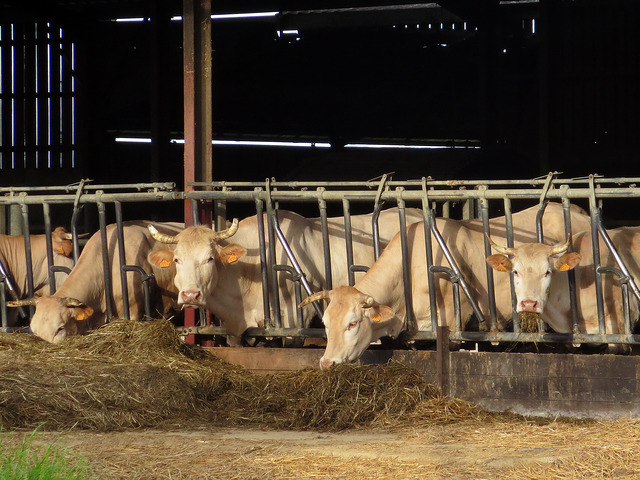
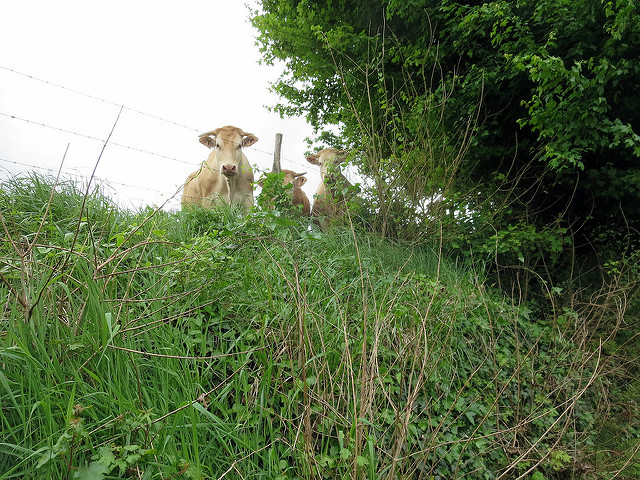
A person can’t spend seventy-nine days making eye contact with cows and not see the world in a slightly different way.

19775643059_c272d4bd52_z19382866220_e5551c1da3_z19341278183_5603913345_z20080409100_0db825a04b_z20242110816_80c3020218_z20268328355_1932361ea3_z20268463125_6e7e71a380_z20944982059_8fd0f266ab_z21105817116_5230e11102_z21973148544_461cb758a7_z

21973159554_199fb36f18_z
Okay, we’re not really making eye contact here. But really, would YOU slow down long enough for this bull to notice you?

(This post, by the way, was inspired by the Facebook group Way of St James – Via Podiensis – Chemin du Puy-en-Velay, where a few weeks ago a number of members shared their often hilarious pics of their own encounters with Cows of the Camino, and particularly the cows of France. If you are at all curious about walking the Le Puy route, check them out. They have a collection of resources from gite lists to active tracking of who’s walking and when.)

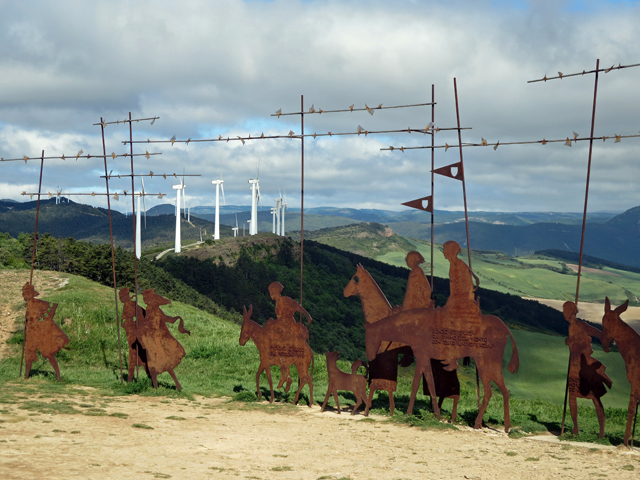
The Surprising Story Behind the Sculpture on Alto del Perdón

Twelve kilometers after Pamplona, past the fields of grasses splashed with red poppies (or the fields of dry dirt, depending on the time of year), the crumbling monasteries, and the towering hay bales, and up a steep set of switchbacks, the Camino Frances arrives at Alto de Perdón, the Mount of Forgiveness.

Alto de Perdon
Alto del Perdón shares the mountain with almost 40 wind turbines


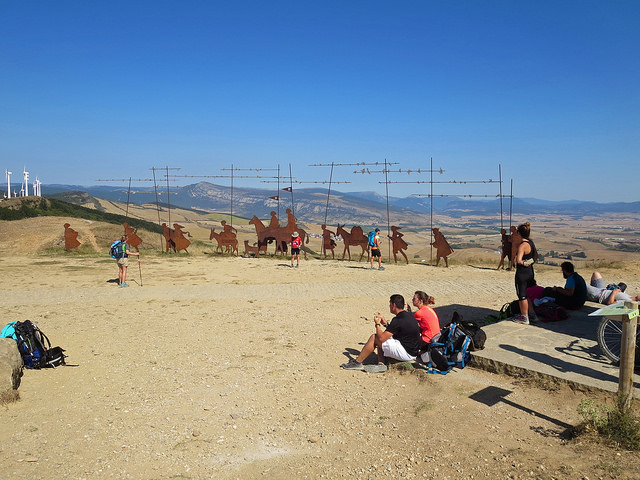
I’ve stood twice on its windy peak, in the shadow of the deceptively quiet, impossibly tall wind turbines.

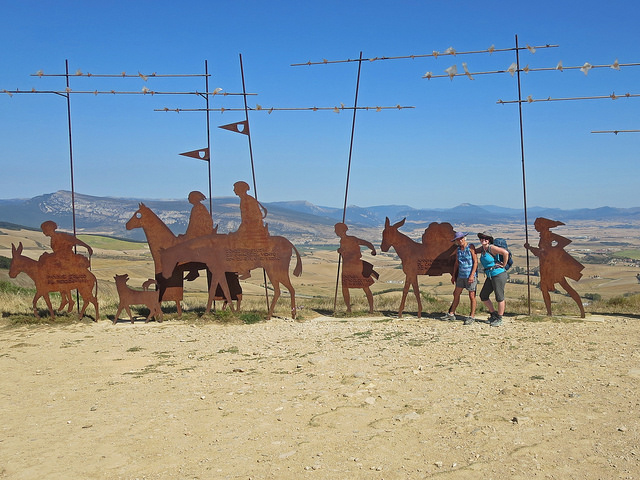
Like most Camino pilgrims who pass this way, I’ve posed for pictures beside the iconic sculpture, which has graced the summit since 1996.

37760473645_fcea42d869_z
Me, Laurel, and a donkey in the August heat

I’ve read the words inscribed on it: Donde se cruza el camino del viento con el de las estrellas — “where the path of the wind crosses with that of the stars.”

But last week, as I read one of my Christmas presents — The Lore of the Camino de Santiago, by Jean Mitchell-Lanham – I discovered a whole new layer of meaning in that famous place.

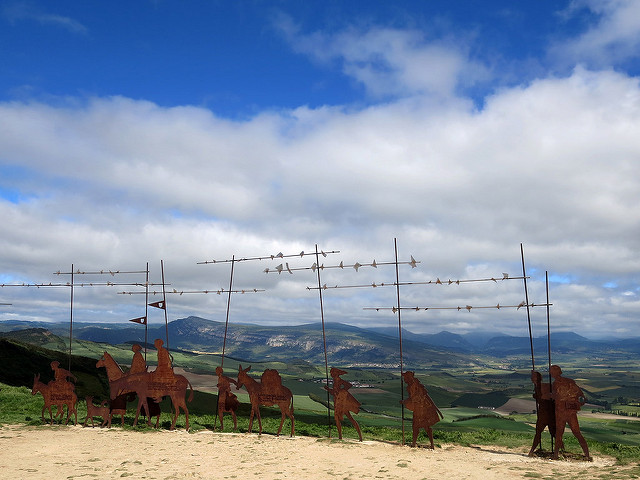
38591798496_2f5993e2d3_z
The only photo I have that captures all 12 figures in one shot

According to the author:

“The sculpture exhibits a small history of pilgrims and the pilgrimage…through various stages of development, from the beginning in the Middle Ages up to the present day, in the form of a procession. Of the twelve pilgrims, the first pilgrim appears to be searching for the route and symbolizes the beginning of interest in the pilgrimage. Next is a group of three that depicts the growth or rise in popularity of the Camino. These three are followed by another group depicted as merchants or tradesmen on horseback that symbolize the medieval era of merchants hawking their wares to the pilgrims. Spaced away from them is a solitary figure that characterizes the decline in pilgrimages due to political, religious, and social unrests from the mid-fourteenth to the mid-twentieth centuries. At the very end of the procession are two modern-day figures depicted to show the renewed interest and rise in popularity of the pilgrimage in the late twentieth century.”

I’ve never heard this particular explanation before, but it makes sense when I look at the figures. Those last two on the right, with their practical hats and backpacks, always seemed a little out of place with the folks on horseback.

20943323990_827b4a46cc_z

Just goes to show that there’s always something new to learn.


You can check out Jean Mitchell-Leham’s book The Lore of the Camino de Santiago: A Literary Pilgrimage (Two Harbors Press) on Amazon here, and probably purchase it wherever books are sold.

My Camino Miracle

Happy 2018! I’m so excited to finally be able to say “my book releases this year.”

To celebrate, I want to share one of the most meaningful memories of my Camino journey. It happened on the infamous Day I Walked Over the Pyrenees.

As soon as we crossed the Nive River, the road started to climb.

IMG_1850
Why does it never look as steep in photos as I remember it being???

Eric wished me luck and disappeared up the hill. We’d talked already about how we shouldn’t even try to walk together today; our paces on inclines were just too different. He promised he’d stop every hour or so and wait for me to catch up.

The sky was overcast but dry, and the sun shone weakly behind a flat layer of grey. I looked back every few minutes to see the white walls of Saint Jean Pied-de-Port behind me, until they disappeared as I went around a corner.

21105583126_632e494ccd_z

And then I climbed some more.

The ascent was relentless. Each step felt like I was on a staircase. My leg muscles were burning when I reached Hunto, the cluster of houses 400 meters above and five kilometers past Saint Jean.

Wait. That had only been five kilometers?

I tried to imagine doing what I’d done so far four more times that day, and as my mind slipped away from the present and into the future, I lost my battle to stay calm and focused. There was an undercurrent of panic in my steps. My heart was already pounding and my breathing labored when the Camino path, now marked with Spain’s yellow arrows alongside the familiar GR65 stripes, split from the paved road and shot up an even steeper set of rocky switchbacks.

The wind picked up as I left the cover of trees and started up the open incline. It was a breeze on my face at first, enough to cool the sweat. But as I got higher it picked up some more, and then some more. Of course it was blowing against me, making each step harder. I felt myself drift under its pressure toward the outer edge of the trail, which fell steeply, though not dangerously, downhill.

Logically, I knew I wasn’t going to blow off the side of the mountain. The wind wasn’t that strong. Rationally, I knew that I just had to keep putting one foot in front of the other. This mountain was steep, but I’d climbed steeper (albeit shorter) hills in France. This was something I could, eventually, do.

My mind knew all of that, but all I could feel was panic.

I’ve never had a full-on panic attack, or at least not one that’s been confirmed by a medical expert, but I came pretty close that morning on the side of the Pyrenees. I couldn’t catch my breath or slow my heart rate. The tears started, and with them the mortification of knowing that all these strangers were watching me melt down. (Of course, most of those strangers weren’t watching me at all. They were fighting their own battles with the windy, steep, terrible mountain.)

I was barely six kilometers in, and it was over. I’d have to retreat to Saint Jean and admit defeat. Eric would have to come back for me.

The inner chorus predicting my failure was almost as loud as the wind.

Through all of it, though, I kept planting my walking poles and pulling myself forward, foot by foot. An object in motion tends to remain in motion… And then, as I rounded yet another hairpin turn and passed another pile of rocks, it happened.

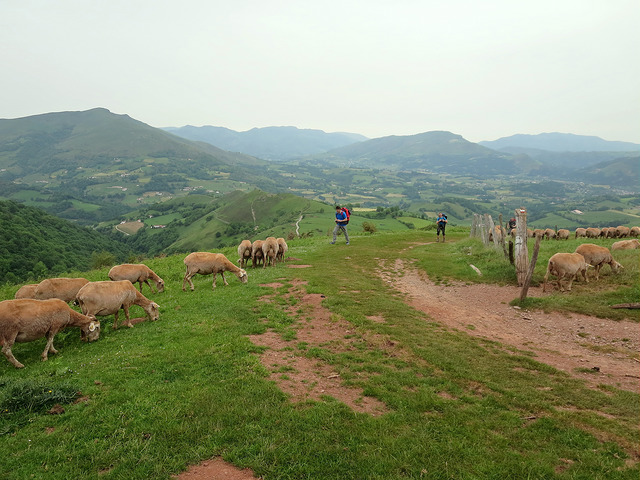
Sheep.

IMG_1857

Before we left for the Camino, people liked to ask what I was most looking forward to. I think they expected me to say something like “the cathedrals” or “a life-changing revelation” or (if they didn’t know me at all) “spending a day hiking over the Pyrenees.” My standard answer, though, was “sheep.”

It was a bit of a blow-off. I was trying hard not to create any specific expectations about would happen on my Camino. But there was one thing that I really, really wanted to experience. My Camino dream was to walk along a narrow country lane, lined with walls or hedges, while a flock of sheep herded by a solemn shepherd flowed around me like I was a rock in a river. That, from the perspective of my city-and-technology-driven life, was the quintessential “Camino moment.”

I had no way of making my fantasy become real, but I knew it was possible. I’d seen plenty of videos of sheep encounters on the Camino. But so far, I hadn’t been so lucky. Eric and I had shared the road with farmers herding cows a few times. And I’d had a close encounter near Ostabat, when a small flock of sheep crossed a road a few hundred yards ahead of us. But by the time we got there—and I practically ran to get there—the sheep were already settled in their new field, the gates were secured, and the shepherd had moved on. My sheep dreams remained unfulfilled.

Until now. Because meandering down the mountain toward me was a flock of the ugliest sheep I had ever seen.

21131784535_d04acd2d51_z
Meandering down the mountain toward me was a flock of the ugliest sheep I had ever seen

Seriously. They’d been shorn recently, so they were all bristly, mud-colored fuzz and knobby shoulders and ears. Several of them had bright blue marks on their sides, as if they’d been tagged with graffiti.

There was no pastoral road, and no fences to keep the flock together. In fact, I wasn’t sure I even could legitimately call these animals a flock. There was no shepherd or caretaker in sight, and the animals seemed to move at their own pace and direction. They were coming generally downhill, toward me, but they kept their heads down, nibbling what little grass existed on the open hillside.

They were less like a flock and more like a collection of grazing sheep under the effect of gravity.

But gravity was working in my favor, so I stopped, delighted, as they swarmed around me and into a field on the other side of the road. The animals paid little attention to the steady line of humans crossing their path, and to my surprise, most of the humans paid little attention to the sheep. They, too, kept their heads down and their feet moving forward.

21131773415_b0a17f72f4_z

Not me. I stayed until the last gangly lamb passed. And in the process, my pounding heart slowed, and my breathing evened out.

When I started walking again, the road was just as steep. The wind blew just as hard. The only thing that changed was my perspective. All my attention was on the piece of magic that had just happened.

Later, when I caught up with Eric, he told me about a conversation he’d had with a devout Catholic from Eastern Europe at about this same time. It was her first day on the Camino, and she could barely control her excitement. This was a holy place, she told Eric.

When he mentioned that he’d been walking for a few weeks already, she asked if he’d had a “Camino miracle” yet.

Eric pointed at the miles of rolling mountains that were a hundred shades of summer green, dotted with flowers and farms and dappled by sunlight. “Look around. This is the miracle,” he told her.

He thought she seemed disappointed by his answer, and they soon parted to walk their own Caminos.

But he’d hit on something.

“The sheep!” I told him. “The sheep were my very own Camino miracle.”


If you’ve walked the Way of Saint James, did you have a Camino miracle?

Why Walk to Finisterre?

When Eric and I approached Santiago de Compostela two years ago, the crowds of people around us grew by the day, as did their anticipation. Together we counted down “the last hundred” kilometers to Santiago, where the remains of Saint James waited for us in an enormous cathedral. On the morning of our arrival in the holy city, we left before dawn to get there in time for the daily pilgrims’ mass, and to see the swinging butafumeiro.

It was thrilling.

But then, the next morning, Eric and I again woke at dawn, strapped on packs, and passed through a sleeping city. We were still headed west.

21972985334_d7200a8bf0_z
Looking back at Santiago the morning we left, silhouetted by the dawn in the eastern sky.

Why? That’s a question many of our pilgrim friends asked us, and something I’ve heard often since then.

Fewer than 10% of pilgrims who arrive in Santiago walk the additional 90 kilometers to Finisterre. Some of the rest are limited by time, and based on the conversations I had, many of the rest didn’t see a reason to continue. After all, Santiago is the historic destination, and where we get the Compostela. This is the Camino de Santiago, not the Camino de Finisterre. Why keep walking?

I can see their point. But for me, the Atlantic Ocean was always the goal. And it isn’t quite accurate to say that Santiago is the historic destination. After all, the residents of the Iberian Peninsula made spiritual journeys to Finisterre for hundreds of years before Pelayo unearthed a grave under a star.

22595735475_c42740235c_z
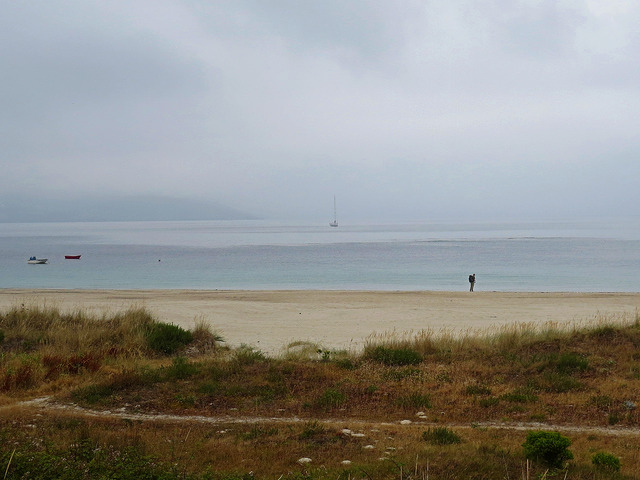
Pilgrim on the beach at Finisterre

Wait, what?

It’s true. The Santiago pilgrimage, like many Christian traditions, borrowed heavily from the cultural traditions in place before it. (For further reference, see the origins of Christmas trees and Easter bunnies.) Celtic pagans had journeyed west to make sacrifices at the Ara Solis temple on the point of Cape Finisterre* for centuries before the Romans left the Italian peninsula, and so by the time the Spanish bishop established Santiago as a prime pilgrimage destination, the local Celtic population had a long history and familiarity with the tradition of traveling toward “the place where the sun died.”

22582090402_6fccf13fda_z
“The place where the sun dies”

Not that I walked to Finisterre because of the pagan tradition, any more than I walked to Santiago because of the Catholic one. I went because I’d already walked more than 900 miles, and it seemed like an epic journey west should end with my feet in the ocean. Where, as poet David Whyte says, there is “no way to your future now but the way your shadow could take, walking before you across water, going where shadows go.”

I wanted to walk until I couldn’t walk anymore.

And so that’s what I did. Those last four days** were the most peaceful, contemplative, and fun days of my Camino journey. The crowds disappeared, and the smaller groups of us who were still walking bonded over long hours on quiet trails, and even longer dinners in small villages. My body was exhausted and ready to be done. But my soul longed for the ocean, and the place where my feet reached the water.

21974543383_caef6f7313_z
Hamming it up on the beach of Finisterre

Still not convinced the extra 90 kilometers are worth it? Check out this video from a Camino pilgrim who brought a drone to capture the view from above. Stick it out until the end, at the point of Cape Finisterre itself.

And then tell me how this is not the most fulfilling, compelling end to a long-distance walk you’ve ever seen.

What’s your experience? Did you walk to Finisterre? Why or why not? Was it worth it?


* Finisterre (“end of the earth” in Latin) is also called Fisterra in the native Galician language. It can all be very confusing.

** Most pilgrims walk from Santiago to Finisterre in three days, but because of where the towns and albergues are located, it requires walking two 35-kilometer days in a row. I had no interest in pushing that hard at the very end, and we were in no rush. I’d learned by then that “walk your own Camino” meant not trying to keep up with the younger, fitter, faster crowd. If we were meant to see them again, we would. So I planned a more sedate, four-day approach, with a stop in tiny Santa Marina.

The Monastery of Light

Laurel and I stopped for the night in Azofra, a tiny town between Logroño and Burgos. The town’s major claim to Camino fame is that the municipal albergue has two-person cubicles AND a fountain in the courtyard where pilgrims can soak tired feet.

When we arrived, our new friend, John, mentioned that Azofra offered another opportunity: just five kilometers off the trail, near Cañas, was an active abbey worth visiting. And then he reminded me of something I rarely considered: we didn’t have to walk there. (I can get pretty single-minded on the Camino. I’m here to walk, so anything that’s not directly in my path is outside my range.)

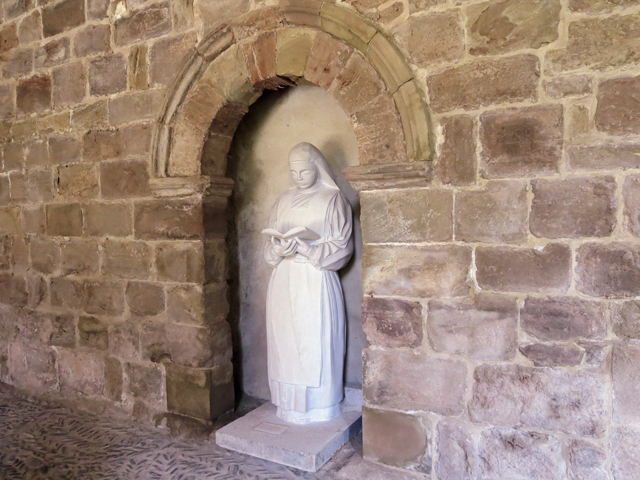
So once we settled into the albergue (and soaked our feet in that lovely pool for a while), John arranged for a taxi to pick us up and whisk us – at speeds that seemed impossibly fast – to the gates of the Abadía de San Salvador – or, as the website calls it, the Monasterio de la Luz (the Monastery of Light). It was late afternoon and mid-week, so the place was mostly deserted. There was no sign of the community of sisters who had been living there since the 12th century, and only a few other tourists wandering the museums and cloisters.

37930116354_c755798fee_z


IMG_3647

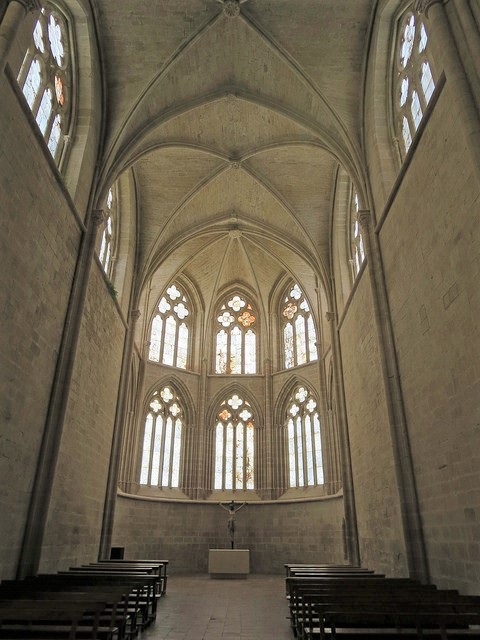
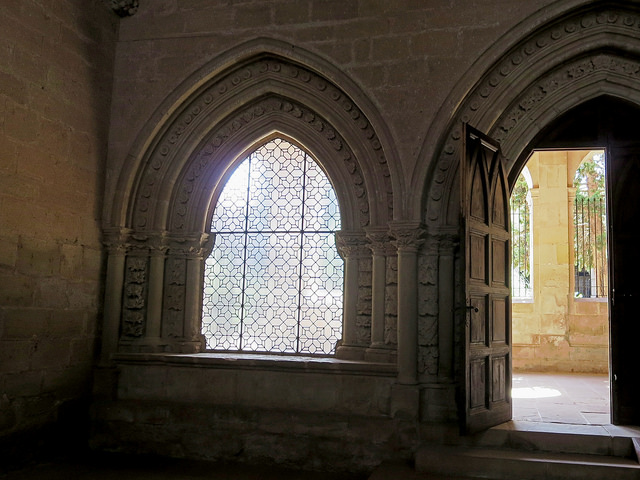
The silence of the place struck me, but even more, I noticed the simplicity. The walls were mostly bare, the windows muted.

Even the statues were simple.

IMG_3641


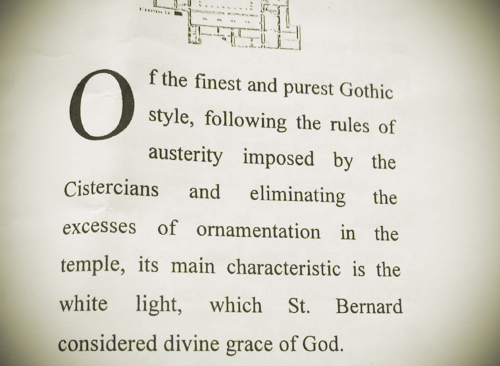
A single paragraph in the English brochure explained it:

IMG_3668

Of the finest and purist Gothic style, following the rules of austerity imposed by the Cistercians and eliminating the excess of ornamentation in the temple, its main characteristic is white light, which St. Bernard considered divine grace of God.

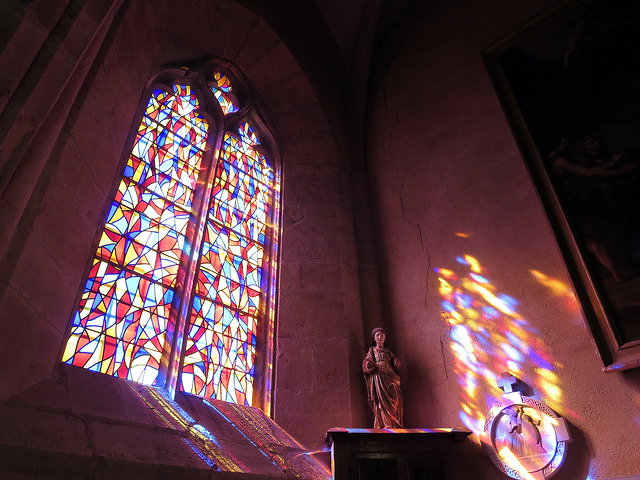
I knew next to nothing about the Cistercians, but I immediately liked them. While most of the churches and historic buildings in Spain were overwhelming in their ornamentation (I’ve written about the Church of the Sensory Overload before), this was decidedly, stunningly, austere. It was calm. Even the stained glass was intentionally muted, creating a place of peace.

38615426642_bd241e4231_z

IMG_3669


I thought about all of this again yesterday, when I went for a walk in the woods near home as a way to work off the Thanksgiving over-indulgence and lethargy. The afternoon wasn’t what most people would consider “ideal hiking conditions.” That is, it was raining pretty steadily the whole time I was outside. (But hey, I’m in Seattle; if we stayed inside every time it rained we’d never go anywhere.)

It was mostly a misty rain, coming from a pale sky. The light around me, even through the raindrops, was, I realized, white. The woods around me, bathed in pale grey, were peaceful.

Saint Bernard, founder of the Cistercians, lover of white light, found much of his inspiration, it turns out, outdoors:

Believe me, you will find more lessons in the woods than in books. Trees and stones will teach you what you cannot learn from masters.

It’s a good reminder as we head into December. In this season of excess and ornamentation, may you each find a few moments of peace and white light among the trees and stones.

7 Camino Gratitudes

It’s Thanksgiving week here in the United States, a time set aside for family and feasting, and hopefully a time to reflect on the gifts we’ve been given.

In that spirit, I’ve been thinking about my Camino Gratitudes: the things I now appreciate (or appreciate more) because I have been a pilgrim to Santiago.

In no particular order:

19775687329_1983f2c2d2_z

1. Churches

I grew up in the Christian Church (the body of believers), but until I walked a thousand-year-old pilgrimage, I had no idea how meaningful a church – a building specifically built and elaborately furnished to draw attention to a mighty Creator – could be.

Designed and constructed without the help of modern drafting or engineering, the cathedrals of the Camino are masterpieces. The small chapels along the road each tell a story. I could – and often did – linger for hours, studying the art and trying to imagine the first congregations of poor, illiterate, mystical believers.


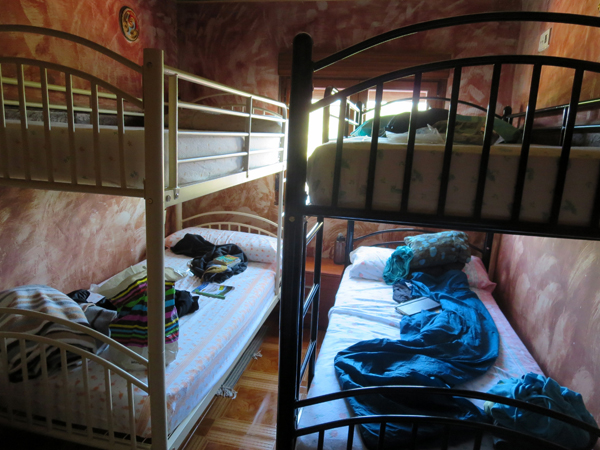
close quarters
close quarters in Villacalval

2. Beds

When I stay in one place, I take my bed for granted. It will be there every night, right where I left it.

When I camp in the wilderness, I give up beds all together.

When I walked the Camino, though, a bed became a gift. In 79 days, I slept in 75 different beds. Some were comfortable, others were almost comically inappropriate, but they were always available. Every day I walked into a new place, a stranger in a strange town, and knew there would be a safe place to sleep. A private corner that would be my own when I needed it most.


21121937742_01a88f04f5_z

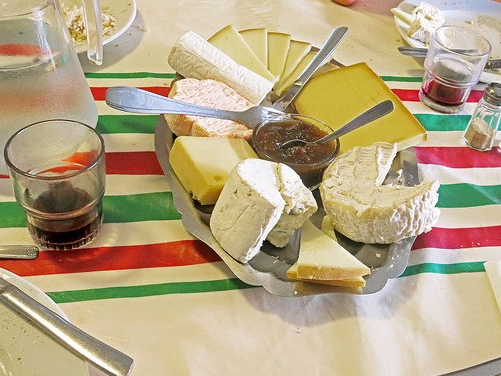
3. Cheese Plates

Forget the Mona Lisa or pasteurization. The greatest gift of France to humanity, in my opinion, is the after-dinner cheese plate. It extends the meal and whatever conversation is happening, and offers a savory end to an experience. Unlabeled and diverse, the cheese tempt us to try new things, to share.

Plus, you know, cheese.

I know what I’m bringing to Thanksgiving dinner this year. 


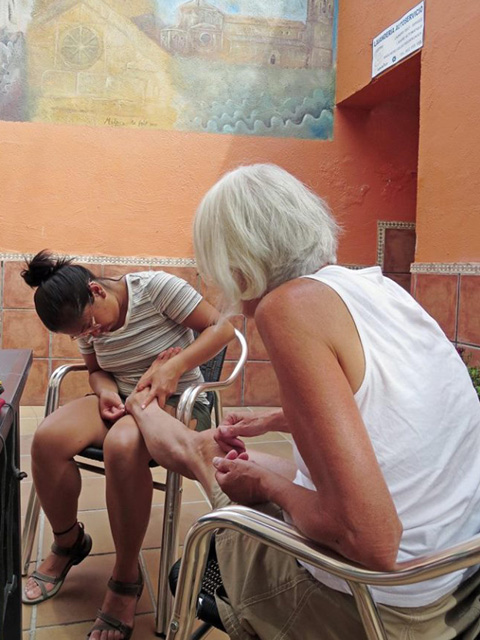
21430526_10155241695113557_1673301597691934749_n
The all-too-familiar afternoon blister treatment


4. Feet That Don’t Sweat

My poor, injury-prone Princess feet have their share of problems, which seem to get worse as time goes on. But I’ve walked parts of the Camino twice now, once in the depth of summer heat, and I never had a blister. Our only guess about what makes me immune to the most common pilgrim ailment is that my feet don’t sweat, and so there’s no moisture to respond to friction.

There are a hundred ways in which I am not a natural hiker or pilgrim, but I’ve got this one superpower, and I’m grateful.


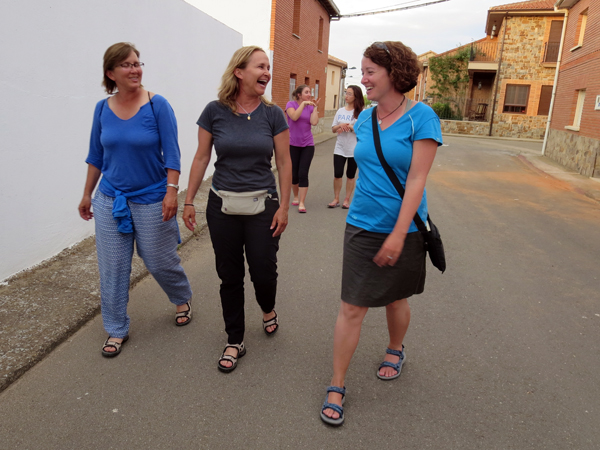
IMG_2338
We’re from three different countries, but we all speak “Camino pilgrim.”

5. Global friendships

Two Americans, a Dane, a Korean, and three Mexicans walk into a bar… and it’s not a joke. It’s a normal afternoon in a Camino town. Walking the Way of Saint James offered me not just the cultural experience of visiting two distinct countries and cultures, but the joy of exploring them with people from a dozen OTHER countries. Today my social media feeds are a hodgepodge of languages, and I have a deeper understanding of life outside my own American bubble.


19647787303_36db1834d1_z
The ruins of a church destroyed in France’s Wars of Religion. (Wait, do I even know what the Wars of Religion are, or when they happened???)

6. History

I’ve always been a student of modern history, but the Camino made me curious about medieval life in a way no book ever could. I met people who lived in the 800-year-old walls of a French town. I walked on roads originally constructed by the Romans. I learned about the Knights Templar by exploring castles that they built. Yesterday I found myself slipping a random reference to “Ferdinand and Isabella” (as in, the Spanish monarchs of the 15th century) into casual conversation, and I stopped and felt a moment of gratitude for everything I never knew about how our cultures grew and merged.


20268463125_6e7e71a380_z
When you move at a human pace, you spend a lot of time being stared at by cows.

7. A Human Pace

For years, “travel” meant watching the world pass by from the comfort of climate controlled, comfortable, motorized boxes. We were usually going too fast for me to notice the details.

But for seventy-nine days, my only climate control was a sun hat and rain jacket. I was rarely comfortable, and I moved so slowly that I could watch the seasons changing day by day and make solemn eye contact with cows.

My tasks – to walk from this town to that town, to wash my clothes and find my food – were simple but time consuming. It could take all day to get over a ridge I’d been watching since morning. I learned to follow the sun’s patterns, waking and sleeping early. Without a smartphone screen to distract me, I was left to sort through my own thoughts and stories.

Now, surrounded by chiming laptops and rush hour drives, I look back on those slow, patient pays, and am grateful to have had them.


What about you? If you’ve walked part of the pilgrimage to Santiago, what’s your Camino Gratitude?