After a couple weeks of winging ideas around, the incredible team at Mountaineers Books and I have finalized the title:
Walking to the End of the World: A Thousand Miles on the Camino de Santiago
It’s a lot of words, but it captures perfectly the things that are important to me about this story: the length of the journey, which extends the perception of “the Camino” beyond the Camino Frances; the focus on reaching the ocean (Finisterre is a derivation of the Latin finis terrae, meaning “end of the earth”); and a subtle nod that this is a walk (accessible) and not a hike or trek (scarier words for people like me).
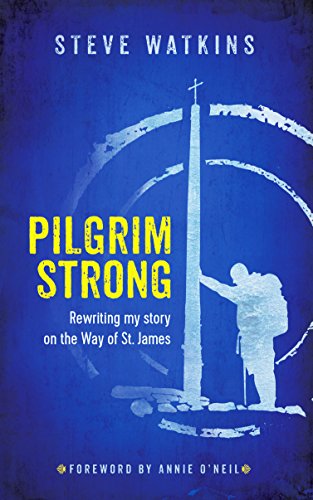
Next stop: choosing illustrations and finalizing a book cover design.
Slowly but steadily, this baby project of mine is getting closer to being in your hands. And I’m feeling like the luckiest writer who ever approached the end of the world.
There are dozens of books written about people’s personal experience on the Camino. Today, a new one will be added to the list, and I’m particularly excited about it.
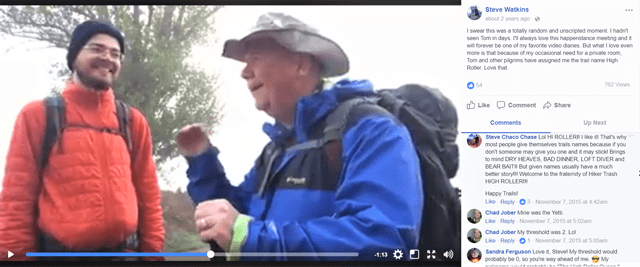
Steve walked the Camino Frances (St Jean Pied-de-Port to Santiago) in the fall of 2015, setting out just a few weeks after I returned from my own adventures. He traveled to Spain by himself, and he took full advantage of social media and his own storytelling skills, posting almost daily updates, videos, and photos to the American Pilgrims of the Camino Facebook group. He attracted thousands of followers who journeyed vicariously with him through a winter Camino, complete with snowstorms and empty albergues.
A screenshot from one of Steve’s many videos from his Camino journey, shared on Facebook
Those posts, and the encouragement he got from his growing list of followers, developed into the memoir of Steve’s journey, which releases today.
Steve was kind enough to send me an advance copy of his manuscript for an endorsement. Here’s what I said:
“Steve Watkins has the mind of a philosopher and the heart of a twenty-first-century storyteller, and in his debut memoir he explores the popular Camino de Santiago pilgrimage in a way no writer before him has done. Pilgrim Strong digs past the everyday experiences of walk, eat, sleep, repeat and explores the unfiltered emotional beauty and hardship of walking for weeks on end. Steve invites readers to join his highest highs and his lowest lows, and in the process to reconsider the very meaning and source of human strength.”
What I loved about Steve’s book was that it told a story that traced such a familiar path, and yet was so different than mine. From the seasonal differences, to the fact that he traveled alone and made social media such a major part of his experience, to the places that made an impression on him, to his spiritual outlook – Pilgrim Strong is my reminder that we all walk different Caminos, and that every story is important to hear.
He was kind enough to take a few minutes from his busy travel and book signing schedule to answer a few questions:
When I teach publishing classes, I always tell my students that the first step in publishing is to identify your audience: who will be drawn to read this specific book? So…who did you write this book for? Who do you hope reads it?
Oddly, I suppose, this book was mostly written for me. I’ve always been a person who understands his thinking better after it’s written down somewhere. Pilgrimage has the potential for being one of the deepest, most meaningful experiences a person can know, but understanding how it affects you is a long and complicated process. There’s a lot to digest and it doesn’t happen immediately. I felt as though the long, thoughtful process of putting words down on paper would bring the level of understanding I desired, and indeed it did.
But somewhere in the process, I realized there was so much of value to share with others, not necessarily about the experience of walking, but about the things I went there to consider and contemplate. I’m not even sure if this should really be considered a “camino book.” My desire was creating a book that will resonate with average, everyday kinds of people who have experienced the ups and downs of life. The Way just happened to serve as a great canvas on which to paint the story. We’re all on a great pilgrimage no matter where we are.
“Pilgrimage has the potential for being one of the deepest, most meaningful experiences a person can know, but understanding how it affects you is a long and complicated process.”
Why did you decide to go on the Camino in the first place?
Even from childhood I’ve pursued certain things that pushed my comfort zones, physically, spiritually, and mentally. I heard it said once that “you never know how much you can do until you try something that’s more.” That’s true enough. Pushing our limits makes us better, stronger people.
When you’ve walked 500 miles across a country, it’s not such a big deal when you miss the front-row parking lot at Target. Aside from the physical challenge of walking long distances every day, the day-to-day exposure you get from pilgrimage in a far-away land is a great learning experience, enhanced all the more for me by the history and significance of this place. This was the proving ground where James, the apostle of Jesus, fulfilled his commission to spread the good news of the Gospel. All those things combined made the draw of the Camino irresistible.
One of the things that made my Camino special was that I chose to do it entirely offline. You took the opposite approach. How do you feel like that affected your experience?
Both for the good and the bad. There are mental and physical stresses that slip up on you during an experience like this, and we put certain pressures on ourselves while engaging in social media. I shared my story transparently in real time, and when you put yourself out there like that you should be prepared to take the bad with the good. While most were supportive and enjoyed the storytelling, a few actually challenged my thinking, philosophies, and the way I did some things. One or two were downright hateful. It’s easy to be careless and reactionary when you’re tired, cold and lonely, and I lost my cool a few times. That’s not what pilgrimage should be about, but alas, “it was my Camino.”
The flip side is that it created an international community of friends with whom I still engage. I think it was upwards of 3,000 people who sent congratulations when I reached Santiago de Compostela that Sunday afternoon. While the Pilgrim Strong release has always been targeted for November 1, a few dozen folks inevitably discovered the Amazon link and bought the book early. During the last few weeks many people in that “virtual community” have sent photos of them holding the book in places all around the world. That is so humbling and nice for readers to make such kind gestures.
If you had to do it over, would you make the same decision?
In the same set of circumstances, all things considered, yes. My entire professional life is invested in the field of mass communication. It’s irresistible.
How did you decide what scenes and stories to share in your book?
In recent years I’ve come to think of myself as a missionary journalist. In just about anything I write, you’ll see simple stories that have a deeper potential to teach and convey lessons about life. So the writing is metaphorical, even parable-like. Trudging through a snowstorm has the potential to teach us about hardship and determination. Feeling lonely in a group of strangers where you don’t know the language can become a lesson about prejudice. Meeting someone who just came to walk a few miles for fun, then shifted her thinking to actually making it to the finish suddenly becomes a story about the power of arrival and the realization of pursuing something higher, something more. The beauty of all this is that the most mundane situations can have extraordinary teaching power for average, everyday people. Everyone loves a good story, and people most enjoy stories about other people. The best thing about this kind of storytelling is that it’s broad, diverse, and the reader never really quite knows where it’s going.
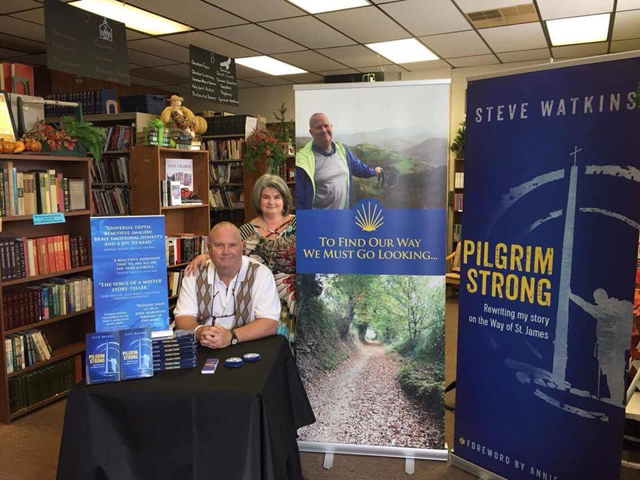
Steve and his wife, Dana, last weekend at a book launch event
Let’s talk about Dana. You share online all the time how blessed you are to be married to Dana. What was it like to walk the Camino without her?
First, you are correct about my feelings toward Dana. The thing I have always wanted most in life is to have a great marriage – not a perfect marriage – but one where there is trust, loyalty, dependence, and where both partners want the best for, and cheer one another on. Having that is my greatest blessing and an answer to prayer. Dana stood by me when I was broke, she held me when I was depressed, and she encouraged me when I had a dream. Every man should know the love of a woman like her.
As much as we like spending time together, she also knows I’m a better person experiencing things like pilgrimage, or running a marathon, or traveling solo in a foreign land. I need those things and I’m a better person all-around experiencing them. She knows this about me and supports it. There is, in fact, a Pilgrim Strong chapter dedicated to this very topic. Forty days away is a long time and I missed her a lot, but the experience was so great I took her back to the Camino Frances last year and we lived it together.
I never like it when people ask me for my “favorite” part of the Camino, but I do think that there are “shimmering images” – specific bright moments where everything clicks, and you feel the sensory experience for the rest of your life. Can you tell us about one of those?
Indeed. My “Camino family” came together in El Acebo randomly meeting up with a teacher from California and a hospitality industry professional from Barcelona. After a week of walking together as a team we experienced something amazing on the stage from O’Cebreiro to Triacastela, and it’s a day that will live in my heart forever.
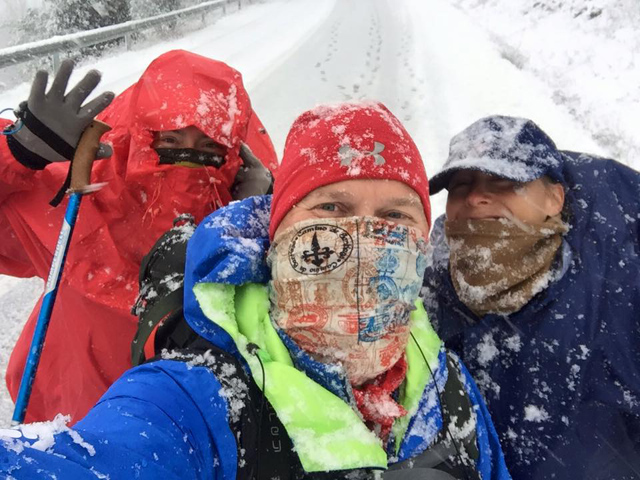
It is no exaggeration to say we walked together through a Galician blizzard for eight hours that day. With white-out snow conditions and winds exceeding 35 miles per hour it was bitter cold and miserable, but we did it together and felt as though we’d really conquered something that day. I’ll never forget after eight hours we’d descended far enough that the weather cleared up and became spring-like, and as we looked back up into the elevations the storm was still in full fury. It’s worth mentioning that I had no pants on the trip and wore shorts through it all.
“With white-out snow conditions and winds exceeding 35 miles per hour it was bitter cold and miserable, but we did it together.”
Anything you want to share that I didn’t think to ask?
Yes. About two months before Pilgrim Strong was finished there was a strong sense that returned. A “what’s next?” kind of feeling. To make a long story short, there is a unique opportunity next year to partner with theMississippi River Parkway Commissionand serve as their “storytelling ambassador” for several months while walking the Great River Road. This scenic byway runs alongside the Mississippi river for 2,069 miles from its source in Lake Itasca, MN, to the Gulf of Mexico. It’s a unique opportunity to tell the story in real time on an even bigger social media platform and then write a book about the experience focusing on the people, history, and culture of life along one of the most amazing natural phenomena in the country. It has amazing journalistic potential, not to mention another adventure closer to home. I’m now in the process of deciding if I can commit to it mentally and physically.
That’s fantastic!
FollowSteve’s blog to find out what happens with this new project.
“People ought to saunter in the mountains – not hike! Do you know the origin of that word ‘saunter?’ It’s a beautiful word. Away back in the Middle Ages people used to go on pilgrimages to the Holy Land, and when people in the villages through which they passed asked where they were going, they would reply, “A la sainte terre,’ ‘To the Holy Land.’ And so they became known as sainte-terre-ers or saunterers. Now these mountains are our Holy Land, and we ought to saunter through them reverently, not ‘hike’ through them.”
– John Muir, as quoted in Albert Palmer’s 1911 book The Mountain Trail and Its Message
Hey, all, remember me? I took a break from regular blogging last month while I juggled a few dozen other things, both professional and personal.
On the book front, my developmental (the big picture) book edits are almost done, and were pretty painless. My editor did a fantastic job of picking out the places where I contradicted, or didn’t explain, or made a joke that went a little too far, and we’ve got a manuscript I’m excited to share with you…eventually. My official release date has been set for October 2018. Between now and then, I’ll work with the team at Mountaineers Bookson a title, cover design, interior art (original maps! photos!), copy editing and proofreading, and marketing. There’s a lot of steps to making and distributing a great book. I’ll keep you posted.
In the meantime, I’m thinking about what it means to “saunter reverently” instead of hiking. To linger in holy places, like this chapel in Rochgude just outside Le Puy. (I’ve told the story of my Moment on a Mountaintop before.) To measure a day not by distance, but by experience.
This writing process is fun, but I’m itching to go sauntering again.
It’s impossible to walk the Way of Saint James, the Camino de Santiago, without encountering images of Saint James. Which makes sense – we are on a journey to his recognized grave, after all. Without James the Greater, brother of John and the first of Jesus’ disciples to be martyred, there would never have been a reason for the early Christians to journey to a remote corner of northern Spain, one of the farthest corners of their known world.
The more I walked, though, the more I paid attention to the different ways that James is represented along the way.
Most of the time, Saint James is portrayed as a pilgrim with a floppy hat, staff, and some kind of scallop shell. This James was kind and welcoming, though the logic of his appearance always confused me. Was he dressed to visit his own grave?
In Spain, there was a second depiction of of Jesus’ disciple that popped up more often than I would like. This one was anything but kind.
Saint James Matamoros, as depicted in the Cathedral of Burgos. Note that he’s wearing his pilgrim’s scallop shell.
This is Santiago Matamoros, or Saint James the Moor Slayer. He is always on a horse, sword drawn, and often depicted with a pile of bodies — or body parts — under his feet.
The image comes from a story that spread across Spain during the centuries-long war between the Christians in the north and the Muslims in the south. According to legend, things were going badly for a Christian army during a battle near Clavijo in 844. They were outnumbered and near defeat, but were saved by the miraculous appearance of Saint James, no worse the wear for having been dead for 800 years. With an enormous sword and an immortal white horse, he led the Christians to victory against the infidels, killing as many as 5000 men in the process.
The story of the battle spread across Spain, cementing the Spanish commitment to the disciple who would become their patron saint and unifying the northern Christian in their fight against the Moors. Hundreds of years later, Spanish conquistadors took Santiago Matamoros with them to the New World, erecting statues and naming churches after the violent defender who would protect them against the violent indigenous gods.
Hoofprints (or horseshoes) of the horse of Santiago Matamoros, as preserved in the reliquary of the Santa Maria de San Salvador Monastery in Cañas
The only problem was that the whole thing never happened. I don’t just mean that a long-dead saint didn’t appear on angelic horseback to slay an opposing army. I mean that the entire battle was fiction. It was fake news.
There was a town called Clavijo, but no battle ever took place near it. And while there was definitely a war between the northern Christians and southern Moors, the two specific armies mentioned never met.
The whole story was wartime propaganda to motivate a beleaguered population.
It took historians centuries to prove it, and by then the legend was too deeply ingrained, and the images and artwork too prevalent, to undo. Santiago Matamoros even has his own statue in the Cathedral of Santiago de Compostela, despite protests, though for the past ten years the church has at least covered the decapitated bodies of his victims with a tasteful flower arrangement.
I always squirm when I see James, the evangelist and humble martyr, turned into a violent, nationalist weapon.
And I wish it wasn’t so easy to see modern parallels.
Your pilgrimage begins as soon as you walk out your door, says a popular Camino mantra.
Historically, that’s true. After all, the original pilgrims to Santiago didn’t have the choice to hop on a plane or train to get to a well-marked and collectively-accepted starting point. They just picked up their belongings and started walking.
(There are still a handful of pilgrims who do this, by the way. I’ve met men and women from as far away as the Netherlands and Switzerland who set out on foot from their homes, eventually connecting with one of the established Camino paths.)
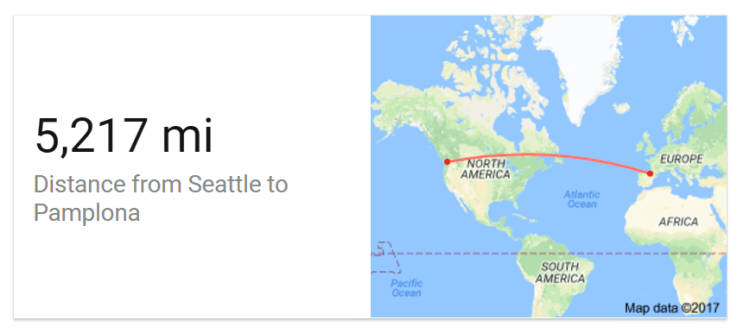
But for many of us, there are some major obstacles, like oceans, between us and Santiago. According to Google, it’s 5,217 miles (8400 kilometers) from home to Pamplona, where Laurel and I started our Camino journey a month ago. And that’s the direct route, without layovers.
Why did we start our Camino in Pamplona?
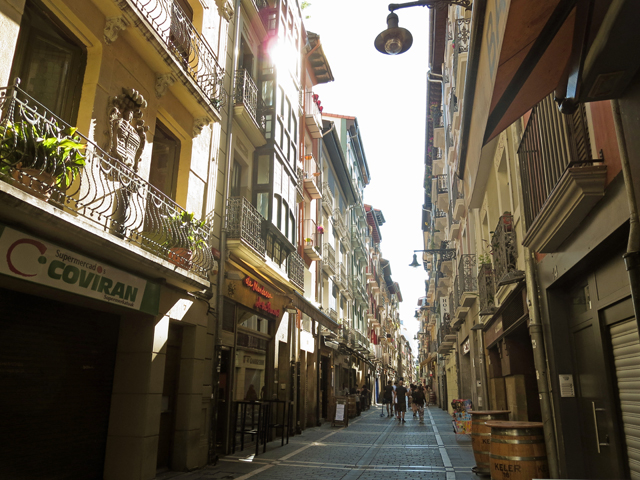
First, because Laurel had limited time off work, and couldn’t afford to backtrack to St. Jean Pied-de-Port and then walk an extra three days. Second, because Pamplona is an amazing, magical city. And third, because the last time I walked over the Pyrenees I swore I would never, ever do it again.
Mostly, though, it’s the convenience. Pamplona is one of the biggest cities on the Camino Frances. While there are no direct flights from the United States, there are plenty of direct ways to get there in half a day from Madrid by train, regional flight, or bus.
Still, a 5200-mile journey can be long and sometimes baffling for two tired, generally un-travelled Americans from the West Coast.
Here’s what it took to get there, and what I learned along the way:
Step 1: Leave for the airport at 4:30am Saturday in order to catch a 7am flight from Seattle.
For Laurel, this is actually Step 2, because she lives on an island almost 3 hours from the Seattle airport. She left home on Friday and came to my apartment, where she spent a short and probably-uncomfortable night sleeping on my office daybed, with my too-curious cat.
We arrive at SeaTac Airport by 5:00 and navigate a surprisingly crowded security checkpoint easily, because all we have are our carry-on (and carry-everywhere) backpacks.
Travel tip: don’t bring your trekking poles. You can pick up an inexpensive pole or two in any European sporting goods store – there are Camino-themes stores all along the Camino Frances – for less money than it costs to check a bag, and far less aggravation.
Step 2: Fly 5 hours from Seattle to Charlotte.
This makes me really appreciate how much longer it takes to fly around the bulk of the Earth, rather than over the poles. Two years ago, Eric and I flew to Paris via Iceland to begin our Camino in Le Puy, and our total time in the air was less than 10 hours. This year I’ve gone more than half that already, and I’m not even in sight of the Atlantic Ocean.
Laurel and I sit separately for this flight, which is a typical domestic steerage experience, with no entertainment, no pillows, and little leg room. I try to sleep as much as possible, despite the very nice, very chatty physics professor beside me.
(There are no photos of any of this, because really, an airplane is an airplane.)
Step 3: Spend 2 hours in Charlotte Airport.
I’ve connected here before, and it’s a good place to kill some time. We stop at a restaurant and had lunch/dinner, thinking it would be the last time we ate until we arrived in Spain. Because airlines stopped serving food on flights years ago, right?
Right?
Step 4: Fly 8 hours from Charlotte to Madrid.
And this is when I learn how different international travel is than domestic, at least on American Airlines.
Laurel and I sit together this time, tucked in one of those middle sections of seats that’s so far away from any window that it’s impossible to know where we were or what was happening outside. As soon as we board, it’s clear that American Airlines has a plan to make the next 8 hours as non-awful as possible. There are entertainment screens on the back of every seat, and a pillow and blanket waiting for each person. Almost as soon as we take off, they start serving a full dinner: a choice of two hot entrees, a salad, rolls and butter, and dessert. (Okay, the food was nothing to get excited about, but the effort was appreciated.) Plus, it came with free beverages, even wine.
I fly 6-hour direct flights fairly often to get from coast-to-coast in the US. When was the last time I was on a plane that gave me free food, let alone wine?
Travel tip: fly internationally more often, and don’t worry about eating before you board.
As soon as dinner is over, the attendants announce that they’re turning out the lights. The implication is clear: time to sleep. It’s only 3:00 Pacific Time, but in Madrid it’s midnight, so smart idea. I sleep restlessly, mostly because our seats are in front of one bathroom and across the aisle from another, so there’s steady traffic, noise, and light. But it’s possible to convince myself it’s night, especially when at “5:30am” (Madrid time, so 8:30pm in Seattle) the crew comes around again to serve breakfast.
Two meals in one flight?
Step 5: Take 3 hours to navigate Madrid Airport, train to downtown, and wait.
It’s 7am on Sunday, we’ve had a handful of hours of interrupted sleep, and we’re in a foreign airport. No problem.
That’s what I tell myself, and it works. We get through customs without anyone even asking questions, find our way out past security, use an ATM to acquire euros, and we’re ready to go.
Travel tip: the most efficient, least expensive way to get local currency in another country is to use an ATM. American banks will charge more, and currency exchanges in airports are a rip-off. Rick Steves agrees with me.
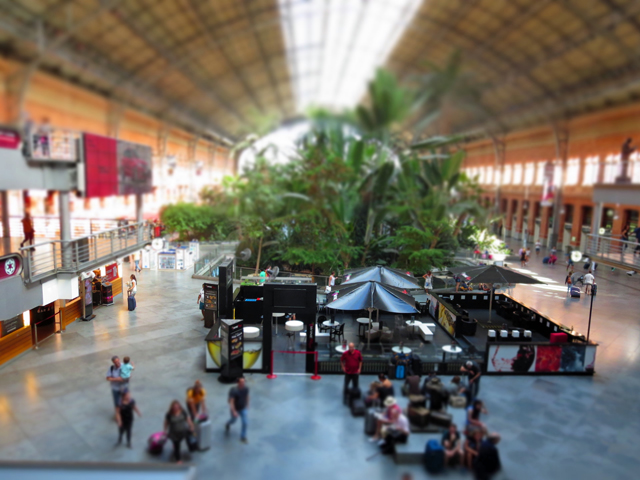
We need to get downtown to the Madrid Atocha rail station, to catch our Renfe train to Pamplona. (There are trains to Pamplona that leave directly from the airport six days a week, but alas, not on Sundays.)
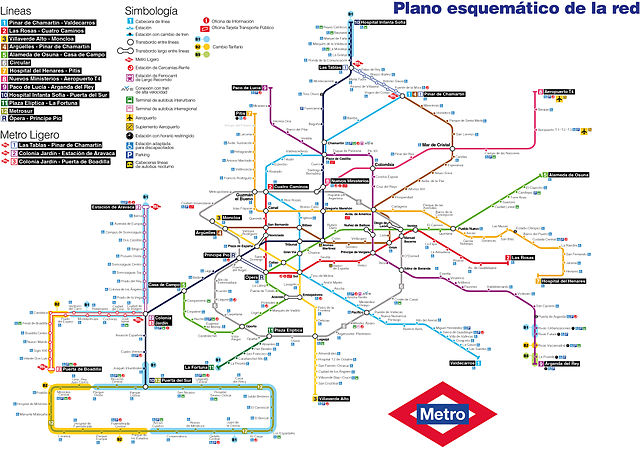
And here’s where I make a mistake. For some reason, I think that we have to take the Metro – Madrid’s urban subway – to get downtown. This requires buying tickets on machines that are not at all intuitive and then navigating two separate connections on the subway.
It’s complicated, it’s not air conditioned, it takes an hour, and we’re both a little punchy-tired. But we do it.
Then, when we get to the Atocha station, there are signs all over promoting the direct Renfe train that goes directly to the airport in 20 minutes. The woman at the information desk says we didn’t even need to buy a ticket; if we have a Renfe ticket, the airport connection is free.
Well, live and learn.
Madrid Atocha Rail Station
Travel tip: The Renfe (Spanish rail system) website is a pain to navigate, but their trains and services are great. There’s a platform in the Madrid Airport right next to the local subway.
We still have a couple of hours before the train departs, so we wander outside for our first cafés con leche and fresh air in 27 hours (or 18, depending on time zones). Madrid is fast and crowded and noisy, and I instantly love it.
Step 6: Train for 3 hours from Madrid to Pamplona
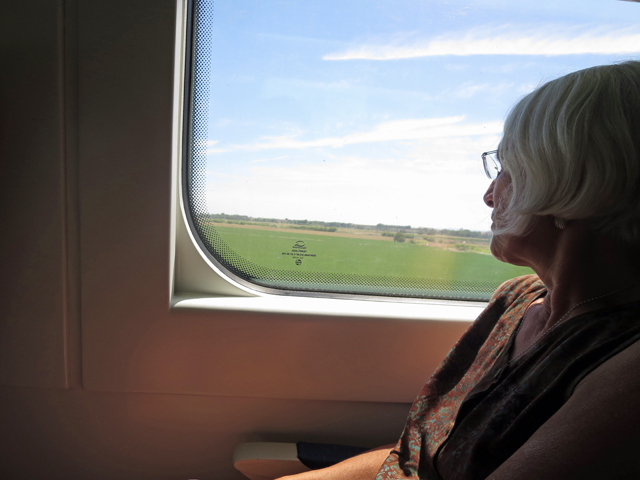
It’s hard to keep my eyes open as we rock gently and cross vast open spaces. There’s a group of nuns in habits giggling in the car, and an old woman who’s probably drunk speaking animatedly with anyone who will listen. But my Spanish is still rusty and I can’t pick out any of her words.
Laurel on the train to Pamplona
And then, at 4:00 Sunday afternoon, 22 hours after we left my apartment on Saturday morning, we arrive.
We walk 2 kilometers from the station to our albergue in the old city. Soon, 2 kilometers will be nothing, but today it feels like 20. It’s the heat of the day, we’ve been awake for days, and we don’t have our walking legs yet.
“Remain humble on this road, or the road will humble you.”
– Kevin Codd, To the Field of Stars
I’m back!
I have a lot to say about my 13-day trip to Spain and the Camino Frances, but let’s start with the elephant in the room:
The plan was to walk for 10 days, from Pamplona to Burgos, a total of about 130 miles. I didn’t make it.
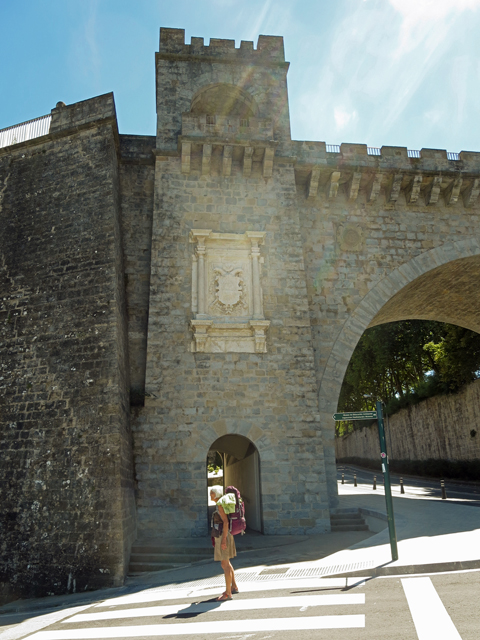
Things started well. As I walked out of Pamplona in the early glow of dawn two weeks ago, my pack felt comfortable. Everything felt familiar.
Leaving Pamplona
“It’s good to be back,” I whispered.
I walked across familiar territory, only it was all much browner than I remembered it. The difference between May and August is dramatic.
Not quite the same angle, but that’s the same little castle on a hill in both pictures.
I was confident, maybe even a know-it-all. I’d been here before. I knew where we could stop for snacks and bathrooms, and what to expect from the climb (and descent) of Alto de Perdon.
Laurel and I took long breaks, met lots of people. It was good to be back.
Me, feeling good after the climb to Alto de Perdon
I felt great as we cruised into Obanos and the lovely, private Albergue Atseden.
“It’s all much easier than I remember,” I emailed Eric.
And then the road humbled me.
The next day, five kilometers from our destination, I felt the foot pain. The sharp, aching, feels-like-I’m-walking-on-giant-bruises pain that plagued my first Camino.
The next day, I felt it earlier in the day. By Day 4, the pain was always with me, more intense than I remember it from two years ago. Resting didn’t help. Massage, changing socks, and ice packs only provided temporary relief.
I took Advil and kept walking through it, but it kept getting worse. I stopped being a pleasant travel companion.I started to worry that I was doing some kind of damage.
“I think I have to quit early,” I emailed Eric from Azofra.
His response: “Quitting is a dumb word in this context.”
He’s right, of course. This wasn’t a “through-hike” Camino for me. I wasn’t bound for Santiago. I’d already done the things I set out to do: I spent a few days with a friend as she settled into her own Camino, and I covered the 40 kilometers I’d missed on our first trip. I’d met a dozen fascinating and wonderful new friends from around the world, and I remembered the rhythm of walk, eat, sleep, repeat. I even had a new idea for how The Book would end. (The epilogue is giving me fits.)
My only reason to keep walking was stubbornness (I’m here to walk to Burgos!). Well, that and an uncertainty of what I would do if I wasn’t a Camino pilgrim.
The next day we pushed through 14 more kilometers to Santo Domingo de la Calzada, which was one of my favorite towns from my first Camino (read the story here), but even a short walking day was brutal.
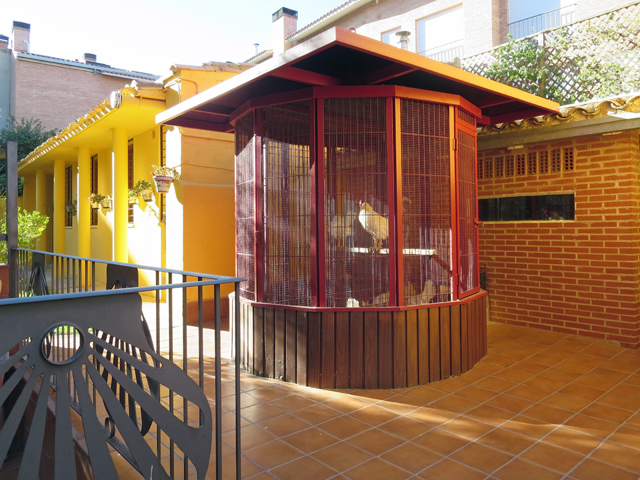
I sat in the backyard of the albergue, next to the coop of backup roosters and chickens who would eventually grace the cathedral, and took stock. I arrived in town planning to walk out the next morning, but my feet were in rough shape. There was a bus from Santo Domingo to Burgos the next morning. I could jump ahead and rest there for a couple of days before going on to Madrid.
The rooster coop in Santo Domingo de la Calzada
Was I done, just like that?
The roosters refused to answer. But while I sat there, undecided, a couple I’d seen on the path a few times came outside. They’d lost their Brierley guidebook sometime during the day, and were visibly upset about it. It seemed unlikely they could find another one in Spain.
I looked at the book in my hands, the one that said that I would have to walk 22-27 kilometers a day for three more days to reach my Burgos goal.
I looked at the couple, healthy and eager to walk.
I had my answer.
I gave them my guidebook and said goodbye to the Camino. The next morning, Laurel and I got on a bus for Burgos. (She has a limited timeframe to get to Santiago and has to skip a few stages along the way no matter what; it made sense for her to jump ahead with me.) The next morning, she walked on, into the Meseta, and I stayed back, watching to sun rise around the cathedral as the last pilgrim stragglers set out.
It wasn’t the Camino finale that I expected, but somehow, it’s going to be the one that I needed this time.
PS. Yes, I have already made a new round of doctor’s appointments to figure out what’s going on with The Princess feet.
I’ve been working intently on The Book all month (that’s a mild way of saying I’ve been up until 2 or 3 every night for at least two weeks), but yesterday I finally let it go, sending it off to a group of beta readers.
And while they’re reading, I’ll be re-living Chapters 11-13. I leave in just over 36 hours for the airport, and Camino 1.3!
Time to put the computers away and start packing.
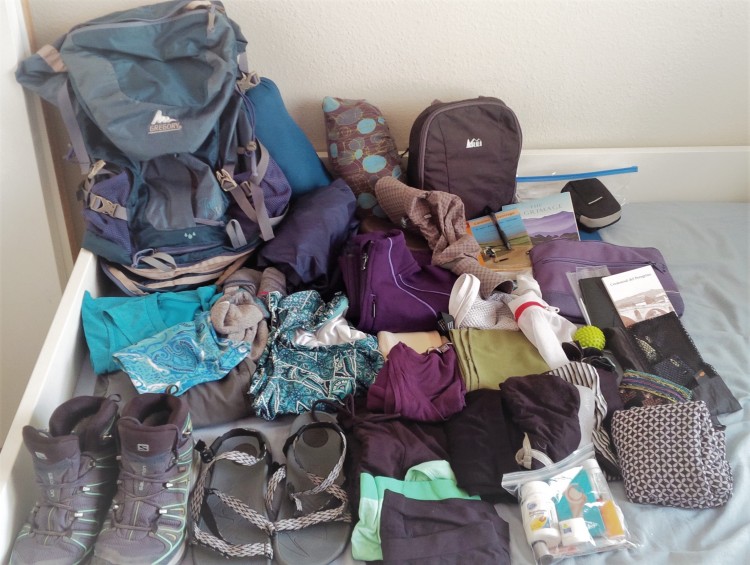
The last time I packed for a Camino, there was still snow in the ground in places. This time, I’m planning for lots of sun and temperatures in the 80s most days. That means I can cut back on the wool shirts and scarves.
But still, when it’s all spread out like this it doesn’t feel like a minimal trip. What IS all this stuff?
Camino Packing 2017. Missing from photo: 750 mL water bottle
Last week Laurel and I sat down to do some Camino planning. Mostly, we talked about the logistics: our packing lists, how we’re going to get to Pamplona, how far we wanted to walk on the first day, stuff like that.
But we also ended up talking a lot about our Camino fears. We’re a month away from leaving now, which is prime season for the “what if’s.”
This is something I remember going through before my first Camino, too. Once most of the major decisions about dates and travel were made, but long before it was time to start packing and doing the last-minute things, there was this stretch of time where there was little to do except let all of the worries creep in. (Well, that and obsessively shop online for the perfect backpacking socks, but that’s another post for another time.)
My journal for the month before my first Camino is full of “ohmygoshwhathaveIdone” attacks of nerves.
These were a few of my biggest pre-Camino fears:
being around so many people. I’m an introvert who needs alone time to recharge. I was worried that sharing rooms with strangers every night would make me emotionally melt.
the possibility of physical failure. What if I didn’t finish? What if I got hurt, or if (and there was a decent chance of this) I just wasn’t strong enough to walk a thousand miles? How would I explain to all the people at home that I’d failed at this thing I’d talked about for YEARS?
being away for so long. Okay, some people worry about their jobs or their families. I was mostly worried about leaving my cat. What if something happened? What if she forgot me?
Of course, all of that worked out. I got lots of solo time while walking, and hostel living wasn’t as intrusive as I thought it might be. Everyone pretty much respects one another’s space. And when the crowds of people became too much, Eric and I checked into a private room for a night.
While the Camino was physically challenging, and possibly the hardest thing I’ve ever done, I did make it all the way to Finisterre, the End of the World. When challenges came up, we dealt with them. When we got sick,we went to the pharmacy, got some medicine, and waited it out. When my feet had problems,I got new shoes.
And yes, the cat was fine. She’s a cat, which means she possibly didn’t even notice we were gone.
The Camino taught me to adjust and adapt, and to roll with what happens (Eric would call it “practicing acceptance”) as it comes, good or bad.
Well, sort of. Because I’m a month out from Camino 1.3, and I’ve got some Camino fears again.
What scares me this time? The things I can’t control.
the heat. There’s no way around this one. Late August is going to be HOT. Like, in the 90s and 100s HOT. (Seattle, by comparison, has hit 90 degrees only once all summer, and most days it hasn’t even hit 80.)
the crowds. No way around this one in August, either. There are going to be a lot of people in Spain. I’m actually hoping that we’ll be behind the biggest wave of Europeans on August holiday, but there’s no way to know until we get there.
I’ve done what I can to accommodate my fears. I’ve spent a bunch of money on clothes that will help me in the heat (just wait ’til you see a picture of me wearing my ridiculous-but-practical sun hat), while also minimizing my backpack weight. I’m walking in the hottest parts of Seattle days, knowing that mirrors at least the early morning hours in Spain.
As for the crowds, we’ve made albergue reservations for the first two nights of the trip, so that we have guaranteed beds while we acclimate. By Day 3, we’ll have a realistic sense of whether there’s a “race for beds,” and we can adapt and adjust as needed.
Adapt and adjust…I guess I’m not surprised to see them make a reappearance for Camino 1.3.
How about you? What were your pre-Camino fears? How did they reflect your actual trip?
Two years ago today, Eric and I got on a train in Santiago de Compostela and set off toward the sunrise. After 79 days of walking, 3 days of rest in Finisterre, and one last day in Santiago, it was strange to be going east. But our Camino was officially done.
The last picture in Santiago, taken at dawn as we walked to the train station
Two years to the day later, I’m embarking on a new adventure.
Before we left for the Camino, plenty of people asked if I would write about the trip. My answer was always “we’ll see.” At the time, I thought that meant “no.” I didn’t want to walk the Camino as a research trip, constantly thinking about how I would describe it to others. I wanted it to be something I experienced fully, in the moment. And that’s what happened. During my Camino I turned off all the screens and lived in the present. I kept a journal and took photosfor myself, to ground my memories, but I stayed away from social media.
However, my Camino was a story that wanted to be told.
A couple of months after I got home, I started to write. It went slowly, tucked into corners of time. Turns out that it’s hard to write a personal project while also writing for others.
After about a year, I had enough on paper to start thinking about what I would eventually want to do with it. I was objective enough to know that this was the practical, travel-focused memoir I had looked for when I first started to consider walking across two countries. The one that answered questions like where do you sleep? How hard are the trails? And most importantly: where do you go to the bathroom if you’re outside all day?
I could pretty easily self publish. I’ve done that before, and as a consultant I’ve helped dozens of others do the same. There are lots of self-published Camino books, and I could see that many of them find engaged, curious audiences.
But there were other options, too. So I stepped back and asked the most important question any writer wanting to publish should ask: who will want to read this book?
Part of my proposal read:
I’m not the typical “outdoor travel adventure writer” type. I’m not risk-taking or super-fit. No one would ever mistake me for an athlete…I’d been to Europe only once, twenty years before, on an organized college tour. I’d never been backpacking. I don’t sleep outside if I can help it. I didn’t speak any French when we set out, and my Spanish was atrocious. (It still is.)
Walking Together to the End of the World is an assurance to people like me that an outdoor, boundary-stretching adventure is accessible to anyone. I’m telling my story in order to reassure others that they, too, can get off their comfortable couches and do something spectacular.
I thought about the armchair travelers browsing my local bookstore, and the people wandering awkwardly through the outdoors stores, wondering if they really belong there. I wanted this book to reach them.
I started looking at traditional publishers, and one name consistently rose to the top of my list: Mountaineers Books.
The publishing arm of Mountaineers is part of a larger outdoor exploration and conservation nonprofit, based here in Seattle. Their publishing mission is “leading readers to the lessons and pleasures of the great outdoors.” I described my book as “a narrative about the gift of letting go, getting outside, and living at a human pace.”
These were my people.
I spent a month crafting a book proposal and sent it off, and then I waited.* (Getting a book published involves a lot of waiting.) And more importantly, I went back to writing.
In May, I got an email from Kate Rogers, the editor-in-chief for Mountaineers Books. She’d read my proposal and liked my writing. We met for coffee (a bonus of working with a local publisher) and talked. I liked everything she told me. The Mountaineers got me, and more importantly, got what this story could be.
Over the next few weeks, Kate and I went from coffee, to getting enthusiastic approval from the full publishing team, to a verbal commitment to publish, and then, yesterday, to a signed contract.
You guys. Walking Together to the End of the World (don’t worry, I’m working on a better title) has a deadline (September 5), and a great publisher, and will release in Fall 2018.
I did warn you that getting a book published involves a lot of waiting, right?
It’s not do-nothing waiting. I’ll be writing and revising frantically for the next two months, while also preparing for and walking Camino 1.3. Then I’ll start working with Mountaineers on edits, photos and illustrations, a cover design, and a marketing plan. Fall 2018 will come before I know it.
Today, when I put the contract in the mail, I was equal parts elated and scared—kind of like the day we walked out of Le Puy. Now that this book has a team behind it, I’ve got to make it as good as I can. That means things might be quiet on the blog over the summer, other than a few posts I’ve got planned about the August trip. But have no fear, I’ll be back soon, with a whole new series of stories.
Also, if you’d like to get regular updates on the book progress, as well as sneak peaks at chapters and opportunities to be part of the launch team, please sign up for the Book Club emails.
Ultreia! (Onward!)
*Caveat: it’s unusual to send a book proposal to only one publisher at a time. There are lots of reasons why even a house that seems like a perfect fit wouldn’t be interested in a project. I had Publishing Plan B, and even Plan C, lined up in case the Mountaineers declined, and I was ready to launch them as soon as I had a more solid manuscript draft in hand. Lucky for me, Kate got in touch before I spent time going down that path.
Two months from today, if all goes according to plan, Laurel and I will be walking from Santo Domingo de Calzada (the chicken church!) to Belorado, where it’s 91 degrees (32 Celsius) and sunny. But here in Seattle, we’re still in the depths of “Juneuary,” and summer seems a long way away. Most days are overcast and damp, I still need a long-sleeved shirt for my training walks, and it’s hard to imagine sweating my way across Rioja.
Instead, I’m remembering other misty, grey days, when the air was just right for walking, and the light was just right for…well, this, which is one of my favorite photos from my first Camino:
This is the Condom Cathedral in the province of Gers, France.
Yes, Condom. But not that condom. In fact, the French (who refer to prophylactics as préservatifs) consistently referred to the town along the Chemin du Puy without a trace of a smile. (These are the same French who snickered every time they mentioned walking through Montcuq; they think it sounds like this.)
Anyway. Back to Condom.
It was an overcast day with an occasional light rain, which made it hard to find a dry patch of ground to sit and rest along the way. The day before I’d had a rough walk into La Romieu, so Eric and I distracted and entertained each other for hours with ideas for the best mottos or tourist slogans for Condom.
Our favorite? (Pardon the crassness.)
“Condom: Come Inside.”
Unfortunately, “come inside” was not going to happen in Condom that day. It was May 1, which is evidently a much bigger holiday in France than it is in the United States. In Seattle, May Day traffic might be snarled by a few labor marches, but business pretty much continues as normal. In France, not only does everything shut down, but the people all disappear. In a town of 7,000, we didn’t see a single local. Even the bars and coffee shops were closed.
A few tourists braved the drizzle to take photos with a life-sized statue of D’Artagnan, who was born in a castle in Condom, and the three musketeers. But they, too, scurried quickly out of sight.
Eric and I sat in the cathedral square and ate a meager picnic of leftovers while we tried to formulate a plan. We’d walked quickly and arrived in town early, hoping to shop for a few supplies, but that clearly wasn’t going to happen. We had a few more kilometers to walk that day to reach our gite in Larresingle (a stop that turned out to be one of my favorite gites of the Via Podiensis), but it was too early to go. They wouldn’t be open for another few hours.
The only thing open in Condom was the cathedral, so we ducked inside.
By this point the novelty of “ooh, a really, really big building with amazing architecture and beautiful stained glass, and it’s a gazillion years old” had started to wear off. We’d been in at least a dozen cathedrals of this size, many older. But the cathedral of Condom stole my heart.
Built at the turn of the sixteenth century, it is all white marble and delicate carvings and impossibly high Gothic arches. The flat grey light outside filtered through hundreds of panels of stained glass that ringed the top of the building, seemingly too delicate to hold up the roof. Each pillar supported a saint, apostle, king, or angel—Renaissance works that felt real. The original pulpit box still rose above the pews, and a painting of a glowering God looked down from the underside of the pulpit canopy on whoever was brave enough to stand there and offer their thoughts.
A few tourists and visitors wandered the aisles, and a painter stood at an easel, trying to capture the space.
We lingered for at least an hour in the church, soaking in the details (and not soaking in the rain, before it was time to walk on.
But not before I caught the photo of a gentle day.
(Oh, one last thing about Condom: on the way out of town we did eventually find an open cafe…well, actually, it was more of a sports bar with gambling, but there was an espresso machine. We ducked in to get a cafe au lait, and when I stopped to use the WC, I saw that there was a vending machine on the wall. What does a bathroom vending machine in Condom sell? Toothbrushes, of course. I was laughing so hard I forgot to take a picture.)











 camino times two