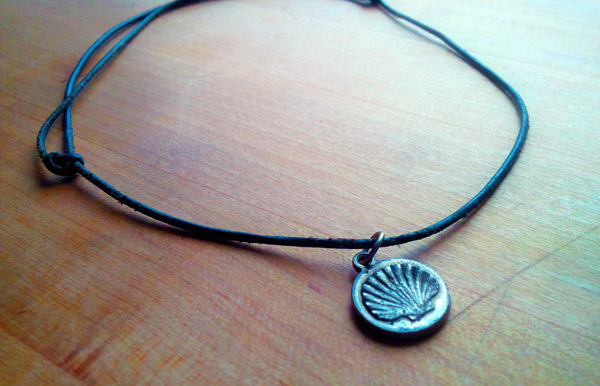
The Camino Credential

It’s here! A week ago I went to the American Pilgrims of the Camino website and requested a new credential for my upcoming mini-Camino. (I’ve started to call it Camino 1.3, because I’ll walk about a third of the Camino Frances.)

And now here it is, all crisp and blank and pretty.
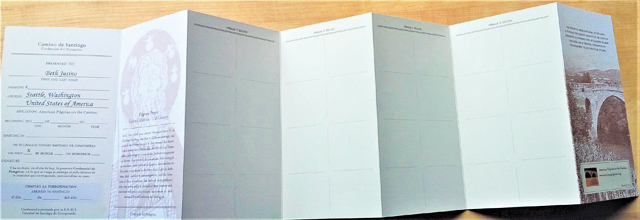
cedential

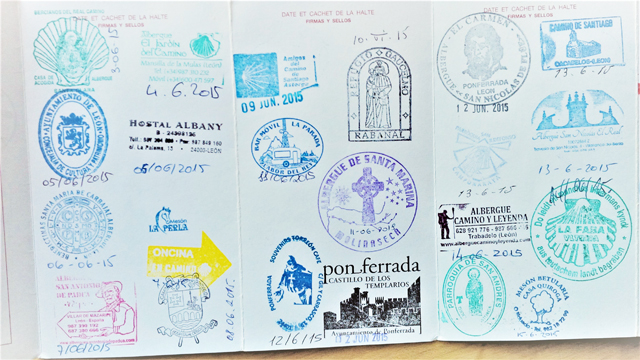
In less than three months, it will look more like this:
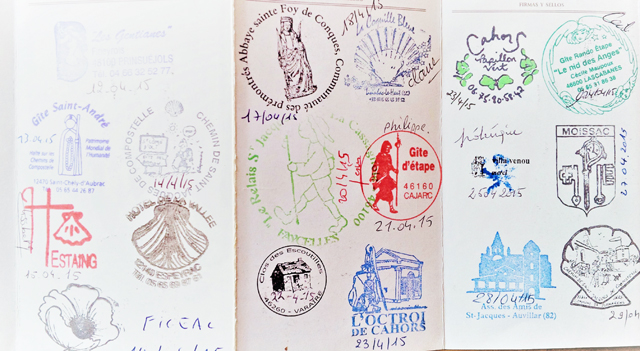
france1frances1

What is a Camino credential?

This is the “passport” of the Camino. Pilgrims along the trails (in France and all across Spain, not just on the Camino Frances) carry these. The albergues, gites, guest houses, and most hotels along the Way stamp and date your credential when you stay overnight. Many of the cathedrals, tourist sites, and quite a few bars and restaurants also have stamps to add.

The stamps become a reflection of your unique Camino experience. No two booklets end up quite the same; even Eric and I, when I compare them, have a few different stamps.

Some stamps are all business. Some are whimsical and bright. We have one hand-drawn stamp from a donativo gite in France that was run by a family. There’s a hand-colored stamp from Cahors, and the one that the gite owner in Lauzerte carved herself.

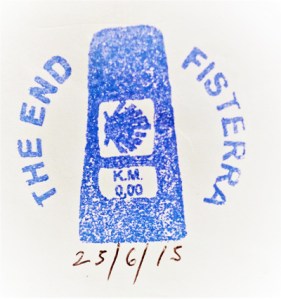
There’s no rule about who can and can’t offer a stamp. Some rest stops and pilgrim shelters along the way offered their own own stamps. And then there’s my favorite: the friendly guy at Finisterre who had designed his own stamp that he offered to anyone passing by.
IMG_20170607_124245_edit

The official reason for the credential is to prove that you are a pilgrim of the Way, and not just a tourist trying to get cheap lodging on a vacation. The stamps and dates show that you are steadily moving in the direction of Santiago. When you arrive in Santiago, the volunteers at the Pilgrim’s Office will use your credential (credencial in Spanish) as evidence that you have earned your Compostela, the certificate of arrival.

Note: you need to acquire two stamps per day in the last 100 kilometers – the only ones that really “count” for the Compostela – to prove that you made the journey. (However, in my experience, when you plop down two full credentials, with stamps going back more than two months, no one really examines those last five days that carefully.)

The other reason for credentials is that they make a fantastic visual record of the experience. In the evenings, Camino pilgrims often pull out their credentials as they talk with new friends about where they’ve been. You stopped in that town, too? Where did you stay? Oh look, you were in that cathedral just one day before me!

If I’m not going to Santiago, do I need a credential?

Anyone who is walking any part of the Camino benefits from a credential, no matter where you start and stop. This summer, I’m only walking as far as Burgos. But I’ll have my booklet for those ten days. Of course, I want it as a souvenir. But more important, most municipally owned hostels, and some of the church- and volunteer-run ones, require that anyone staying there have a credential.

When Eric and I walked in 2015, we had a friend who “dropped in” with us only from Leon to Astorga. She had a credential and collected stamps for the few days she was on the path. We also had a friend who came for five days and didn’t have a booklet. Those were sometimes hard days to find lodging.

Where do I get a Camino credential?

In order for a credential to be accepted in Santiago, it must be issued by a recognized association of the Camino. (This is a fairly new rule, made in response to some of the shadier Camino tourism companies trying to make their own “credentials” and selling them for as much as 25 euro. Officially recognized credentials are free, or cost no more than a euro or two.)

There are Camino societies in many countries, and most of those issue credentials to their citizens. (At the bottom of this page is a list of where to get an approved pilgrim credential.)

You can also pick up a credential in many of the bigger cities/major starting points along the Way. The cathedral of Le Puy and the Pilgrim’s office in St. Jean Pied-de-Port both issued credencials from Les Amis du Chemin de Saint-Jacques (the friends of Saint James). In Spain, you can get a credential issued from the Cathedral of Santiago itself at the major albergues (usually municipal, but sometimes church- or volunteer-run) in the larger towns all along the Way. This turns out to be useful if you’re starting somewhere other than a “traditional” starting point, or if you’re a serious stamp-collector; the booklets can fill quickly! (I had an APOC credential that I filled walking from Le Puy to St Jean Pied-de-Port, and then a French credencial that carried me through to Finisterre).

In the end, my credential wasn’t just a way to prove to a guy behind a desk that I deserved a certificate written in Latin. It was a way to record each step of the journey.  It truly was about the journey, not the destination. And when I got home, it wasn’t the Compostela I framed and hung on the wall; it was my two, wrinkled, faded, beautiful credentials.
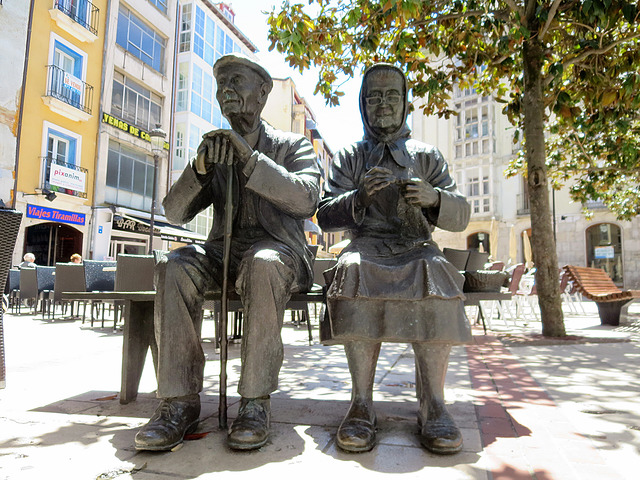


The Old Couple in Burgos

The first time I went to Burgos (I can say “first” now, since I’m officially planning the second trip), we arrived early in the day and had all afternoon to poke around. I loved the city, with its broad plazas and crooked streets. And mostly, I loved the modern, realistic statues scattered in the unexpected corners.

Of course, there’s this famous one. (So famous that somehow I didn’t end up taking a photo of my own, mostly because there always seemed to be a line of pilgrims waiting to pose with him.)

9426202505_d465f48f91_z
Photo: Francisco Martins/Creative Commons


And the newspaper reader.

21127706029_35705db3e9_z


And then there are these two:

21127710429_c3d730b45a_z


They’re tucked under a shade tree in a busy plaza, without a plaque or sign (that I noticed, at least). Every time I walked past them, I smiled. Every time I look at the picture now, I smile.

They just both look so content.

So why am I telling you this? Because tomorrow (Saturday) Eric and I will mark another anniversary, and move another step closer to being these people. He asked me not to make a big “anniversary post” or anything on social media this year, so I won’t. I’ll just give you a lovely photo of a happy older couple, and say that in another few decades, I would like for us to be sitting next to them on that bench in Burgos (because of course we’ll still be traveling) so that we can gossip about what kids these days are doing, and maybe she can teach me how to knit. Or maybe we’ll all go for a stroll.


In the meantime, though, we’ll just pose with the pilgrims…

22606920431_53f51e217d_z

IMG_2600


A TEDTalk About the Camino de Santiago

I’ve long been a fan of TEDTalksthe annual conference full of “ideas worth sharing,” presented by some of the most interesting people in the world on every imaginable topic. So I’m not sure how it’s taken me a whole month to discover that in TED2017, one of the speakers offered an ode to the Camino de Santiago. The full video is not available (yet? I’m hoping TED will eventually post). But here’s what I know:

5908d71414000028001a6280
David Whyte at TED2017. Photo: Bret Hartman / TED

In a series of presentations around the theme Tales of Tomorrow, poet and philosopher David Whyte talked about “the fuzzy frontiers of the past, present, and future.” And to illustrate his point, he read  two of his poems, which were inspired by his niece’s Camino pilgrimage.

I immediately went out and found the poems in Whyte’s book, appropriately titled Pilgrim. There are seven poems in all that are dedicated to the Camino, with titles like Refuge and Rest.

This excerpt from Santiago, one of the works Whyte read in Vancouver, stood out:

…every step along the way, you had carried

the heart and the mind and the promise

that first set you off and drew you on and that you were

more marvelous in your simple wish to find a way

than the gilded roofs of any destination you could reach:

as if, all along, you had thought the end point might be a city

with golden towers, and cheering crowds,

and turning the corner at what you thought was the end

of the road, you found just a simple reflection,

and a clear revelation beneath the face looking back

and beneath it another invitation, all in one glimpse:

like a person and a place you had sought forever,

like a broad field of freedom that beckoned you beyond;

like another life, and the road still stretching on.

Excerpt from “SANTIAGO”
From PILGRIM: Poems by David Whyte
©2012 David Whyte

51-FWDqt1zL._SX312_BO1,204,203,200_

I’ve been struggling to write about my own arrival in Santiago for the book in progress. It was, for me, anticlimactic and deeply self revelatory at the same time. Perhaps I just found a few words to help me forward.

And if anyone finds a link to the full video of Whyte’s talk, please share it in the comments!

Whyte has excerpted a different piece of this work on his Facebook page (scroll back to late April), and another writer has written about the second TED Talk poem, Finisterre, in this Huffington Post piece. (Ignore the part where he says Finisterre is in Portugal; we know better.)

Invincible Nature (Almost Wordless Wednesday)

19774482450_62af15e8e3_z


“Nature is always lovely, invincible, glad, whatever is done and suffered by her creatures. All scars she heals, whether in rocks or water or sky or hearts.”

          — John Muir, John of the Mountains


Photo taken just outside Fineroyls, France, in the remote high plains of L’Aubrac. This was our first week of walking from Le Puy, and the man in the photo is Eugene, our first English-speaking friend.

We walked with Eugene through three stunningly beautiful, challenging days, sharing stories and struggling through the steady climbs and descents of the Le Puy Camino route. The hills, not to mention that giant backpack, took their tolls on Eugene’s knees, and after a couple of weeks he had to go home to Australia to heal. This photo, capturing both the shadows and optimism of early morning, was the last time we saw him.

He came back the following year, though, and finished his walk to Santiago. All scars do heal.

“No Problem!” On the Generosity of Camino Strangers (and a Wild Ride to Logroño)

One of the best parts about planning this summer’s mini-Camino is that it gives me the chance to go back and walk the 40 kilometers of “missing link” in my last Camino, between Viana and Najera.

There are lots of reasons why a Camino pilgrim might decide to skip ahead on the trail via bus, train, cab, or other motorized vehicle. (I met one woman who hitchhiked for half a day’s walk on a farmer’s tractor.) Generally it comes down to two things: limited time or some kind of body failure. For us, it was a little of both.

Our friend from Seattle, Ian, was coming to join our Camino for five days. The plan was to meet in Logroño on Saturday night, and set out together on foot the next morning. We would then have five days to walk the 120 kilometers to Burgos, where he would catch a train back to Barcelona, and then a plane home.

On paper, it looked good. In real life, things kind of fell apart. Ian’s bus connection in San Sebastian didn’t work out, and he was delayed until Sunday morning. Even worse, Eric and I came down with back-to-back stomach bugs that wiped us out for three days. On the night we were supposed to meet Ian, we were still in Viana, about ten kilometers from Logroño. We were physically on the mend, but we weren’t in long-distance walking shape.

I knew we would have to get flexible about our self-imposed “walk every step” rule, but the logistics confounded me. I needed a morning bus from Viana to Logroño, but I couldn’t figure out how that worked. The tourist office was, of course, closed. The website was confusing.

That night, I consulted our albergue hospitalero, a grandfatherly man who had set us up in a private room and cooked us a “healing soup” when we were miserable (shout out to Albergue Izar, one of the kindest and most hospitable stays of my Camino Frances). The abuelo confirmed that there were no buses on Sundays in Viana, because it was such a small town.

But still, the Camino provides.

Here’s the rest of the story, from my book-in-progress:


26850771281_eef99a4874_z
Photo Credit: Hectorlo (Creative Commons)


Eric’s stomach was on the mend. I was feeling almost human again. We decided we could walk ten kilometers to the city in time to meet Ian’s bus, and then together we’d take a cab ahead to Najera. It wouldn’t be fun, but we could do it.

The abuelo looked worried. In hindsight, I should have paid more attention to that. 

We both slept well that night, and the next morning I got up, packed, and went downstairs before Eric.

There was the abuelo. “No problem!” he was booming, in English. I recognized the man he was talking to as the driver of the support vehicle for the noisy, brash Italian mountain bike team who’d stayed the night before. As far as I had seen, none of them spoke either Spanish or English. But still, the driver boomed back, “No problem!”

I poured a cup of tea. My stomach still didn’t feel strong enough for coffee.

The men were still talking, one in Spanish and the other in Italian. I understood “Americans” and “enferma,” and I started paying attention. 

“Najera!” the abuelo said.

“No problem!” the Italian said again.

Wait, what? I had several problems. I went and got Eric. “There’s a situation developing downstairs.”

As we reached the stairs, the abuelo waved us over. In Spanish, he introduced the Italian, and told us the man would take us to Najera.

“No problem!” The Spanish grandfather beamed.

“No problem!” The Italian grinned.

We tried to explain that there was a problem, because we weren’t going to Najera. We needed to go to Logroño.

“No problem!” both men replied, and they picked up my backpack and carried it to the van. I heard the driver tell another Italian, “Najera.”

“Problem!” I kept squeaking. “Logroño!”

But really, Eric was still a little feverish, and I was weak. Getting a ride into the city, as long as it was the right city, sounded good. And it didn’t really seem like cheating if we accepted the kind support of fellow pilgrims.

So in a rush of words and bags and confusion, we found ourselves in the back of a windowless van, driven by two men we’d never seen before, who spoke no English. We were surrounded by five dirty bicycles–evidently each rider had a backup–and a pile of duffle bags. I wondered if I should send out some kind of emergency text message, in case we were never seen again. 

21322869311_34f35d782a_z
Our volunteer taxi, driven by two men who spoke only Italian and who knew as little about Spanish geography we we did.

It was only after we pulled away, with the kind abuelo waving proudly and still saying “No problem!” that we realized the real problem: our drivers had no idea where we were going.

“Logroño ?” The Italian man in the front passenger seat asked, looking confused and pulling out a map.

“Logroño,” I said firmly.

“Dove?” Where?

It occurred to me then that mountain bikes travel a lot farther than people on foot, and these Italians had only mapped out their route to the place where they needed to meet their riders, probably fifty or sixty kilometers away. They had no reason to know how to get to a city just ten kilometers past where they started.

The next few minutes were a comedy. The drivers left Viana and got on a highway of some kind. We drove for a few minutes, the van feeling like it was going dangerously fast. But then again, I hadn’t been in a car for more than a month. I had no idea if we were even going the right direction. We all kept pointing at signs and reading them to one another.

Finally, there was a sign for a Logroño exit.

“Logroño!” All four of us shouted.

We ended up in some kind of modern industrial park, deserted at eight o’clock on a Sunday morning. The driver skeptically asked us if this was where we wanted to go.

I shook my head. “Cathedral?” I guessed. Tall churches were generally easy to find.

But in a city of 150,000 people, even finding the historic section took a while. We kept driving in circles, taking sharp turns, until finally, the buildings started getting older. The streets narrowed. 

“Sì?” the man sitting shotgun asked, waving out the window.

“Sì,” we said. I had no idea where we were, but we could navigate better on foot than this wild ride.

The Italians left us by the side of the road, while we thanked them over and over, and they assured us “No problem!”

The whole trip took maybe twenty minutes.

Two hours later, while we killed time at a cafe in the city square, we saw two women who had left Albergue Izar on foot while we were still sorting out the van question. They were just arriving in town.

No problem. 

It’s official! Camino 2.0: My Surprise Return to Spain

A few days after Eric and I started walking from Le Puy, with 10 weeks of walking still ahead of us, we were already talking about how to come back and do more of this. After all, “the Camino” isn’t a single trail, but a web of paths that criss-cross Europe, branching back as far as Italy and Geneva and winding in from every corner of Spain. There was so much to see.

Taking another 3-month sabbatical wasn’t in the cards (or the bank account) for a while, but by last summer it was reasonable to start planning a 6-week trip. I’ve spent the past year reading up on the Norte, the Primitivo, the Portugues, and the French routes from Arles and Vezelay. We have an abundance of options.

After seeing the incredible photos and stories from my favorite travel bloggers Uncornered Market and Nadine Walks, we decided that we would start on the Norte and then cut down to the Primitivo.

It was going to happen in Spring 2017…you know, right about now. But in January, when my feet were still giving me trouble and my work calendar was filling up, we decided to put the trip off to fall. We’d see Galicia during a different season.

But sometimes good things get in the way of good things. A couple of months ago, Eric accepted a new job. It’s a good position with a great organization, and overall, it’s a win. But they weren’t too excited about him taking a 6-week sabbatical just 6 months after he started.

The Norte walk is delayed again, this time until sometime in 2018.

But if my first Camino taught me anything, it’s that sometimes the real magic happens when I’m not planning, or even looking for, it.

Which brings me to Laurel.

14567482_10154214777573172_1409525531020828410_o

This is me and my friend Laurel. Ever since Eric and I got back from Spain in 2015, she’s been talking about walking the Camino. Specifically, she wants to walk the Camino Frances to celebrate a milestone birthday, which happened last month.

But the person she planned to travel with can’t go this year. And Laurel had some hesitation about traveling alone.

Which is how I found myself, about a month ago over dinner, blurting, “If you really want to do this, I’ll go with you.”

Well, the Camino heard me. Two weeks, a little research, and one long happy hour planning meeting later, it’s official.

Laurel and I will fly to Madrid on August 12 and start walking from Pamplona two days later. I’ll tag along for about 9 or 10 days, as far as Burgos, and then I’ll go back to Madrid and head home, and Laurel will continue across the Meseta.

Reasons why this is magical:

  • Pamplona was my absolute favorite city in Spain.
  • I’ll get to re-visit the section of the trail that I barely noticed two years ago because of a stomach bug.
  • I’ll get to fill in my one “missing link” of the path. I don’t think I’ve blogged about this yet, but in the thousand miles between Le Puy and Finisterre, we only “jumped ahead” (notice how I didn’t say “cheated”?) with a motorized vehicle once, from Viana to Najera. Now I’ll get to see the 40 missing kilometers the way they were meant to be seen, on foot.

Reasons why this is scary/challenging/different:

  • No Eric. Eek.
  • A total trip of two weeks. I’ll walk a little more than 200 kilometers, so it’s nothing to sneeze at, but there’s not much “settling in” time. By the time I start, it seems like I’ll be almost done. How will that change things?
  • August. The hottest month of the year in Spain, and one of the two busiest of the Camino. How will that change things?

But overall, this is all I’m thinking about right now (click to see bigger photos):

Well, that and the tapas. And the Rioja. And the people.

Question: have any of you rented bikes on the Camino Frances? Laurel is considering renting a bike in Burgos and riding the Meseta (probably to Leon). Any advice or recommendations?

Scuba Diving the Lot River?

About a week after leaving Le Puy, it starts to feel almost routine. You follow the red and white stripes of the Chemin de Saint Jacques (the Way of Saint James) along shaded paths, crumbling castles towering above.

19774388510_9e11c9c190_z

You enter a village, another one of France’s most beautiful. In this case, you’ve come to Espalion.

You walk along the river and admire the 14th century bridge and the 16th century castle.

19775658619_9eb2374b15_z

But then something else catches your eye. Is that… a scuba diver standing next to the fisherman?

19936124216_76fdbdb6d7_z

Sure enough, right there on the Lot River, in a town that could happily rest on its stunning history, is a bronze man straight out of 20,000 Leagues Under the Sea.

It turns out that two of the early diving suit pioneers, Benoit Rouquayrol and Auguste Denayrouze, were from Espalion. In fact, they developed their early prototypes of self-contained underwater breathing apparatus as a way to rescue trapped coal miners in nearby Decazeville.

Just another small surprise along the Via Podiensis, where it only seems like time stands still.

In fact, here’s a recent promotional video for Espalion, highlighting everything from its castles to its spinning classes:


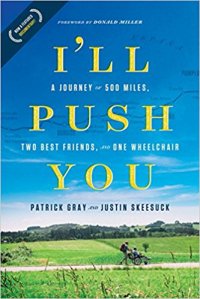
“I’ll Push You.” (Video)

“I’ll push you.”

Okay, when I say that, it’s usually a threat, not a promise. But I’m not Patrick Gray.

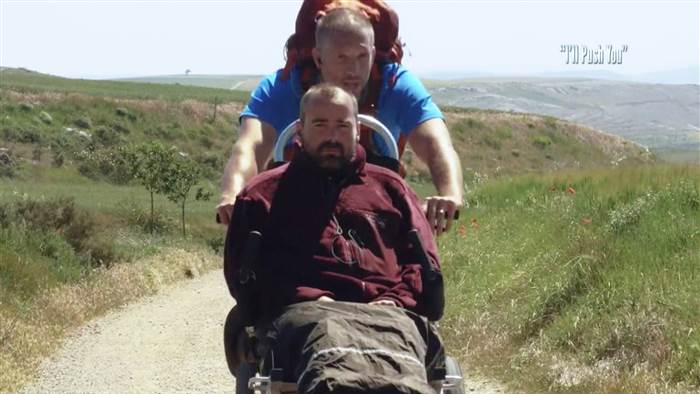
Maybe you saw this profile on the TODAY show last week, about the two childhood best friends from Idaho who tackled the Camino Frances together. Two friends walking isn’t so unusual, but this is: one of them is in a wheelchair, with a progressive neuromuscular disease that robs him of the use of his muscles.

tdy_jbh_push_170415_tease_04_93102cf8e34aa5859c1fd227fd66add9.today-inline-large

“We’ve done everything together so far. Let’s have one more adventure, and let’s make it a grand one.”

For them to get over the Pyrenees and across the Meseta, they needed to rely on one another, and on the kindness of the strangers they met along the way.

“We experienced community the way it was supposed to be experienced.”

Patrick Gray and Justin Skeesuck have written a book, coming out in June.

51v-3mi8RIL._SX331_BO1,204,203,200_
And there’s a documentary:

If that doesn’t bring tears to your eyes and motivation to your Monday, I don’t know what will.


Storks in Strange Places

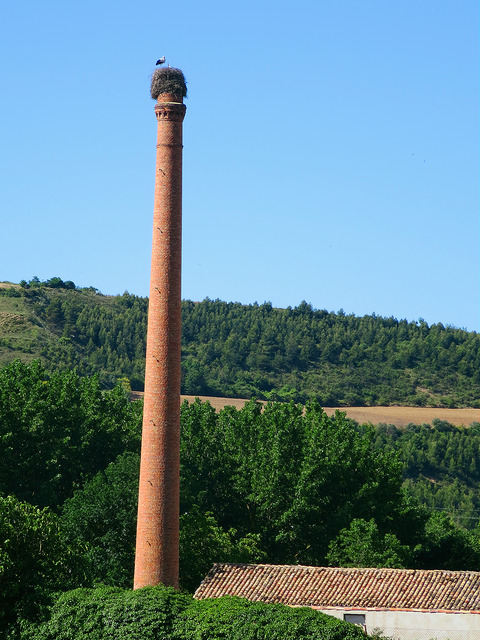
It was a warm, sunny day in May when we walked into Puente La Reina. As we approached the town, something caught my attention.

20943296770_d23dbba24e_z
My first stork nest sighting

“What is that on top of the chimney tower? It looks like a…nest? But that would be huge!”

It was a nest, and it was huge. And if I looked really, really carefully, I could see not only the equally huge white bird in the nest, but two smaller heads occasionally poking up over the edges.

Baby storks!

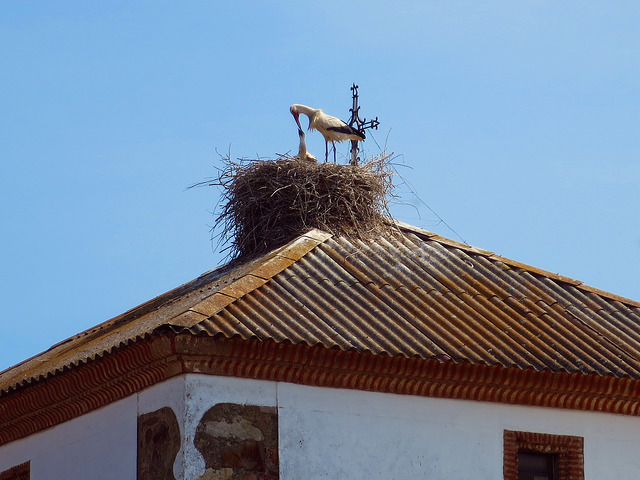
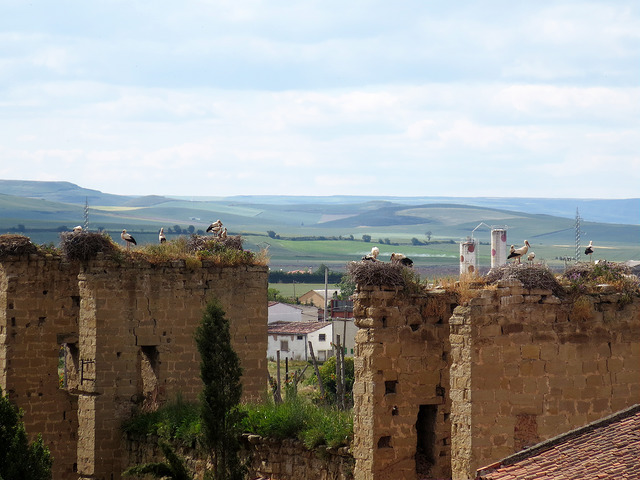
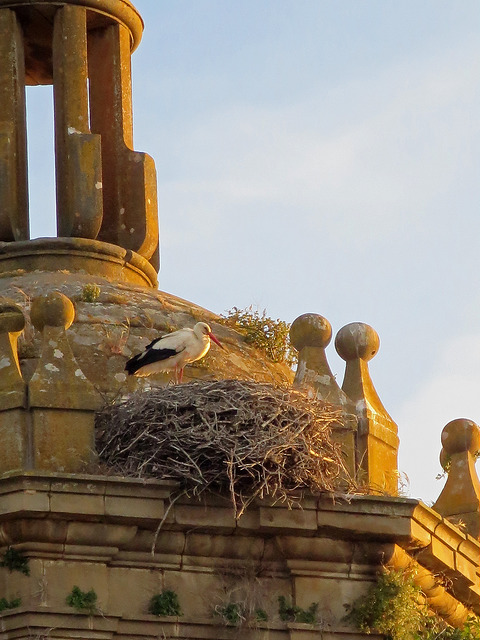
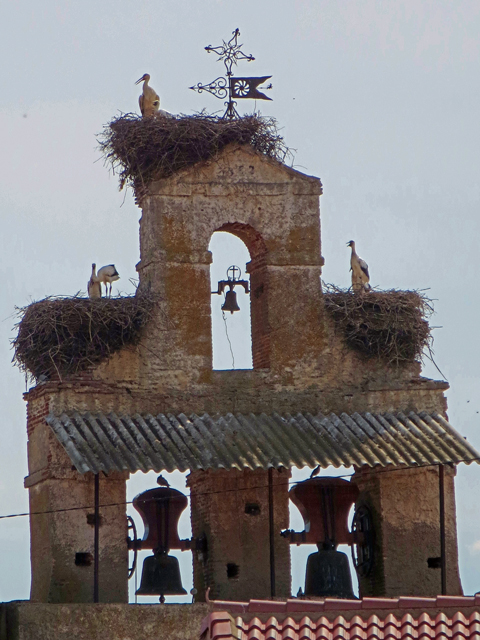
That was the beginning of my love affair with the white storks of Spain. The precarious pile of sticks on the abandoned factory was the first of dozens, maybe hundreds, of nests, huge and precariously balanced, that we saw on almost every high point across northern Spain: clustered on church bell towers and medieval ruins, nestled in electric towers, and even a particularly classy setup on top of a Roman-style column in the heart of Leon.

Over the weeks that followed, we watched small, feeble stork heads emerge into bigger, more assertive juveniles. We heard the strange clicking sounds that storks use to communicate (storks are otherwise silent and unable to vocalize).

I was fascinated. I couldn’t stop taking pictures of all of the storks in strange places.

22408038590_847d3963af_z22582472232_1eea9f125e_z21322669841_8596414778_zIMG_2356IMG_241621127696299_79db3ef463_z21126756848_0d7ed5b1cc_z21105167626_51f8bba426_z


My European friends were amused by my fascination.

“We have a tradition where I come from,” said a Swiss friend. “We say that storks bring babies.”

Oh, yes, I told him. We have that story, as well.

“But I thought you have no storks in the United States?”

Well, no. I considered this. But since when are traditions based on things that really exist?

Maybe that’s why I loved the storks so much. It was like stumbling into the magical place that was full of Easter bunnies or Santa’s elves, hanging out in the off season.

Just another confirmation that the Camino is a path through a fairy tale.

22595959185_9cddfcdeca_z


If you’ve walked the Camino (or observed white storks elsewhere), what’s the strangest place you’ve seen a stork nest?

The Morning We Became Pilgrims of Le Puy

(An excerpt from the book in progress, describing the morning of April 8, 2015.)

Despite the wine and the jet lag, I slept fitfully in Le Puy, waking every hour to stare into the darkness and listen to pilgrims breathing in the cubicles around me. We were so close to beginning this thing.

When my watch finally said it was close enough to six, I turned off the alarm and quietly packed my belongings in the dark. For the first time I put on my “walking clothes”—the hiking pants, the merino wool shirt, the vest, the scarf—that I’d so carefully chosen. I could hear the sounds of a dozen other people doing the same thing.

We couldn’t talk to each other, but we were together in this adventure.

19378913490_7cbfb6c453_z
Dawn in Le Puy

Downstairs, the tables were set for breakfast. Isidore waved us to empty seats, each set with a cereal bowl and a small juice glass. I saw a pitcher of orange juice and a basket of crusty bread. But at six in the morning, the sky still dark outside, all I could think about was coffee.

My wishes were granted when the female volunteer—I still didn’t know her name—came over with a coffee pot.

Cafe?”

“Yes, merci.” My Frenglish made her smile as she waited to pour.

There was a cereal bowl and a juice glass. No mug.

Hesitantly, I reached for the glass. Maybe the French didn’t drink their coffee Venti. After all, demitasse was a French word, wasn’t it?

Her smile turned into a laugh.

“Non, non.” She reached past me and poured me a full bowl of coffee. I looked around and realized that yes, everyone had a bowl of coffee.

Well, okay. When in France…

I chalked up yet another lesson about the change in culture. For the next thirty-five days, every morning I ate a French country breakfast: sliced bread, not toasted, on which I either spread butter and/or some kind of fruit confiture (jam), or I dipped it into my giant bowl of coffee.

At quarter to seven, Isidore told the assembled group (and pantomimed for the Americans) that he would take us to the cathedral for the blessing, but first we should please clean our dishes. There was a rush of gathering bowls and cups, and a line formed at the sink. Eric, whose tendency to help and “be useful” is almost pathological, settled in at the tap and washed everyone’s bowls and glasses while they donned their jackets and packs.

Everyone was charmed by him. Well, everyone but me. I was antsy, impatient with my husband’s good deeds. What if they started without us?

19566861555_a11abc0328_z
Entering a side door of the Cathedral of Le Puy just before dawn

But of course, we weren’t late. Isidore led our small group through the pre-dawn streets and up a back alley I hadn’t noticed before, right to the side entrance of the cathedral. He led us through the main sanctuary, pausing to make the sign of the cross before the Black Virgin, and to a smaller side chapel, where a line of backpacks already rested against the walls.

There were twenty people or so in the pews, and our group filled in around them. Remi wasn’t there, but I recognized the brothers from dinner the night before. They stood, arms crossed, stiff and frowning.

I christened them the Brothers Grim.

The mass, of course, was in French. We managed to stand and kneel at roughly the right times, but the words washed over me as I looked around the stone chapel. How many people had carried their bags into this same room, had said the same words, and had set out in the name of Saint Jacques?

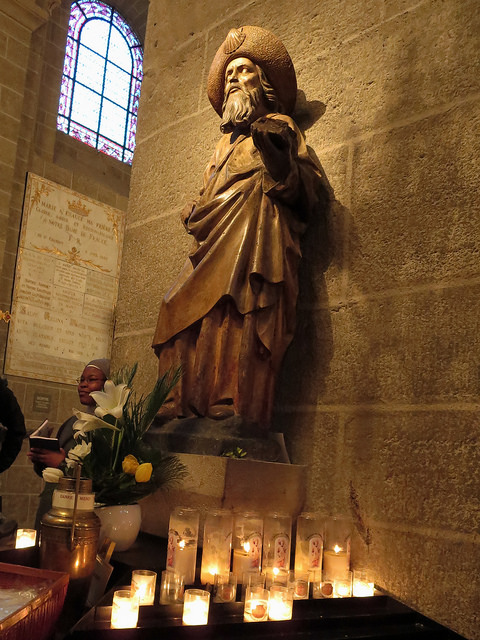
The mass ended, and the priest explained—in several languages including English, bless him—that we would all proceed to the altar of Saint Jacques. We filed into the sanctuary and toward a wooden statue surrounded by candles. This image of Jacques was dressed as a pilgrim, with a floppy hat and pilgrim shell, staff in hand.
I stood, shifting nervously under the weight of my backpack, until I realized that no one else was wearing theirs. Another pilgrim lesson: don’t wear your pack until you have to, and don’t wear it inside, where you’re likely to bump into other people or priceless antiques.

StJamesLePuy
The altar of St James, wearing pilgrim gear in Le Puy

The priest asked each pilgrim to introduce themselves. Eric and I were the only Americans and English speakers, but there were also a couple of Germans and at least one woman from Belgium.

The priest prayed in the native language of each pilgrim, and a nun in a full habit and wimple gave us a printed card to carry with us, that said:

Almighty God, you never cease to show your goodness to those who love you, and you allow yourself to be found by those who seek you. Look favourably now upon your servants who are setting out on pilgrimage and direct their way according to your will. Be for them shade in the heat of the day, light in the darkness of night, relief in tiredness, so that they may come safely, under your protection, to the end of their journey, through Jesus Christ our Lord.

After another prayer, he gave us each a small silver medallion, the size of my thumbnail. On one side was a scallop shell, and on the other, to my delight, was the Black Virgin and the words “Notre Dame de Puy.” I immediately slid it onto a necklace cord I was already wearing.

I would wear that medallion every day until we were back in Seattle.

LePuymedal
The pilgrim’s medallion from Le Puy

Eric, I noticed, also attached his medallion to the cord he wears around his neck to carry his wedding ring.

Neither of us would call ourselves sentimental, nor are we at all Catholic. But there was something about that moment, and the scope of this journey, that demanded solemnity and some act of commitment.

We were pilgrims of Le Puy.