6 Ways to Be THAT Camino Pilgrim

Two weeks ago I impulsively posted a list that a few fellow pilgrims and I wrote one afternoon on the Camino. It was about “that” pilgrim — you know, the one who crinkles plastic bags and bangs into people with their pack and doesn’t clean up after themselves in the albergue kitchen.

I posted the link on the American Pilgrims of the Camino Facebook page and asked for suggestions for what to add to the list, and I got ALL KINDS of responses. (Note: if you’re not part of the APOC Facebook group and you have any questions about a Camino trip, stop reading right now and go join. Then come back.)

The post touched some kind of nerve, because overnight it became the most-popular post I’ve ever had on this blog, and it launched dozens of discussions on Facebook.

One comment over there really got my attention. Mike suggested that if I was going to make a list of how NOT to be that pilgrim, we needed a parallel, positive approach. What are the ways to be THAT pilgrim — which I read as the one who not only thrives personally, but makes the experiences of everyone around them better?

What a great idea! Anyone who’s walked the Camino has discovered that the people around you affect your experience as much as anything else, including the weather. But when you’re in the middle of it, and surrounded by beautiful scenery and blistered feet and threatening weather and the steady pressure of moving forward, it’s easy to get tunnel vision and forget that we influence those around us as much as they’re influencing us.

It’s taken a while to write this post mostly because it made me acknowledge something that I need to confess before we go any further:

Most of the time, I was not the pilgrim I’m about to describe

Just because I blog my stories and observations now, from the comfort of home, doesn’t mean that I had some kind of unusually clear perspective when I was in the middle of it. To be honest, a lot of days I wasn’t very good at this. I was caught up in my journey, my aches and pains, my desires and fears, and my own pet peeves.

But there were plenty of people around me who cared for me when I was on the edge, and who were THAT pilgrim for me. I’m lucky enough to be married to one of them. From the day we landed in France to the last night in Finisterre, I often coasted in the jetstream of Eric’s generosity, his joy, and his natural instincts for doing this well.

So here are the things I saw, especially in him.

20242842786_2d2f71b45f_z
See, I told you he was the perfect Camino travel partner. That’s my bag he’s carrying.


6 Ways to be THAT Pilgrim

1. Practice acceptance.

This was Eric’s daily mantra, which I’ve written about elsewhere. Instead of complaining to others about the people/showers/menus/schedules that are not ideal, work with what you find and make the best of it. Focus on the things that are good. A positive attitude will spread to the people around you.

“Sometimes I just have to accept what is rather than what should be, and adjust myself, rather than the immovable situation in front of me.”

2. Try to speak to people, especially local residents, in their own languages.

Yes, it’s possible to get by on the Camino with English and some awkward sign language, but the experience is richer if you can reach past the isolation of being an observer.

We were about two weeks into the Le Puy Camino, which I had (ill-advisedly) started without knowing ANY French beyond “The apple is red” (Thanks, Duolingo). I picked up basic Camino words quickly enough, but was terrified to say anything out loud. Ever. My accent was atrocious (okay, still is). Surely people would judge me. (Or more likely, when they didn’t understand me I would judge myself.)

Then one night we met a Canadian named Jack, whose French accent was as bad as mine. But he wielded it fearlessly as he chatted with the bartender, our host, and especially our fellow pilgrims — faces I’d seen every day for weeks, but was too timid to try a conversation. And they responded to his efforts. No one laughed at him. Instead, they told him stories.

If nothing else, learn to say thank you as often as possible, and in as many languages as you can. Gracias. Merci.
IMG_2338
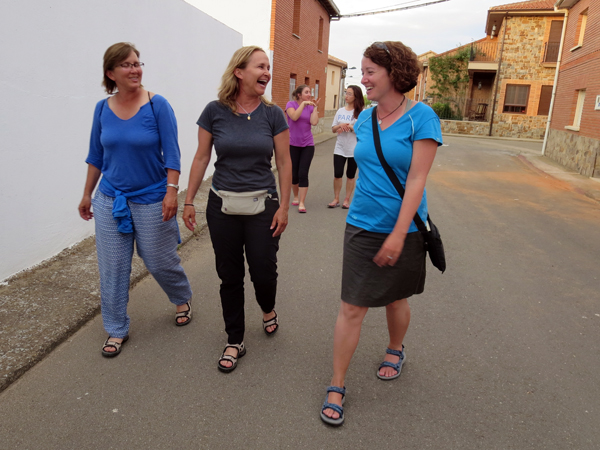
Three Mexicans, an American, and a Korean walk into a bar…and by the time we leave we’re all great friends.

3. Share stories with those outside your comfort zone.

I think it would have been easy, as a married couple traveling together, for us to have become isolated, depending on and talking only to one another. But how boring would that have been? We already know one another’s stories. And Eric has never met a person who stayed a stranger for long.

The Camino is not just about the stunning scenery or the thousand years of history. It’s also about the people who come from all over the world to experience it together. I can’t think of a similar opportunity for a shared experience that crosses so many cultures, and provides so much opportunity for conversation.

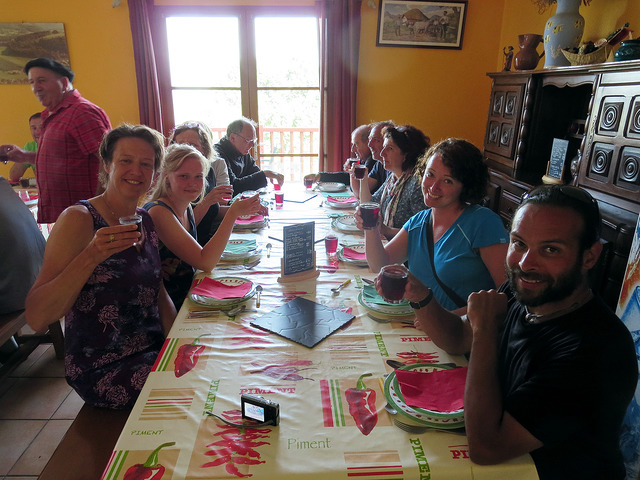
The people who stand out the most in my Camino memories are the ones who not only shared a meal, but shared their stories. So invite the Danish office worker or the Korean college exchange student to join you for dinner one night, or walk for a while one afternoon with the French retirees. Ask them about their homes, and see where the conversations go. (Remember #1.)

4. Offer to help.

I often tease Eric about being pathologically helpful, but really, it’s a powerful gift to bring to the Camino.

When I think about our first week in France, I always come back to the people who helped us limp along. They would translate for us and make phone calls for us in the remote areas where reservations were important. One guy went two kilometers out of his way to help us find the fromagerie. An entire walking club basically adopted us for a week, tracking us down most evenings to make sure we were cared for. I called them all our Camino angels.

Two months later, we were in a place to return the favors. There was the time in La Faba, sometime after eleven at night, when I felt a movement near my albergue bed. The hospitalera was waking Eric, on the bunk above me. A fellow guest who spoke only French was very sick, she said, and she couldn’t understand him to know what was wrong. She’d heard Eric speaking in French earlier, and asked if he could translate. (He did, of course. It turned out the sick pilgrim was just drunk.)

Be aware of your surroundings. If you see another pilgrim struggling to communicate and you have a smidgen more language skill than they do, try to help them breach the barrier. If you see someone struggling to carry their bag (umm, that was mostly me), offer to share the load. Volunteer to do the dishes after a communal dinner. Share your tube of Voltaren (best European export since the croissant).

19954760732_ae48732217_z
The first (and only) time Eric had a blister, it seemed like every person in France wanted to give him something to help.

5. Make something special for everyone one night.

After a long, rainy, hard climb from Astorga to Rabanal, Eric and our friend Emily stumbled across a couple of oranges in the tiny town market, and an idea was born. An hour later, the smell of hot mulled wine drifted through the donativo albergue, and our fellow travelers drifted toward the kitchen like those cartoon characters who float behind their noses. Weeks later, random people still talked about that night.

On a warm summer night in Ribadiso, a couple of young pilgrims pulled out guitars (how did they carry those?) and sang on the lawn as the sun set. Again, the community of scattered pilgrims drifted toward one another.

They don’t happen every day, but look for opportunities to make those moments.

6. Walk your own pace (and let others do the same).

There were days when we would walk too far (for me), and I would be a hot mess by the time we got to the gite or albergue. Barely waiting until we were checked in, I would stumble off to my bed and curl into a ball of tired, sore, grumpy misery. I didn’t want to talk to anyone. I didn’t want to think about anyone else. Needless to say, I was not THAT pilgrim on those days.

As our Camino continued, we learned to slow down and take more breaks, and my body got stronger and better at walking. Things started to be more fun. When we limited our daily distances (for me, that meant keeping it under 30km, but everyone’s pace is different), I had the energy to explore, and to interact with my fellow pilgrims. I had the courage to try the languages, and initiate the conversations, and even do something for someone else every now and then.

Being THAT pilgrim for the people around me, in other words, started by understanding how to care for myself. If I used all of my energy in a race to the future, I had nothing left for the people in the present.

Which brings me back, again, to #1.

But like I said, I’m no expert in this. Camino alumni, what would you add to this list? What were the things that made other pilgrims THAT person for you?

Camino By Sea (Video)

It’s often said that the Camino begins as soon as you walk out your own door, wherever you are.

According to the official statistics provided by the official Pilgrim’s Reception Office, in 2016:

  • 91% completed the Camino on foot
  • 8.5% by bike

Then, in that final half a percent, there were four Irish guys who came by boat.

CNS-E1-2014-08-Naomhóg-crossing-the-Irish-Sea-1080x675
Photo: Ahnu Pictures


And not just any boat. Four men, including Oscar-winning singer and songwriter Glen Hansard (Once), arrived in A Coruna in June 2016 in a traditional boat called a Naomhog that they built themselves. It was the end of a three-year journey (rowing for one month each year, that started 2500 kilometers away in Ireland.

“People might say we’re out of our minds, undertaking this journey. And you need some of that because if you were fully sane you’d do nothing at all.”

A Coruna is the starting point for the Camino Ingles, the shortest of the “official” overland Camino pilgrimages, traveled historically by those from the British islands who came to Spain by boat.

The great Celtic odyssey is all recorded in a documentary that aired this month on Irish TV. The whole thing isn’t available in the US yet (c’mon, Netflix…), but the trailer is up on Vimeo:


I love this quote from near the end:

“The idea of going on pilgrimage in boats like this was to sail away from the land, encounter signs of strangeness and wonderment, and then come back home with a different perspective on the world.”

10 Tips for Not Being “That” Camino Pilgrim

Are you planning your first trip on the Camino? Packing your bag, breaking in your shoes?
May I suggest that you also plan how you will interact with your fellow pilgrims? The Camino is a community, and the experience depends as much on how we interact with one another as it does whether it rains for three days straight.

Here’s a collection of advice I just found tucked in my journal, solicited from fellow pilgrims and compiled over sangrias and cervezas during our afternoon rests.

IMG_1016

1.  Don’t bring ANY plastic bags that crinkle.

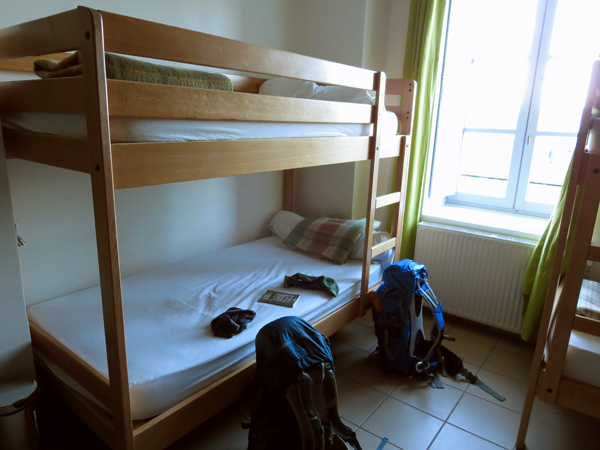
Period. Forget the snoring. The real sleep-killer in albergue dorms is the incessant crinkling sound of plastic. Do not put your belongings in plastic grocery store sacks. If you have food in a crinkly sack, do not touch it in rooms where people are sleeping. Pack your gear in mesh laundry bags. If you are worried about keeping your things waterproof, line the inside of your bag with a plastic garbage bag on days when it rains. (This is especially true if you’re one of the “start walking at five in the morning” types.)

2. Don’t turn on the lights in the sleeping area while others are resting.

That includes when you get up in the middle of the night for the bathroom, or when you’re the first one awake in the morning. Sleep is precious.

3. Don’t talk in the sleeping area while others are resting.

That includes if someone in your room is taking an afternoon nap, or if people are still asleep in the morning when you’re preparing to leave. Step outside to take that phone call or talk to your friends about tomorrow’s plans. Sleep is precious.

4. Pack as much as possible at night, leaving out only what you need for the morning.

In the morning, if anyone in your room is still asleep, carry your bag and belongings into the hallway or common area to pack.

(Clearly, we all had some strong feelings about the primacy of sleeping.)

IMG_1915-1

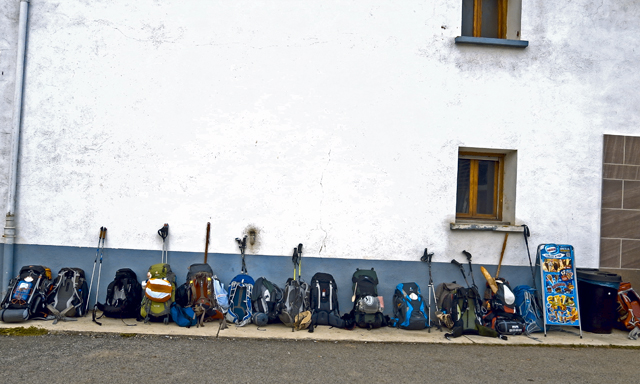
5. Take your backpack off before you go into an enclosed space like a bar or shop.

Yes, in small towns and rural areas it is safe to leave your bag outside. That scene where the Gypsy kid steals a whole backpack in The Way was fiction. In cities, it’s generally safe to leave it just inside the door. If you’re really uncomfortable, take the pack off and carry it in front of you where you can see it and not bang into anyone or anything.

6. If you’re walking in a group and you’re spread across the path, be aware of people behind you who want to pass.

(This was definitely Eric’s contribution. I rarely walked fast enough to pass anyone.)

7. Don’t treat your nasty, blistered feet on the beds, bathroom counters, or dining tables of a common area.

Eeew. Other people will use that after you.

20945191649_0c98f61c40_z

8. If you’re cooking in a communal albergue kitchen, share the counters, share the burners, and share the supplies.

Unless, that is, you’ve volunteered to make dinner for everyone.

9. Be kind to the locals.

Remember that you’re passing through, but they live in this place, and see a hundred people like you every day. It must be exhausting. Speak as much Spanish or French as you can, and be grateful for anyone who’s willing to try to cross the bridge to speak English.

10. Don’t tell others how to walk their Camino.

Yes, I appreciate the irony of saying that here. That’s kind of the point. People will be noisy, and messy, and selfish. You’ll think that someone is wearing the wrong shoes, that they’re not walking far enough, or they started at the wrong time of day. Their bags are too big, and they should leave that bottom bunk for someone else who needs it more. You’ve got strong ideas about what makes a “real” pilgrim, and a list of things that people SHOULD NOT do.

The thing is, other people have other lists of things that bother them, and you’re probably annoying them, too. And you’ll be faced with people who do all of the things above, and more. Don’t let them affect your journey.

Experienced pilgrims, what would you add to this list?

The Chickens of Santo Domingo de la Calzada

The town of Santo Domingo de la Calzada was bound to be one of my favorite stops on the Camino Frances, because I’m a sucker for a town with a good story, and Santo Domingo’s is a Camino classic.

21127759309_3f9448942b_z

Like most good seven hundred-year-old legends, the details vary, but here’s the basic idea:

A devout German couple was making the pilgrimage to Santiago with their eighteen-year-old son. When they reached Santo Domingo, a local girl took a liking to the young German, who, being a good Christian, did not respond to her advances.

Hurt and angry, she put a silver cup into his bag and accused him of theft. The town believed her and hung the innocent boy. His parents, although they were sad, went on to Santiago, where they prayed for their son. On their return trip, they again stopped in Santo Domingo, this time to visit their son’s body. To their surprise, he was still alive, and still hanging from his rope. (At this point I always wonder how they didn’t notice that part before they left, but it’s best not to ask a lot of questions about these stories.) In some versions of the story, the boy spoke to them and told them that Saint James himself was keeping him alive. The parents rushed to the town’s sheriff and demanded that he release their son.

The good sheriff was just sitting down to a hearty poultry dinner, and laughed in their faces. “That boy is no more alive than these chickens on my plate,” he said.

(See where this is going?)

Yep, the roasted birds sprouted back their feathers and beaks, got up, and started walking around the dinner table. Properly chastened, the sheriff rushed to the gallows and released the young German, who was pardoned and allowed to go home.

IMG_2179
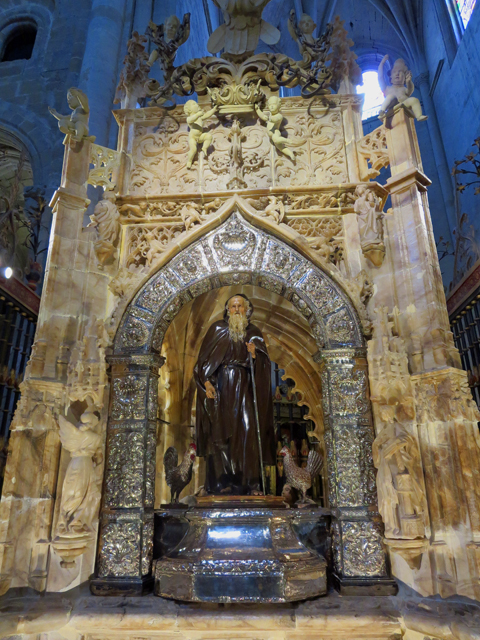
The elaborate tomb of Saint Dominic is adorned with chickens

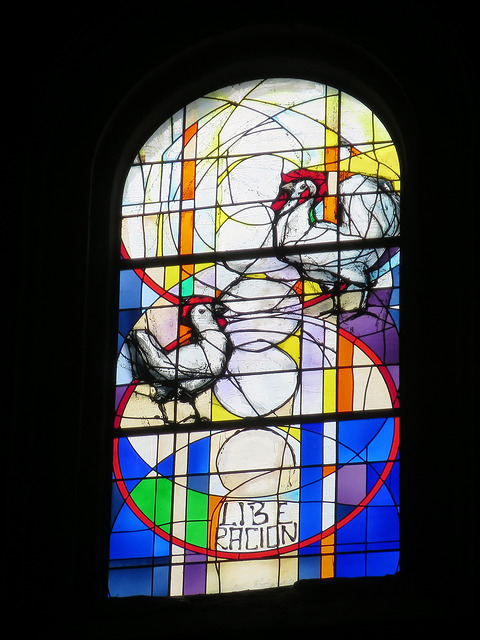
The story spread, lending credibility (of sorts) to the Santiago pilgrimage and drawing spiritual tourists to Santo Domingo itself, which petitioned the pope to allow them to display two birds, a hen and a rooster, inside the church as a symbol of the miracle.

IMG_2175
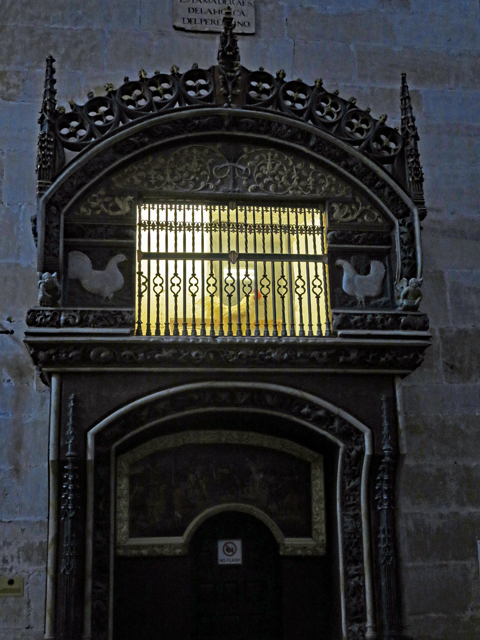
The chickens are given an elaborate (and hard to photograph) home in the cathedral of Santo Domingo

Which makes the cathedral, to me, forever known as the Chicken Church. (Sorry, Saint Dominic. You have some pretty great stories yourself.)

We arrived in town in the early afternoon, and I willingly shelled out a few euros to witness firsthand the glass box, set high in the wall of the sanctuary itself, with two bored-looking birds pecking around. They’re rotated regularly, I’m told, from the coop supported by the local Confraternity albergue.

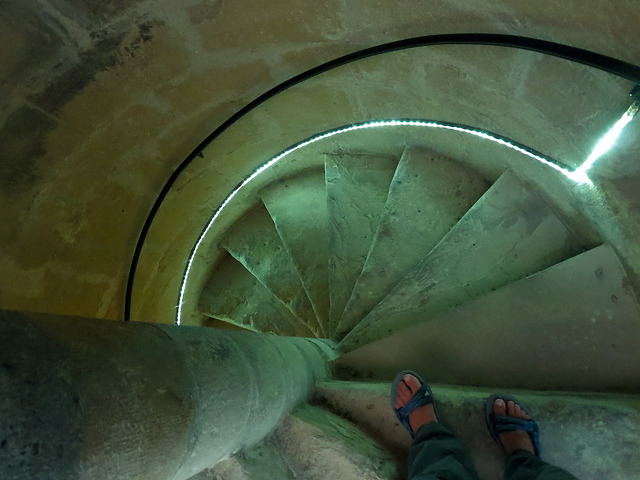
The chickens were fun, and the museum of religious artifacts built into the original cloister is full of the icons and images that defined early Christianity. But the real surprise of Santo Domingo’s cathedral, and the part not to miss if you’re the adventurous type, is up an unmarked (at least when we were there) spiral staircase in the back of the grand space.

21126561820_7a9d8df14d_z

I don’t know if I would have been brave enough to take them on my own, but I was in the wake of two urban explorers, and they had disappeared around the corner before I could utter my first squeak of “we’ll get in trouble!”

20693554723_2434ca0f9a_z

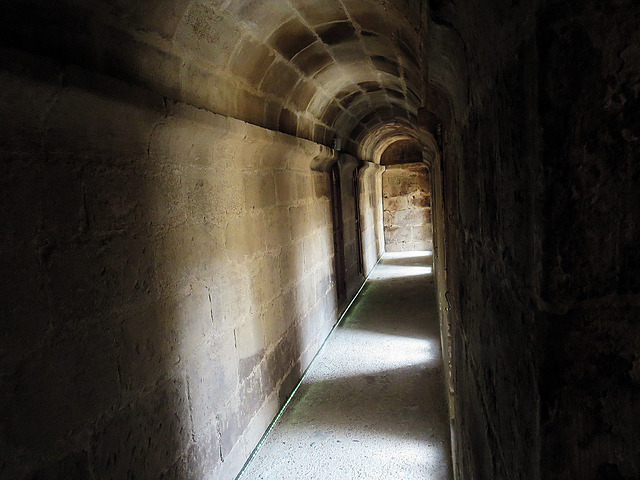
We didn’t get in trouble, of course. The stairs lead to defensive corridors that surround the cathedral, when the thick walls of a town’s church protected more than just the souls of its parishioners, with narrow windows overlooking the street, and then all the way up to the roof.

IMG_2186

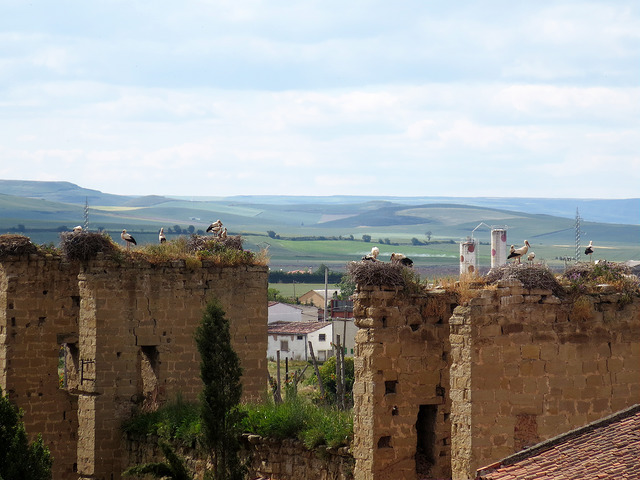
Santo Domingo’s old city spread around us, with the remnants of the old defensive walls now supporting a whole colony of storks.

21126756848_0d7ed5b1cc_z


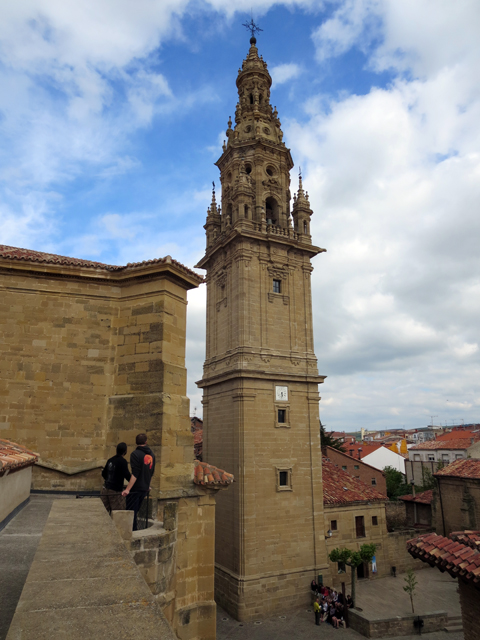
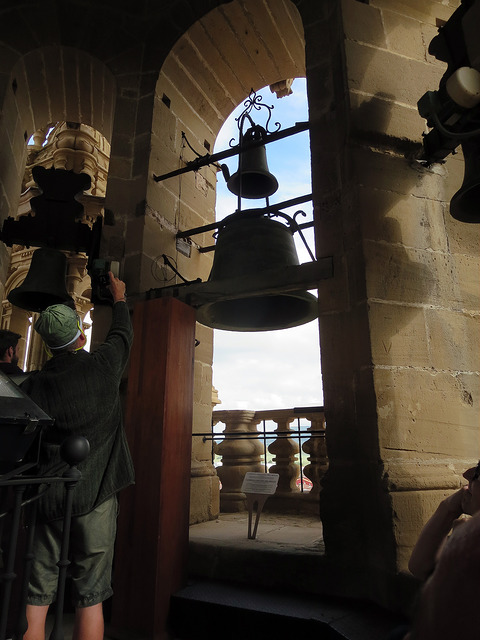
Eventually we crossed the square to the cathedral tower, which is oddly not connected to the actual cathedral. The sign said it’s because it had a habit of falling down. The stairs led all the way to the bells themselves, so we waited until the hour struck, and the giant brass bells swung and tried to deafen us all.

21303992812_db662008df_z

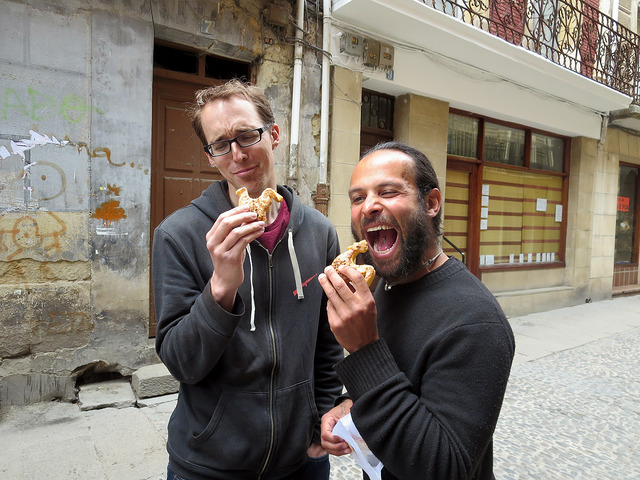
And then we came down and snacked on cookies shaped like chickens, because tourism thrives on good stories as much as I do.

20693574813_86e28416e6_z

The Pull of the Ocean

ocean
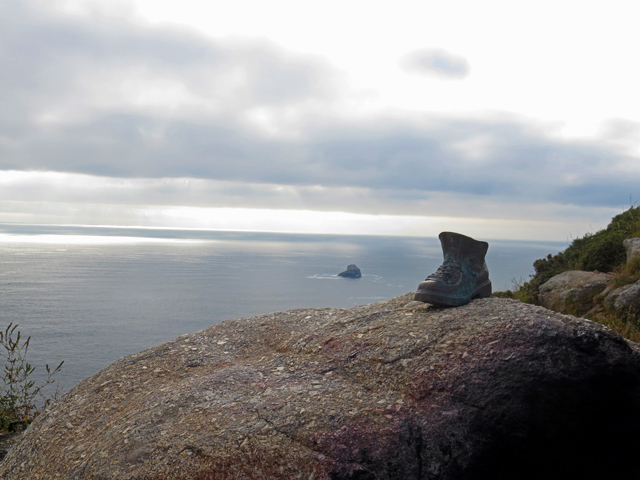
The pilgrim’s boot at Finisterre

“The sea, once it casts its spell, holds one in its net of wonder forever.”

 – Jacques Cousteau

Most pilgrims and hikers on the Camino see Santiago as their destination. But for me, the walk was always about reaching the ocean. I would walk west until my feet touched water, and there was no more “west” to walk.

Santiago was a nice stop, with lots of great traditions, but it wasn’t the end. I didn’t get sentimental or reflective there, even as I watched the botafumeiro swing and hugged St. James himself.

But on the rocks of Finisterre, watching the sun set over the ocean that I’d only ever seen from the other side, the journey felt complete, and the enormity of what we’d done finally hit me. We had walked to the End of the World.

We lingered in Fisterra (the town that is closest to Cape Finisterre, which explains why people get the words mixed up) for three days, and in hindsight, I wish we’d stayed longer. Every night we walked to the lighthouse and watched the sun set. Those were some of the best moments of my Camino.

So it’s no surprise that this week I’ve sought a similar view, albeit on the other side of the globe. I’m holed up, alone, in a hotel not on the west coast of Spain, but on the west coast of Washington. It’s just me, my laptop, my Camino story, and the sun setting over the ocean. (Well, in theory. It’s been raining since I got here.)


IMG_20170314_121126
There’s an ocean out there past the dunes, really.

I’m watching the rain and the waves, and trying to recreate what it’s like to be outside 16 hours a day, walking across the shadeless Meseta, lingering in sweltering towns made of mud and straw.

These beach moments, and the time they offer to reflect, are great gifts in a world that happens at warp speed. I don’t take them lightly. Thanks to all of you on the blog for joining me on the journey.


The Sagging Middle


img_1408

In my day job back in Seattle, I help writers revise and develop their work, which are often works of fiction. One of the things I’ve learned to look for is what we call the “sagging middle.”

A good story starts off with a lot of drama and tension. Things happen.  Everything is new. And then, near the end, there’s a conclusion and some kind of resolution. The murderer is caught, the couple discovers true love, the orphan finds a new home.

But things get tricky in the middle. Even with the best writing, chapters can slide by while nothing about the situation changes. Everyone is just marking time, waiting for the resolution.

About two weeks after we walked out of Le Puy, I felt like I was entering the sagging middle of France. I’d walked fifteen to thirty kilometers a day, without a break, and I was tired. The novelty of springing out of bed before dawn every day, of putting on the same clothes, and then putting one foot in front of the other, was already feeling too familiar.

It’s what Angela and Duffy Ballard, in their book A Blistered Kind of Love, called “the spectacular monotony.”

The days were blending together, and not just for us. It was about this time, somewhere between Figeac and Cahors, that I overheard this exchange:

It was mid-afternoon, and we’d stopped for a beer in an outdoor cafe before we went looking for our gite, which was somewhere outside town. While we waited, I eavesdropped on two young men behind me who also had backpacks propped beside them.

“Where are we?” one asked.

“No idea,” the other answered. “But if we’re going to wash our underwear and let it dry tonight, we must go soon.”

Such is the middle of the Camino.


Camino Frances Memoirs

A few weeks ago I posted recommendations for memoirs about the Le Puy Camino (also known as Via Podiensis or Chemin du Puy).

Now let’s look at a few of the personal stories available for the Camino Frances.

This is a harder list to narrow down and do justice. Not surprisingly, because the Camino Frances attracts so many pilgrims, there are quite a few (like, dozens) more books available.

51codjmsvyl-_sx331_bo1204203200_
To the Field of Stars by Kevin Codd

This was the only Camino Frances-specific book I read before we left for our own Camino in 2015, and I’m so glad I found it. One of the most well-crafted of the Camino memoirs, both thoughtful and personal, Codd’s experience as an American priest on the Camino Frances is full of details about what it’s like to experience the walk, without ever getting boring. The references can be a bit dated; a lot has changed since 2003. But the story will make you want to get off the couch and follow along.


41mi3egeopl-_sx331_bo1204203200_

A Million Steps by Kurt Koontz

It’s hard to research the Camino on a site like Amazon without bumping into this independently published tale. It’s timely (Koontz walked in 2012) and detailed… but okay, my editor’s brain wondered often is it wasn’t a little too detailed, cataloging each action of every one of his thirty days. There’s not much of a story arc or resolution to his narrative, but there’s plenty of information for someone who wants to know what the Camino Frances is like.


512b8v7pvl-_sx332_bo1204203200_

Walking Home: A Pilgrimage from Humbled to Healed by Sonia Choquette

I had a strong reaction to reading this memoir last year, just a few months after I returned from my own Camino. The book is well written, thoughtful, and interesting. It also describes a Camino experience that’s almost the exact opposite of mine. (That’s not a bad thing.) The author, a self described “intuitive guide” and “spiritual teacher,” used a travel service to pre-book a Camino package, with hotel reservations every night and baggage service to drive her heavy pack every day to her next stop. Not surprisingly, then, her Camino was less about the walk itself (although she has some interesting descriptions of herself as a Templar in a former life) and more about how she processes through a number of trials and tragedies happening at home.


51tufblehcl-_sx325_bo1204203200_

I’m Off Then: Losing and Finding Myself on the Camino de Santiago by Hape Kerkeling

A fun “fish-out-of-water Camino tale told by a popular German comedian, it’s a bit dated by now if you’re looking for information (Kerkeling walked back in 2001).


And I confess, I’m just beginning to tackle the stacks of Camino memoirs that have recently released and are loaded on my Kindle. These look great, but I can’t tell you much about them yet. (Give me a few months, and I’ll update this list with a Part 2.)

519sa3agepl-_sx331_bo1204203200_

Sunrises to Santiago by Gabriel Schrim

51j6l-cokwl-_sx331_bo1204203200_

In Movement There Is Peace by Elaine Orabona Foster

51im4doe8bl-_sx311_bo1204203200_

A Camino of the Soul by Katharine Elliott

51qwmhaiwfl-_sx322_bo1204203200_

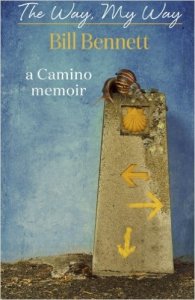
The Way, My Way by Bill Bennett

51urdbwvsyl-_sx331_bo1204203200_

The Way Is Made By Walking by Arthur Paul Boers


What am I missing? What’s your favorite Camino memoir?


Disclaimer: The above links all go to Amazon.com, partly because some of these books aren’t widely available in bookstores, and partly because I have an associate account there. If you click the link and buy one of these resources, I will receive a few fractions of a cent. It’s a small way to pay the domain and hosting fees, and help make Camino Times Two self-sustaining. However,  if you have a preferred local bookseller who can order these titles for you, you should absolutely do that. 

I Have Always Known (Almost Wordless Wednesday)

19774211738_6dd52085e0_z


I have always known

That at last I would

Take this road, but yesterday

I did not know that it would be today.

— Ariwara No Narihira


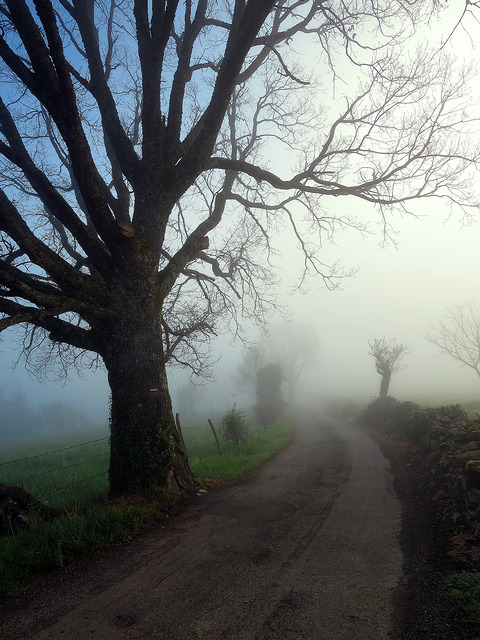
Photo taken just outside Figeac, France. The red and white stripes on the tree mark the Chemin du Puy, the Camino stretching from Le Puy to Saint Jean Pied-de-Port, France.

(hat tip to Robert Woltman and his lovely piece  on “The Spiritual Aspects of the Camino” for introducing me to this poem.)


This Is Your Brain On Walking. Any Questions?

19936263186_c8a9b78d69_z
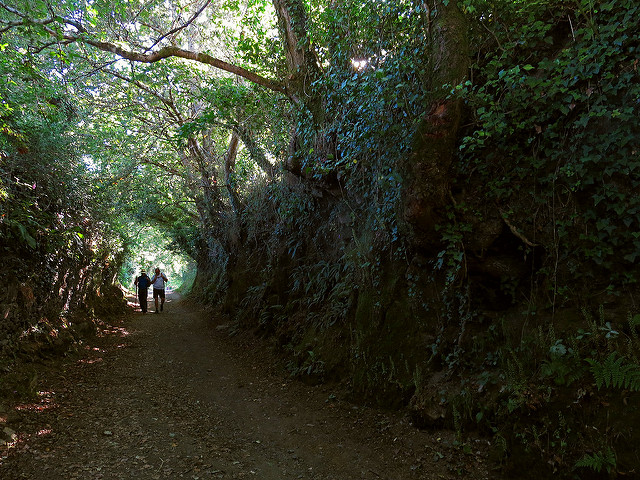
Walking the Via Podiensis in France

I came across this story last week about Vancouver author John Izzo. A popular author, business speaker, and consultant, Izzo had a successful career writing and teaching about how to live and work better.

But he wasn’t happy.

So where did he go to rediscover himself? The Camino, of course.

“Izzo hiked in Spain for 29 days and found he was happier when he learned to surrender to circumstances, rather than hooking his happiness to outcomes.”

(Click here for the whole article)

(Sounds a lot like my Practice Acceptance mantra.)

Izzo isn’t pointing out something new. It’s been 2400 years since Hippocrates said “Walking is a man’s best medicine.”

Modern medicine still agrees:

Something as simple as walking to work makes you happier.

Committing to walking outside, in nature, has a host of physical benefits.

Walking specifically in nature, away from cities and traffic, has measurable effects on mental health. 

Something like the Camino de Santiago takes walking to an extreme, and blends it with the spiritual practice of pilgrimage.

Is it any surprise, then, that walking the Camino de Santiago is often life changing?

21974442783_68b7e912f7_z

A long, intentional walk like The Camino is a chance to stretch both muscle and mind. It’s a place to think, to grieve, to pray, to rest, and to build a lot more of those nerve endings in the brain.

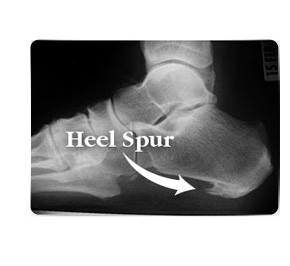
Of course, the opposite is also true. NOT walking is NOT good for your mental health. Trust me on this one. Last week my physical therapist once again grounded me from walking any distance. My feet and their plantar fascitis/tendonitis/heel spurs still aren’t healing. I’ve spent more time off my feet in the past year than I have being upright. And I have both the expanding waistline and the general sense of “blah” to prove it.

Being grounded is excruciating.

13912306_10154070096218557_5585583823761095650_n
This is not my actual x-ray, but I do have a similar-looking pointy thing on my heel.

But I’m in this for the long game, which starts with six weeks on the hilly, remote, beautiful Camino Norte/Primitivo this fall. (And then will expand to the Camino Arles, the West Highland Way in Scotland, and that’s just getting started.)

“It’s not optional,” I told the PT. He agreed not to try to talk me out of it.

Because like Izzo, my life can’t all be about writing books and teaching classes. Except this week, my life is still writing books and teaching classes.

So will you all do me a favor and go outside and walk somewhere this week? Breathe the outside air, find a pace that your body likes, and just go.

A Detour to Eunate

After chugging across France in a steady, respectable 35 days, we crossed the Pyrenees and arrived in Spain with an unusual conundrum: we were early.

We were meeting a friend in Logroño in ten days. If we followed the normal pattern of walking 20-30 kilometers a day, we’d be there in six.

So we did something radical: we slowed down. We took a full day of rest in Pamplona. And then, instead of walking the typical “full” day from Pamplona to Puente La Reina, we decided to cut it in half, stopping for the night after just thirteen kilometers in the tiny town of Urtega.

(An added bonus to this plan was the chance to get off the “typical” pilgrim route, which in late April was crowded with way more people than we were used to.)

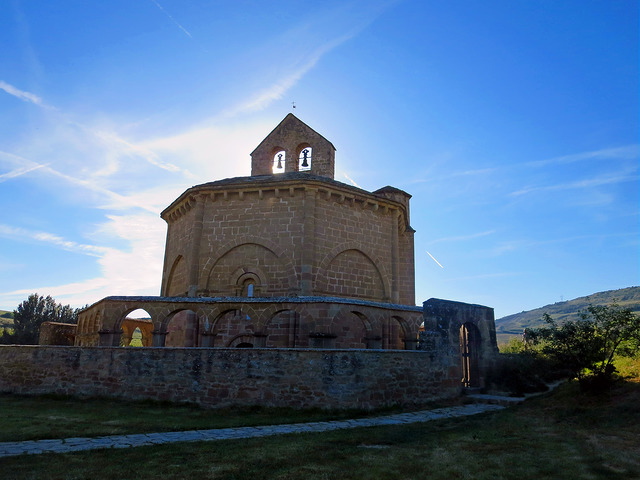
All of this backstory is just an introduction to how Eric and I ended up all alone on a chilly spring morning, at the legendary Church of Santa María of Eunate.

From the book in progress:

The trail the next morning was blissfully peaceful and empty. We left while the Russian teenagers were still snoring on their bunks and the woman from California was still packing, secure in the knowledge that there were would be no one else on the road. The closest albergue was more than eleven kilometers away, on the other side of Alto de Perdon.

We were just ten kilometers from Puente La Reina, our stop for the night, but there was a side trip I was eager to take. The Church of Santa María of Eunate, officially the ending point of the Camino Aragones,  was just a four-kilometer detour off the Camino Frances.

img_2047
The Church of Santa Maria of Eunate

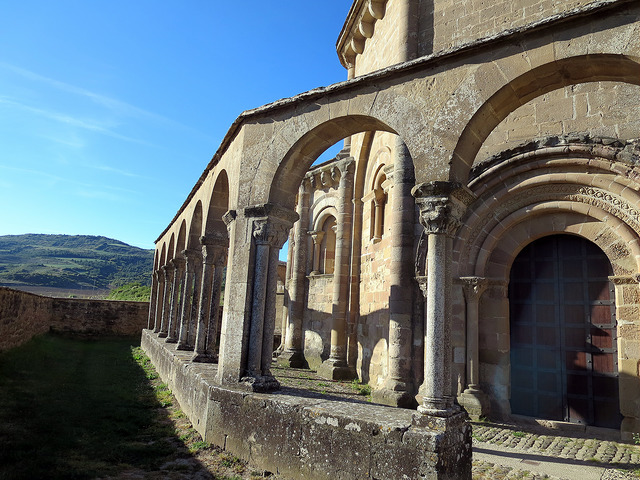
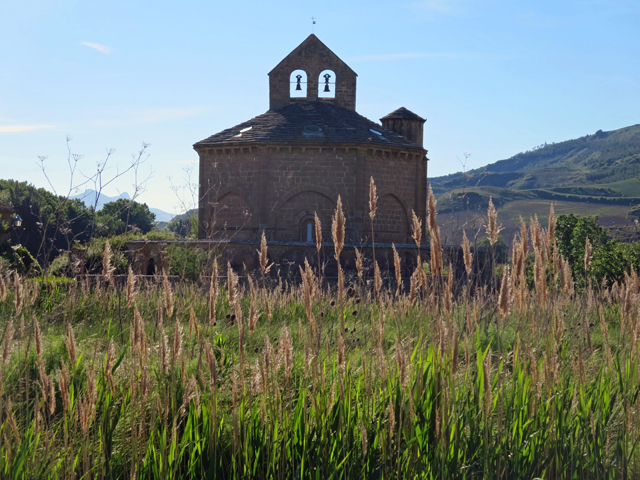
A Romanesque chapel built in the twelfth century, the octagonal Eunate is as famous for its mystery as its beauty. It stands alone in the middle of wide, flat fields, surrounded not by a porch but by a delicate, freestanding cloister. Its unique design and remote location leave historians with different interpretations. Most books agree that it has Templar connections, but there are few other areas of agreement. Perhaps it was a personal chapel for a powerful person of nobility? A hospital? A mausoleum? A landlocked lighthouse of sorts? (It has a distinctive tower for hanging lanterns, which in this open country would have been visible for miles.)

20510338753_57be51b770_z
The freestanding cloister wall of the Church of Eunate

Archaeologists have found scallop shells adorning bodies buried beneath the structure, so we know it has a place in the story of the Santiago pilgrimage.

And until recently, I’d heard that the volunteers who ran the chapel had opened it as an shelter for pilgrims, inviting them to sleep on mats under the domed roof, blessing them with a candlelit dinner, music, and prayer. But when the number of pilgrims increased, the logistics of hosting so few became difficult. People who were turned away were upset.
Eunate closed its doors.

Now the chapel is open to visitors only during the day…every day except Monday. And of course, we were passing through on a Monday.

No matter. I knew if the chapel was closed, it would also be quiet. I was right.

The path to Eunate crosses wide, flat fields that were still brown in mid-spring. The sun was bright, casting sharp shadows in the early morning light, silhouetting a building that was much smaller than I expected, and also more beautiful.

20943299720_06646f1a37_z
Morning at the Church of Santa Maria of Eunate


We put down our packs and lingered, circling slowly, soaking in the quietness and the details of the architecture.

I wished I could go inside to see the famously simple architecture, but instead I contented myself with walking around the outside, lingering over the weather-worn faces carved on the sides. I hummed childhood hymns I hadn’t thought about in years.

We stayed until the tour bus pulled up, and then it was time to go.

20944649569_5c3acfed7f_z