Before we left for our Camino, people would ask me what place I was most looking forward to visiting, and I would always say Pamplona.
Partly, I admit, that’s because it was the only name I recognized. I looked at maps with words like Moissac and Castrojeriz, and drew blanks. The books told me that Conques and Burgos were lovely, but I had no reference.
I carried a small, battered copy of The Sun Also Risesand re-read it as I walked toward the Pyrenees. It’s not my favorite Hemingway, but it’s such a love letter to the region.
(It’s also, by the way, where I learned, somehow for the first time, that bulls are killed in bullfights. Somehow—and I think I blame Bugs Bunny for this—I always pictured a bull fight as something like a rodeo, more like a a timed event than a to-the-death kind of thing.)
But anyway. We weren’t in Pamplona for San Fermin, and there were no bulls running or dying (thank goodness). But that doesn’t mean the town was ever quiet. This, more than the literary history or the bloody sport, is why I fell in love with Pamplona…it was one of those cities where around every corner was a new surprise.
Brierly’s Camino guide, the ubiquitous orange book used by almost every English-speaking pilgrim in Spain, recommended blowing through Pamplona mid-day and staying in a suburb on the other side of town. But I wasn’t having any of that.
I was a bit city-starved by this point. For almost six weeks, we’d been walking through pastoral countryside and exploring small towns for almost six weeks. It was lovely and beautiful. But I’m a city girl by nature. I love busy streets and alleys and plazas and people. This was a place where I wanted to linger. So we arrived mid-day, checked into a hotel just a block from the Plaza del Castillo, and stayed for two nights.
There was music coming from every corner when we arrived, and I assumed it was some kind of festival, but a local we met told us no, this wasn’t a particularly special day. This was just Pamplona.
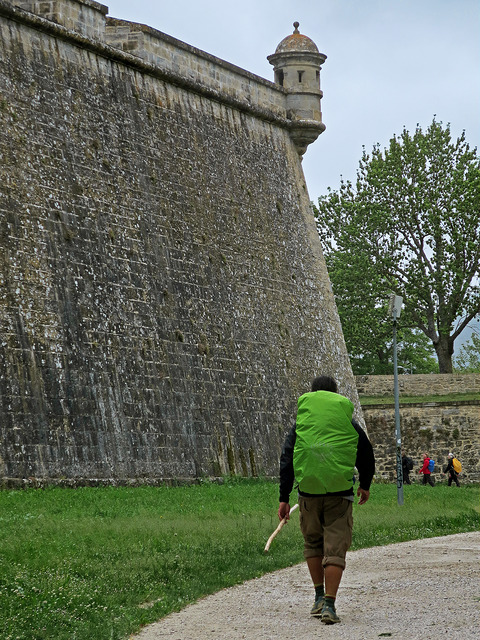
To get there (at least on the Camino), you must first circle the outside of the medieval walls in order to enter through the historic pilgrim’s gate…
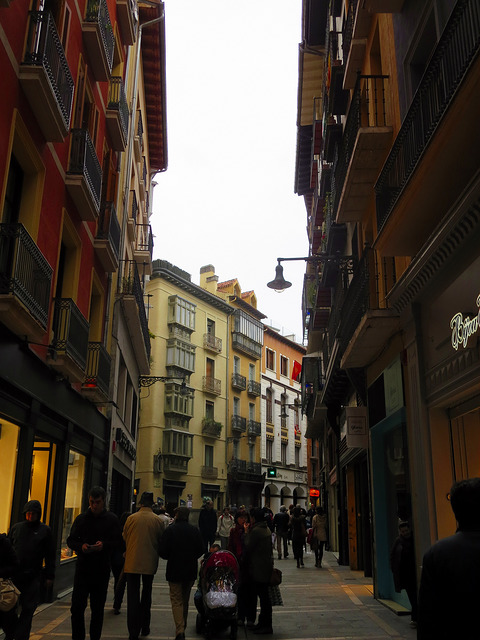
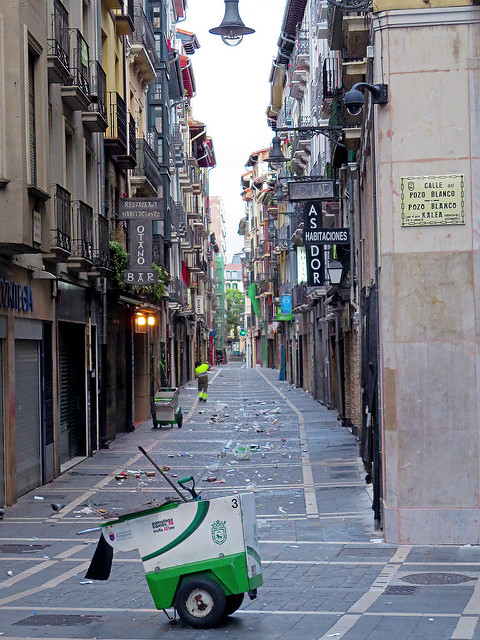
…and then navigate the crooked, colorful, pedestrian-friendly streets…
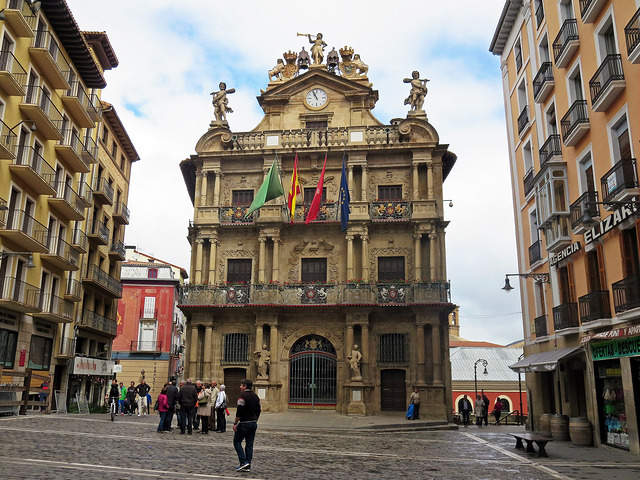
…past the famous city hall, where every year the rocket is launched that starts the nine-day festival of San Fermin…
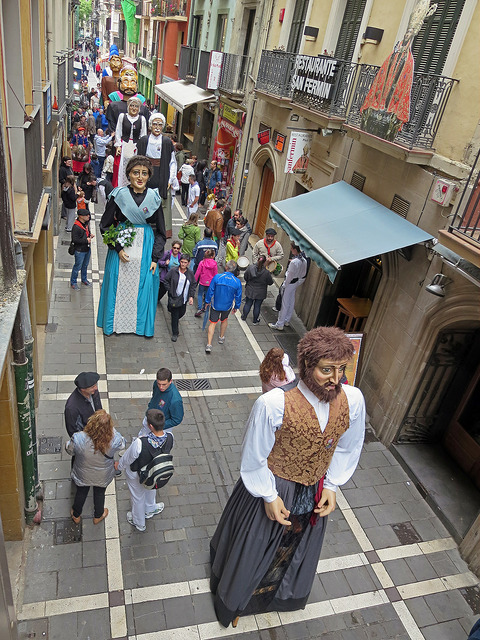
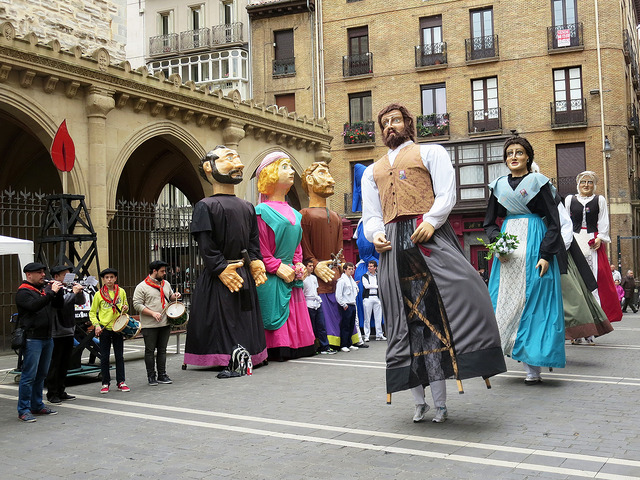
…and then a few more blocks to a hotel room. But it’s hard to stay inside when there are dancing troupes of fifteen-foot puppets twirling in front of the cathedral and parading down our narrow street…
…and a young boy with a paper mache horse and a plush mace going around bopping small children on the head (there’s some great story behind this, and I wish I knew it)…
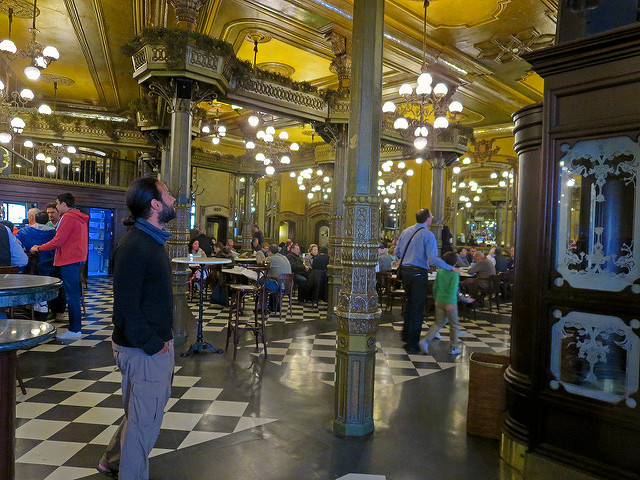
…while around the corner literary types and tourists sip cocktails in Café Iruña, Hemingway’s favorite haunt still gaudy in its Art Deco glory…
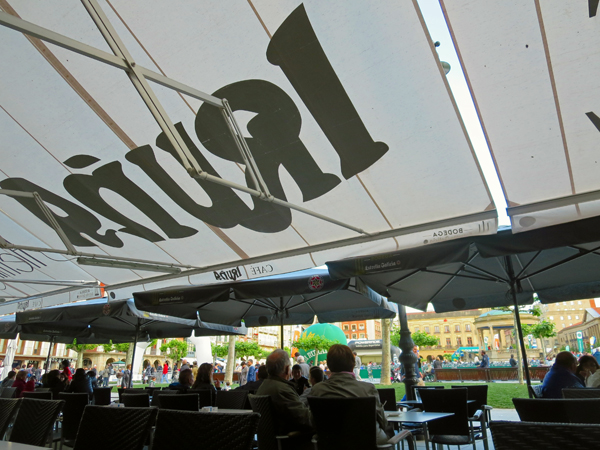
…and watch impassively as a thoroughly modern triathalon ends in the main square, pumping out hip hop for an outdoor Zumba class…
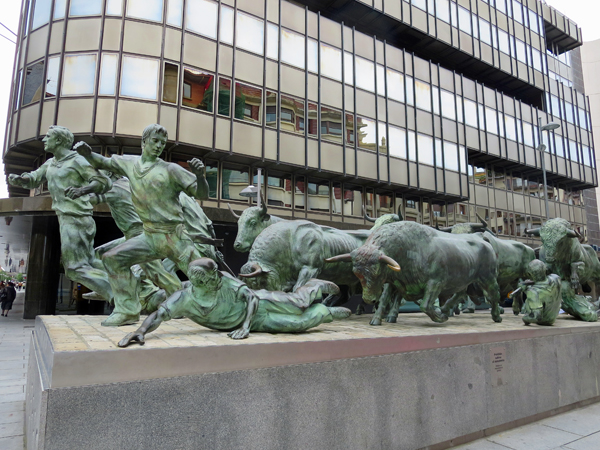
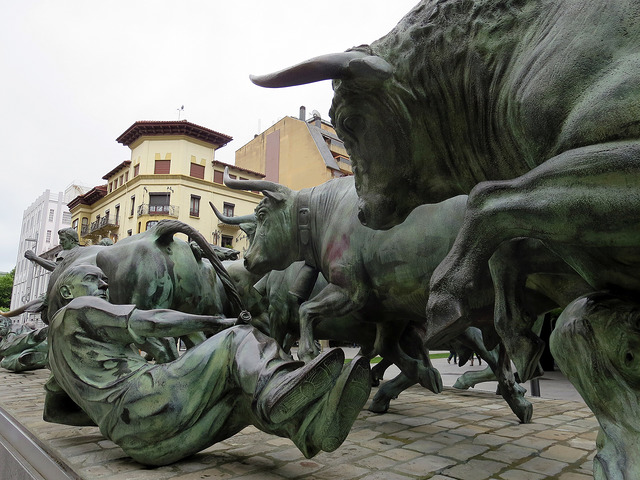
…just a few narrow, bumpy streets away from the bullfighting ring, and the powerful statue just outside…
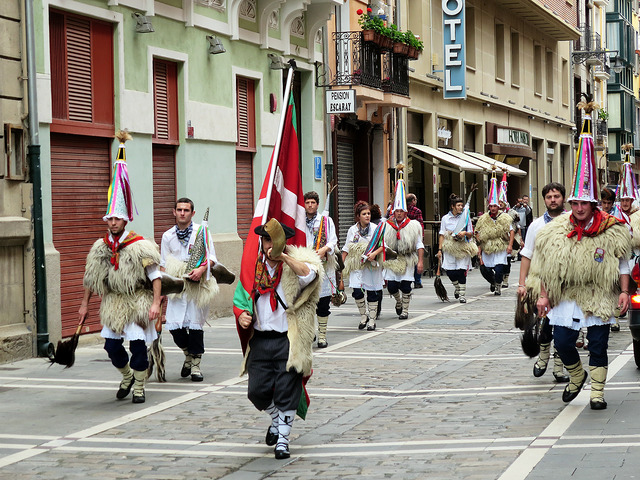
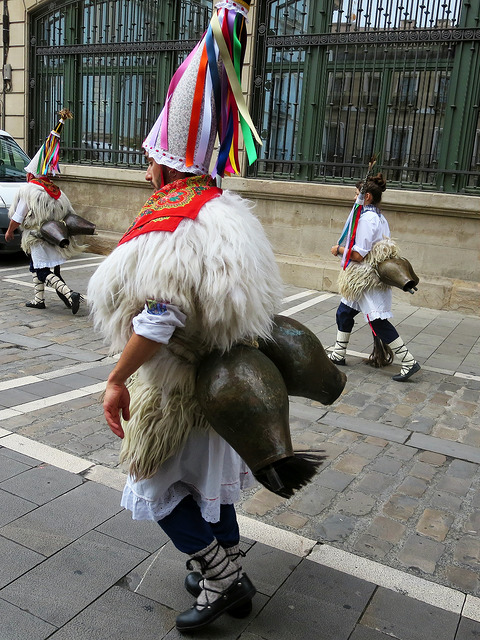
…while just up the street a traditional Basque group with fur on their shoulders and giant percussive bells on their butts march by, looking fierce…
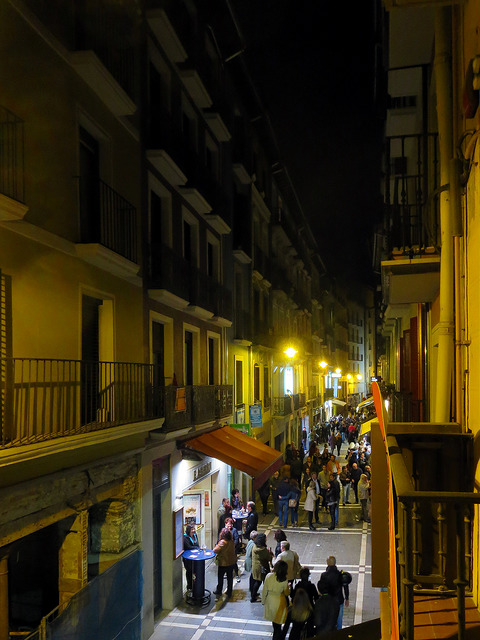
…and then a night of wine and tapas, and discovering that our surprisingly cheap private room, with the balcony overlooking a shuttered street, had turned into a wall-to-wall crowd of people at ten o’clock at night, and the party literally lasted until dawn.
Now, I can sleep through most noises, and never needed ear plugs on the Camino. But a party in Pamplona, ten feet below your window, is pretty much impossible. It’s also so cheerful and so quintessentially Spanish that I couldn’t be annoyed.
When our Camino was over and we had a few days of extra time before our flight home, this was the one city I really wanted to revisit. I wanted to sit longer in the enormous Plaza del Castillo again, and see what human puppets would go dancing by next. And I wanted more of those tapas…
But alas, by that time it was almost San Fermin. Rooms were booked, albergues were closed, and if what we saw were the locals on a random May weekend, I couldn’t imagine the city with two million tourists.
This week marks one year since we boarded a plane in Paris and set out for home, our (first) Camino officially over.
I’ve heard many Camino pilgrim stories about the rough re-entries to “real life.” But wow, our first few hours, and then days, were almost comically awful, and an opportunity to practice a few of the lessons and skills we’d picked up in our 79-day walk.
Watching one last French sunrise, setting out on what would be a 29-hour journey home
Because it was a holiday (translation: expensive) weekend in the U.S., we’d booked our return flight into Vancouver, BC, which is only about a three-hour drive from Seattle. And we had a good friend who’d volunteered to give up his Sunday to drive up to Vancouver and pick us up.
(Yes, we have really great friends.)
Now, this friend drives a very small car, so the plan was that he would pick up our bigger car, which had been sitting at our apartment building for three months, for the airport run.
And this is where things start to fall apart.
Eric and I landed in Vancouver at about 9:00 pm, after two long flights and an eight-hour layover in Reykjavik, and before we even got through the customs line, I turned on my phone and found a text message waiting, which said something like:
“Car trouble on the way to Vancouver. Had to leave it on the side of the highway and get a ride back to Seattle. You may need to find another way home. Sorry.”
Pre-Camino me might have panicked. Post-Camino me, I’m happy to say, took this turn of events more or less in stride. Eric and I were used to dealing with surprises by this point. One of his most-often-used Camino mantras was “practice acceptance.” The albergue is full? Okay, let’s find another one. The only market in town is fermé (closed) for no apparent reason on a Tuesday? Okay, let’s keep walking. Stuck with a surly bar owner or hostel manager? Okay, we’ll be somewhere else tomorrow. There’s no need to panic or get upset. We’ll figure something out.
So here, in a Canadian airport, we just kept practicing acceptance.
While Eric connected with our friend to see what the story was with our car (and to make sure he was okay), I started playing travel coordinator. It was too late to ask anyone else to drive all the way up to get us, but I figured I could find a cheap airport hotel room for the night and catch a bus back home in the morning.
Except when I went to online, there was only one hotel room available, and it was 50 kilometers away from where we were…and almost $400. I checked multiple sites. No luck.
I went to the bus website and found that every ticket for the next three days was sold. I checked Amtrak. Same story.
We went to the airport information desk and explained that we’d been traveling for twenty-one hours, and almost entirely offline for three months. We hadn’t seen any news, but something was obviously happening in Vancouver that day.
That’s when we found out that the American team was in the FIFA Women’s World Cup, which was being played in Vancouver that night. It was a Very Big Deal for American soccer fans, who had spilled over the border in numbers probably not seen since the 2012 Olympics.
And we’d landed right in the middle of it.
I’ll spare you the details of the tragic comedy that filled the next couple of hours. I kept trying to practice acceptance while I tried alternate plans, but every effort was swatted down by some Camino god with a sense of humor.
My sister, who’d moved to Seattle while we were gone, could drive up to get us…but no, someone had stolen her car a few weeks before, and she wasn’t allowed to drive her rental car out of the country.
The very nice information desk people tried to find us a public bus to take us to the border…but no, we’d missed the last one. All of the private bus companies were booked for days.
The final straw landed when I found out that ONE rental car company in the airport still had ONE car available, and for just $250 I could drive it one way from Vancouver to Seattle. It was a ridiculously inflated price, but it was the only option we had. So we stood in line for thirty minutes, finally got to the desk, navigated another ten minutes of paperwork, waivers, and questions…and then when I handed the woman behind the counter my card, she rejected it.
“We don’t take debit cards.”*
I took a deep breath. Practice acceptance… okay, fine. I’d carried the “emergency” credit card for the past three months, though we never needed to use it. Now I pulled it out with a flourish.
She took it and shook her head. “It’s expired.”
Whaaa..??? Sure enough, the card had expired a few days before. “They sent the new card while we were gone,” I explained. “I’ll call my sister, and she can go through my mail and find it. There will be a new expiration date, but the number’s the same.”
The woman shook her head. “I cannot take this card.”
We offered cash to rent the car. She refused.
Finally, I said, “Is there any way for me to rent this car and drive it to Seattle tonight?”
There was not an ounce of empathy or understanding in her voice when she said “no.”
No other rental car company had any available cars.
That was the point where I ran out of acceptance. I sat on the floor of the rental car office, too tired to leave, too angry at them for not even trying to help.
Our first day home from the Camino was not what we expected… RIP, Daisy the Car.
In the end, all we could do was go back to our friend, the one who’d already driven halfway to Vancouver, navigated the sudden breakdown of our car, and was now back in Seattle. “Hi…we’re sorry to ask, but your small, cramped car is sounding better than sleeping in the airport for three days…”
Did I mention we have really great friends?
He set out from Seattle once again, making it to the airport in record time, and got us home in the wee hours, twenty-nine hours after we’d started the trip. We slept really well that night.
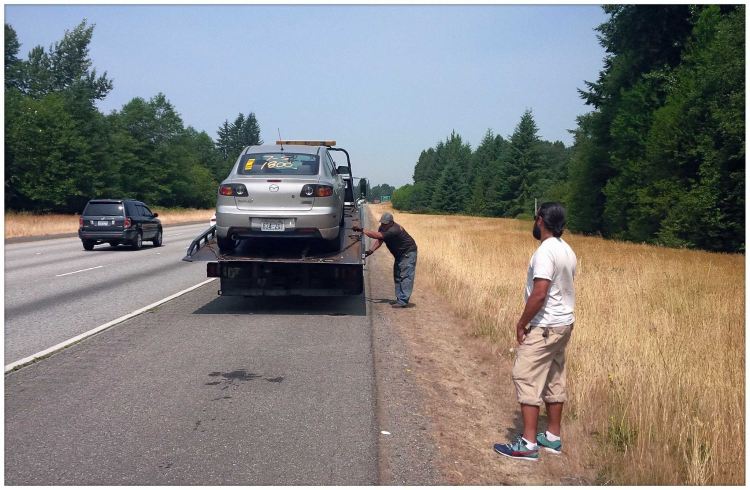
But of course, the adventure wasn’t over. Eric and I still had a car – our only car, by the way – stranded on the side of the highway. So the next morning, we woke up in time to take my sister to work and then borrowed her rental car and went looking for our car on the side of the highway, somewhere between Seattle and Canada.
We had her towed to a mechanic, who looked at the melted engine and told us we should start shopping for a new car.
My tag on Facebook that day said “Looks like the Jusinos are going to be traveling on foot for a few more days, at least. The Camino continues…”
The car was dead.** Our homecoming was overshadowed by car shopping…which is not what you want to do right after you’ve gone without an income and spent most of your disposable savings on a three-month sabbatical.
We went from being offline all the time to spending every spare minute scouring Craigslist. We went from relying almost exclusively on our own feet to obsessively thinking about, talking about, test driving, and comparing cars.
Practice acceptance, Eric kept saying. He was very zen about the whole thing.
Me? I was less so. I wasn’t prepared for this sudden immersion into ringing phones and emails and traffic and noise. I’d forgotten how to multitask. I didn’t want to work. I couldn’t afford not to.
It was nice to have a real bed again, and a closet full of clothes that I didn’t need to wash in the sink every night. But the concrete jungles of used car lots didn’t compare to a field of poppies and crumbling chapels.
In the end, of course, we slogged through the inconvenience just like we slogged through the occasional day of drenching Camino rain. It wasn’t pleasant, but it would end eventually. We’d buy a car, find our footing, and wind up in a new place again.
Only now we had a few new tools…and mantras…to get there.
* This, by the way, is unusual. Most rental car companies accept debit cards.
** I should say here that the car essentially committed suicide, and it had nothing to do with our friend driving it. That was just bad luck. Turns out that our particular year and make of car has a known (but unacknowledged by the manufacturer) habit of, without warning, destroying its own engine. This is something that became obvious when our mechanic tried to replace the engine—an expensive process, but cheaper than buying a whole new car—and couldn’t find a single one available for our make and model.
Another Camino mantra: sometimes you win, sometimes you lose…
It’s pretty obvious that, even a year after we flew home from our adventure, I’m passionate about the Camino. The great thing is, I’m not alone. Five years ago, when I first started planning this journey, if I said “Camino de Santiago” I got a lot of blank looks. Today, there’s a lot more “oh, that’s the thing in that movie…” (thanks, Martin Sheen) or “oh, my friend’s cousin just did that.”
On August 5, I’m going to share my research, tips, and experiences “Walking the Camino de Santiago.” It’s offered through the University of Washington’s Experimental College, the enrichment program of non-credit classes for students and community members. (I’ve been teaching with ExCo as part of my “day job” for years.)
This isn’t a “hey, let me show you pictures of my awesome vacation” experience. I’m only offering this to a small group (20 people max), so that we can focus on the practical questions that I wish I’d known before I started.
The outline is still a work in process, but I know that we’ll talk about:
What the Camino de Santiago is—the history of the Camino, and the current network of more than a dozen separate trails that cross three countries.
How to choose the “right” Camino path —considering each person’s available time, distance, and what they’re looking to experience, and exploring all of the Camino options (especially now that Frances is getting so crowded).
What an average day on the Camino looks like—the terrain in different regions, from volcanic hills in southern France to wide, arid bread basket country in central Spain; the accommodations, from municipally-owned hostels to full bed-and-breakfast guest houses; and the support systems of stores, medical help, and other needs of a hiker.
What to eat.
How to budget.
What to pack and what to leave at home.
How to be safe, especially for anyone traveling alone
There will be lots of pictures for inspiration, and maps and lists to really help prepare.
So if you happen to be near the Seattle area, I’d love for you to join us. You can find more information here.
And wherever you are, I’d value your feedback:
If you’re considering your first pilgrimage, what are your biggest Camino questions?
If you’re a Camino veteran, what do you think new pilgrims really need to know before they leave?
The first day of summer brought me a gift: the first head cold of summer. I’ve spent the past week on my couch, going through a full box of tissues, drinking gallons of green tea, and catching up on Season 3 of The Americans.
I could do all of that, of course, because this summer I’m at home, with a bed and a couch and endless Internet.
But what about last year, when I was sharing space with strangers and moving every day?
What happens if you get sick on the Camino?
The bad news is, it happens. Although my immune system held up remarkably well for being subjected to 75 different sleeping quarters in 79 days, there was one time when it just gave up and quit.
We were in Spain, on the Camino Frances, and had just arrived in Los Arcos. After a rather bad sleep in a donativo albergue the night before, we splurged on a slightly nicer private albergue in the center of town. Still bunk beds and shared rooms, mind you, but the mattresses were thick and the bathroom—one floor down a lovely tile staircase—was clean and modern.
After an afternoon exploring the town (the Los Arcos cathedral is AMAZING…don’t miss their open hours) and a mediocre dinner, I retreated to my lower bunk, feeling a little “off.” I woke up in the dark of night feeling very off. Out of the sleeping bag, past all my snoring roommates, out the (squeaky, of course) door, down the charming but treacherous staircase, and into the bathroom…just in time.
Don’t worry, that’s all I’m going to say about that.
This is me in Los Arcos, the afternoon before I got sick. In hindsight, I should have wondered why I felt like I needed to wear every single warm thing I had — the scarf, the long-sleeved wool shirt, the jacket, the socks under sandals, probably the long underwear under the pants — on a sunny afternoon in late May.
Thinking I’d eaten the wrong thing at dinner, I made my way back to the bunk, back to sleep…only to wake up an hour later and do it all over again. And then again an hour after that.
(A note to anyone who stayed in my albergue room in Los Arcos last June: I’m sorry. I tried to be as quiet as I could. A note to the albergue owners: your establishment is lovely and you are kind, but the door to Room 2 really needs some oil.)
That charming, treacherous staircase became my enemy, and the modern plumbing my only friend. And that nice thick mattress? I didn’t spend nearly enough time with it.
In the wee hours of the morning, when our roommates started stirring, I whispered to Eric that we wouldn’t be going on to Viana that day.
I stumbled down the stairs and managed to drink some tea while Eric talked to the albergue owners. Mi esposa está enferma. My wife is sick. Can we stay somewhere in town today?
And here, my friends, is where the good news kicks in. That saying “the Camino provides?” It becomes utterly true when things go wrong.
The albergue owner took one look at me, faintly green and sitting uncomfortably close (although not dangerously close, dear reader; I promise I kept my distance as much as possible) to his lovely breakfast spread, and made a phone call. In five minutes, it was arranged.
The next bit is fuzzy in my memory, but I know there was a pickup truck, and a man who spoke only Spanish, and a code for the door of a guest house…or maybe a hotel…a few blocks away. All I know for sure is that at 8:30 in the morning, I was in a clean, white, private room…with my very own bathroom. I could see that top of the cathedral from the window, and watch the storks caring for their babies. And I could sleep.
I spent the day in that bed, and my stomach slowly, slowly healed. By the next day, I felt ready for some food and a short walk (and more accurately, I was starting to worry about an appointment we had to meet a friend in Logrono two days later). I made it 18 kilometers that day, stopping in Viana at the Albergue Izar, an experience I’ve described before as one of my best on the Camino. When Eric came down with the same thing I had, they cared for us, fed us, and made us welcome.
When in need, look for the green cross. (Photo by Elliot Brown, Creative Commons license)
So…what does that mean for you?
Be prepared for sickness to interrupt your Camino at some point. Almost every veteran pilgrim has a story. That bug I caught made its way through the pilgrims, and many of our friends caught it at one stop or another. Months later, my friend Steve fought fevers and chills for days.
If at all possible, give yourself a cushion in your calendar. If it’s going to take you 33 days to walk the Camino Frances, book your return tickets for 35 or even 40 days out. (Yes, I know, your boss only gives you so much vacation, the dogsitter can only be trusted for so long, etc. But this is also a once-in-a-lifetime trip. If you’ve already invested this much, you can squeeze out another couple of days somehow.) We met too many people who kept trying to plow ahead, or who had to skip stages of the Camino, because they hadn’t factored in the unexpected.
Remember you’re in a First World Country. Europe’s healthcare system is top notch. There are farmacias (usually more than one) in every town, even the smallest ones that will have standard over-the-counter medicines. Pilgrims who have had more serious ailments almost unanimously report that the doctors, medical clinics, and even hospitals are excellent (and usually far less expensive than any kind of care we’d get in the U.S…but that’s another complaint for another time).
What am I missing? What are your “sick on the Camino” stories, or your advice for future travelers?
Did you miss me? It’s been quiet on the blog, and on the book-writing front, for a few weeks. That usually happens when things are noisy elsewhere.
My day job of writing, editing, and teaching has been frantically busy all month. It seems like every time I try to set aside time for my own writing and projects, I get that email with a can’t-say-no request. (Not that I’m complaining…I’ve gotta make enough to pay for the next Camino.)
In the middle of that, though, I started to receive another set of emails, these coming from my family on the other side of the country. My 91-year-old grandmother’s health went from good to bad quickly, and ten days ago, she passed away. With just a few hours’ notice I hopped on a plane with Eric and my sister, and we flew home to New Jersey for the memorial services. It was a bittersweet time, celebrating with family the life of someone we all dearly loved. The last time I saw my grandma Eric and I were just starting to plan our Camino adventure, and I told her all about the adventures ahead. I didn’t see her in the months since we’ve been back to share all of the stories and photos, but I know she was cheering, and praying, us on.
We came back to Seattle just in time for Eric and I to pack and head out again, this time for a long-planned anniversary weekend in the outdoor playground town of Squamish, BC. More on that in a minute.
Because in the midst of all this, Facebook keeps giving me those “one year ago” photo flashbacks. And one year ago, we were in the middle of the Meseta.
14 years married, 750 miles walked. Still smiling.
Eric and I spent our 14th wedding anniversary walking from the shiny, modern Albergue Los Templarios in Teradillo to the sleepy, almost eerily deserted town of Bercianos del Real Camino, passing through Sahagun–traditionally considered the halfway point of the Camino Frances–along the way.
Sunrise in Teradillo
It was blisteringly hot when we arrived with Nic, from Switzerland, and Vivianne, a Korean exchange student who’d been living in Spain for the past year. We followed the yellow arrows painted on the empty streets to Albergue Santa Clara, where we snagged the last two dobles (double rooms with two twin beds). The dormitory area was already full.
Not exactly a honeymoon suite…
Before you start thinking that a doble would offer some anniversary-appropriate opportunity, I should mention that those lovely yellow walls between rooms only went about three-quarters of the way to the ceiling, and the rooms were closet-sized. Still, though, those are real sheets on the beds, and real towels on the table. These are not luxuries a pilgrim takes lightly.
I took a short walk around town, only to find it deserted. Many of the buildings, long and close to the ground, were made of mud bricks, and you could see the straw that held them together. It felt like one of those dream sequences in the movies, where you walk through a deserted landscape, hyper-saturated with color but completely silent. The only person I saw was an old woman, in traditional black dress and headscarf, sitting on a bench outside an open door. She was completely still, never acknowledging me and not even blinking as I walked by. The more I think about it, the more I wonder if I imagined her. It was that kind of place.
I returned to my friends, who were sensibly sheltered under giant umbrellas in the albergue courtyard, drinking one-euro beers from the vending machine and getting to know our fellow pilgrims—a mother, aunt, and daughter from Mexico. We passed an easy, lazy afternoon hiding from the sun, swapping stories, and watching the household chickens peck at a watermelon. We finally ventured out to the only bar in town for an uninspired pilgrim dinner of lomo (fried pork) and the always-present patatas.
The food may not have been much, but our international pilgrim cohort made a cheerful table, and I couldn’t have hoped for anything better.
And in the “be prepared for the Camino to surprise you” tradition, the morning after our blah dinner, our hosts provided the most elaborate breakfast spread that we found anywhere on the Camino. We feasted on a variety of breads, cereals, yogurts, juices, eggs, fruit, and more. Most albergues don’t even bother with breakfast, but this family overflowed with generosity.
So that was a year ago. This weekend, Eric and I spent our 15th anniversary weekend on foot once again. (Once you catch the bug…) Instead of walking a long, flat day across the Spanish Meseta, though, we were in British Columbia, Canada, climbing the short but almost vertical trail up to the south peak of “the Chief.”(They called it an intermediate hike, but anything that gains 600 meters in 3 kilometers, and requires ladders and chains, is a climb in my book. This thing made the Day in the Pyreneeslook easy.)
I wore my Camino pants, though they don’t fit the way they did a year ago. Pilgrims, beware the post-Camino weight bubble; this time last year I needed a belt to keep my pants on. This weekend…not so much. Of course, instead of a pilgrim menu, I had an enormous stone-oven-baked pizza loaded with cheese and pesto….at a brewery…with very tasty beer. So maybe the bubble is just me.
Life keeps carrying us forward…and we keep living the lessons learned along the Way. We remember. We celebrate. And we keep walking.
What is it like to walk from Saint Jean Pied de Port to Santiago de Compostela?
I just found a video that sums it up and edits it down to just 4 minutes. It looks like they walked about the same time last year that we did, and so everything here is so familiar I feel like they were taping my trip, from the vast green fields of Rioja to the rugged, rainy hills of Galicia.
I remember that the outdoor food truck/rest area where the older couple are dancing is just before Los Arcos, and the black-eyed sheep, and you walk under the arches of the ruined abbey just before Castrojeriz. I know the city walls of Burgos, the cathedral of Leon, and the Gaudi Castle in Astorga.
So pause your day, sit back, and imagine yourself outside, walking across an entire country with people from around the world.
It was just over a year ago, on May 13, 2015. (I thought about posting this on Friday, but it seemed like bad luck.)
We still casually refer to it as “the day we walked over the Pyrenees,” as if that’s a normal thing.
This was probably the most dramatic, difficult, culture-shocked day of my entire three-month trip. Not only were we walking into a new country, we were also walking on a new, much more popular Camino path. Gone were our quiet days of encountering the same 20 or so familiar faces along the trail and at the dinner table. The day Eric and I arrived in Saint Jean Pied de Port, the pilgrim office told us there were 400 credencials issued. There were tourists everywhere. We heard English everywhere.
That first morning, it felt like I was part of a long line of people, stretching for miles, all trudging in the same direction.
The ants go marching one by one, hurrah…
I don’t know if the crowds were unusual. It was the start of a holiday weekend. And with the rumor of bad weather coming, everyone was in a bit of a rush to get started. We’d also considered taking a rest day before setting off on the next stage, but decided to push ahead and save the rest day for Pamplona. (Despite the crowds, it was a good choice. The day we crossed was blustery, but clear. Later, we met pilgrims who started the day after us who were surrounded by sheets of rain and fog the whole way over the mountains. Radio Caminotold us about people being “taken off the mountain” with hypothermia and even someone dying, but those stories went unconfirmed.)
If I was tempted to be a snob about being an “experienced” pilgrim among so many just setting out, the mountains kicked it right out of me.
“Walking over the Pyrenees” means crossing via the Napoleon route near the western edge of the mountains, as they dip toward the Bay of Biscay. (Yes, this is the place where Emilio Estevez died in The Way.) The highest pass tops out at 1430 meters (4700 feet), which would put it comfortably in the White Mountains of New Hampshire.
So it’s not exactly Mount Rainier, but that steady, relentless, sometimes steep incline for 20 straight kilometers (12 miles) is nothing to take lightly. I hate, hate, hate uphill walking, and this was definitely the hardest day of the entire 1000-mile Camino for me. . I bow at the feet of those who choose to make it their first day…I had 35 days and almost 500 miles under my belt, and I still huffed and wheezed and swore and had serious doubts that I was going to make it over.
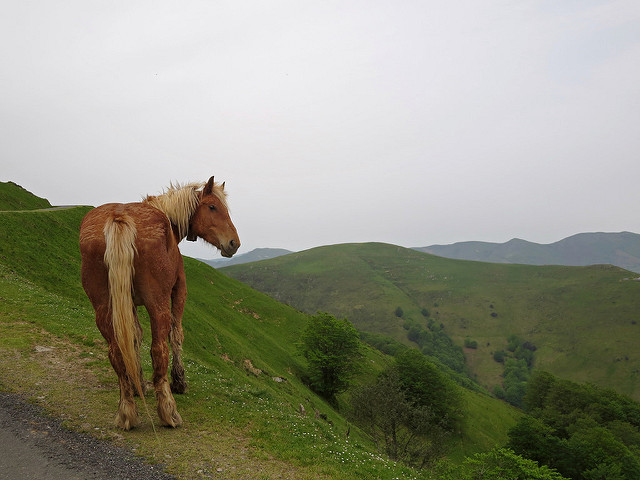
And I might not have, except these amazing things kept happening. I would walk around a corner and find myself in the middle of a herd of sheep, or having to hop off the trail because the GIANT MOUNTAIN HORSES with bells were standing, placidly, in the way. Or because everything around me was so mind-blowingly beautiful.
When we finally passed the summit and started down (because of course you have to climb 1250 meters only to immediately go back down 400 on the other side), the crowds and lines of people disappeared, and I found myself surprisingly alone (Eric was miles ahead of me for most of the day) in the middle of a forest, out of the wind and surrounded by the green of spring. I scrambled down the last five kilometers in a weirdly happy state, and arrived at the recently renovated monastery of Roncevalles in time to get one of the last three beds in the building. (After that, they filled the “dungeon” of the basement, and then the overflow spaces in shipping containers outside, and after that I don’t know what they did. By that point I was well into my celebratory wine.)
I call it the most amazing day that I’m glad I never have to do again.
(Click the pics below to see them full sized and with captions)
Leaving Saint Jean Pied de Port (note the clock: we were out before 7am!)
Looking back at the last misty French dawn
Sheep on the trail
The Pyrenees
Regal
Blocking the path, looking at the view. (These horses were HUGE!)
Walking with Horses
Tangled, hungry, blue-painted sheep
An original pilgrim shelter, still open for anyone caught in bad weather
One of the most famous stops of the Chemin du Puy, the Way of Saint James from Le Puy to Saint Jean Pied de Port, is in Conques. For many pilgrims, this is a high point of the trip. Our experience was not quite the same. Here’s an excerpt from the book-in-progress:
We made a steep, almost stair-step-like descent into the historic village of Conques before noon. I’d been looking forward to this, an important stop for both the original pilgrims and the modern travelers.
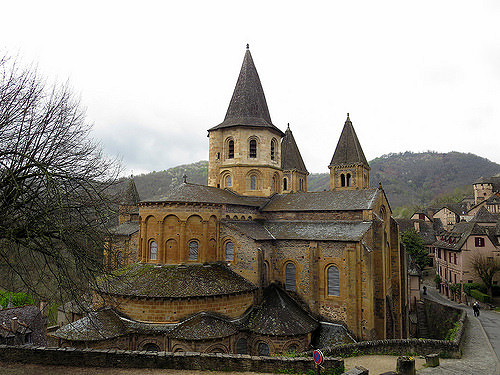
The town is tiny, just a few hundred people who live along narrow cobbled streets that cling to a steep hillside, hidden from the rest of the world deep in a valley. There are no motorized vehicles in Conques, as the terraced streets are too steep and narrow to support them. The power lines are buried underground, and every effort is made to retain the original medieval architecture.
At the center of the town is the Abbey of St Foy, which has welcomed pilgrims since the ninth century. The cathedral is massive, capable of hosting hundreds if not thousands of visitors. It was built not for the local residents, but for the pilgrims, who started flowing to the remote valley to pay their respects to the relics of the virgin saint Foy on on their way to Compostella.
The Abbey of Saint Foy, Conques
The superstitions that surround the early Christian church fascinate me, and Conques’ story is particularly twisted. Saint Foy (Faith in English), a virgin who was brutally tortured and killed for her integrity, was not from Conques, nor did she die in Conques. Instead, her remains were unashamedly stolen by the men of God.
Seriously. This stuff only happens in the Middle Ages.
The story goes like this: when the pilgrimage to Compostella took off, a path was established beginning in Le Puy, a site already recognized for its own holy history. Pilgrims would weave through the country, visiting other holy site along the way, building up as many grace points and indulgences as possible to protect them on the journey.
Foy was one of the most revered and popular French saints of the time. Her remains were protected and displayed in a monastery in Agen, a nearby town which flourished with the influx of pilgrims—and their donations and their business.
Conques wanted a piece of that. And so they sent one of their monks to go undercover at the Agen monastery. The man worked there, gaining trust and presumably building relationships, for TEN YEARS, at which time he was put in charge of the relics.
Which he immediately stole and carried back to Conques.
The Conques monks never denied what they’d done…doing so would have brought the credibility of their relic into question. Instead, they set up a security system to protect what they’d stolen and then let it be known that Saint Foy had moved to a new valley. Pilgrims, without any record of a fuss, changed their path from Agen to Conques, and continued to seek the good favor and blessing of the stolen saint.
…
Perhaps as penance, perhaps as another way to add to their coffers, the abbey of Saint Foy provides pilgrims with a beautiful gite right beside the cathedral, in a building that once housed the monks themselves. It wasn’t open this early in the day, so Eric and I stashed our heavy bags in the courtyard and set out to explore.
On the surface, Conques was magical and absolutely charming. But after ten days of walking through charming and magical villages, it also felt a little like “Disney Does the Middle Ages.” Every shop was selling to the tourists, from cheesy, cheap “pilgrim” walking sticks to scallop shell jewelry. The deeper I explored the narrow streets and thatched roof buildings, the more I suspected that no one really lived there.
(This suspicion was borne out a few weeks later, when we met a man who used to work for the monks. He said that the summer population was about two hundred, all shopkeepers and artisans who come for the tourists. But in the winter, when the gite was closed and the tourists went home, there were just seventeen people living in the village — the monks and the people who worked for them.)
I had felt far more at home in Saint Come-d’Olt, I decided, because people really called it home. Its cathedral may have been smaller and shabbier, but there were posters by the door with ways that members could volunteer. People did their regular shopping there, and took their kids to school there. It was just as old as this (give or take a hundred years), but it continued to exist.
…
At three, we clustered with a few dozen other pilgrims in the gite courtyard, trying to stay out of the rain, trying to navigate the system for where to store shoes and hiking poles, and how to get our backpacks into the giant plastic bags coated with insecticide that would supposedly kill any bedbugs we might have carried in. The whole thing was cheerfully inefficient, but eventually a volunteer took our money, stamped our credencials, and led us up a circular staircase, worn with deep grooves work into the stone steps.
How many larcenous monks had passed here?
The dorm was bigger than any we’d seen so far, with sixteen people settling into eight bunk beds. We saw the two stern women from Saint Chelys, but the black-eyed woman didn’t look so stern anymore. In fact, she was crying, quietly, in her bunk. Her feet were wrapped in bandages, and she looked utterly miserable.
I offered her a small smile that I hoped was empathetic—I’ve done some crying in a bunk, too, I understand—and just tried to stay out of everyone’s way.
Tired of the theme park attitude outside, Eric and I escaped to a small reading room upstairs with a couple of smuggled-in bottles of monastery-brewed beer and caught up on our journaling. The light was soft and grey, the towers of the stone cathedral loomed just outside our windows, and the floors creaked with a thousand years of history under our feet.
…
If the descent into Conques was steep and treacherous, the climb back out of the valley the next morning was just as bad. The rain of the past few days had made the path muddy, and I chose my way, looking back over the valley at the lovely, artificial town. I’d been dreading this climb the whole previous day, staring at the wall of green that surrounded us not as an object of natural beauty, but as an obstacle that I would have to overcome.
And like most things that I dread and anticipate and fret about, it turned out to not be so bad.
I’ve been neglecting the Camino Playlist recently. So I asked Eric, who is more musically driven than I am, anyway, to tell me about the songs that provided the soundtrack to his Camino. (Just because we went together doesn’t mean that we had the same experience…)
Without even thinking, he pointed me to Sylvan Esso’s “Hey Mami,” because of the repetition, the beat, and the line:
She walking so fast, she walking so fast, she walking so fast…
It’s a little more urban than Louis Armstrong, but hey, walking a thousand miles gives you plenty of time to mix up the musical genres. And it’s an appropriate choice for Eric, who usually left me in the dust…
But also a tempo that’s designed to get moving. I don’t know that treking along in the same clothes for 79 days is really a good way to “look like a babe,” but this goes onto my own Camino Training playlist, because it’s time to start thinking about the next long walk. (More on that later.)
You can see the whole Camino Playlist here, or see the links to all of the songs in the Camino Playlistcategory.
A few weeks ago I shared my five favorite albergues on the Camino Frances, the path from Saint Jean Pied de Port to Santiago. But that only covers half of my Camino. Now I want to step back and look at the five most unforgettable gites of the Chemin du Puy, the Camino route from Le Puy to Saint Jean.
This was actually a harder list for me to write, and I may have to come back with a runners-up list in another few weeks. Every place we stayed in France was unforgettable, with its own magic. (Eric’s Top 5 list, for example, is almost entirely different than this.)
The pilgrim’s experience in France is also very different. In Spain, the albergue was basically a hostel, providing a bed, a bathroom, and sometimes a kitchen. Most nights in France, we were guests in smaller settings with no more than a dozen other pilgrims, hosted by an individual or family in every sense of the word. We didn’t just sleep in gites; we ate family-style dinners and breakfasts there, too. (Demi pension was one of the first French phrases I learned, and one of my favorites.) And so food becomes a much more important part of the equations.
So here we go, again in the order we were there.
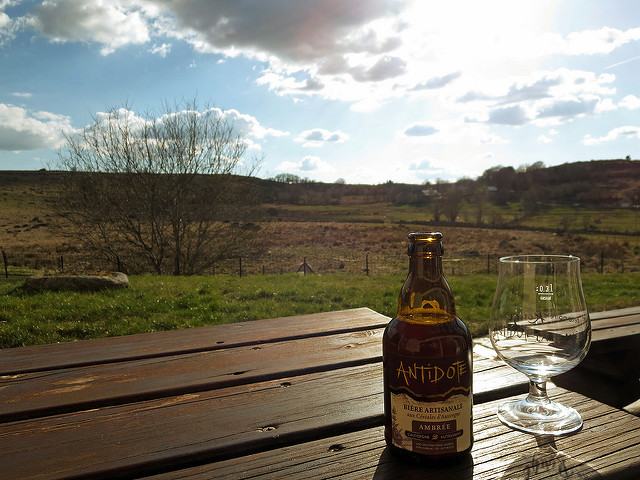
The Antidote to a long day: a beer and the stunning openness of Fineyroyls
Walking through Aubrac, Eric said, was like walking through the stories he loved as a child. These are the high plateaus of the Massif Central, irregular rolling hills of open country marked only by miles—er,kilometers—of stone fences made from the boulders that dot the landscape. We were a few days out from Le Puy, and I was still suffering through the earliest, most miserable days of toughening my feet. I arrived in Fineyrols, a cluster of houses too small to be a village, footsore and miserable. But the place has a wild, remote magic that pierced through my sulk almost as soon as I sat down.
Les Gentianes is, by necessity, all inclusive: they have private rooms in a chambres d’hotes and several dortoir rooms over a giant barn. There were no markets or churches to explore, but the front desk sold snacks and beverages, including an aptly-named local brew called Antidote, which I enjoyed on their patio during a long, sunny afternoon of watching kids make friends with the shaggy ponies in a field nearby.
But it was the food—oh, the amazing French food—that pushes this to the Top 5. The dinner they served their guests was one of the best of the entire trip. This is where I first tasted aligot, the marvel of mashed potatoes with local, fresh cheese and garlic. And every bit of the three-course meal, from the creamy vegetable soup to the tender beef tips to the fresh bread on the table, was just as good, made with just as much care. Breakfast the next morning was the same, going beyond the traditional French white-bread-and-jam with a spread of multiple breads and yogurts and enough strong coffee to send us out for another day in the high country.
I wrote a bit about our unexpected arrival in Saint-Come-d’Holt here. I was delighted as soon as we walked into the village, medieval and walled, and then discovering that our gite was actually IN the city walls sent my history-deprived American mind into giddy rapture. The narrow staircase that wound up five floors was worn concave by all of the feet that went before us. The rooms were low and narrow, with casement windows looking past the courtyard and over the rooftops and the famously twisted church spire of the old city. Saint-Come-d’Holt is tiny, just the right size to explore in an afternoon on foot with plenty of time to sit in an outdoor cafe with a Leffe and a journal.
But as much as I loved the history-filled building and the busy town, it was our hosts, Sylvain and Sabine, who made this the best night. He is Canadian, and his wife is French. They walked the Camino together in 2010, and their Compostellas hung on one wall. They were generous with their time, and not only did Sylvain teach us about Radio Camino, he also spoke with understanding about our struggles with language, distance, and settling into the whole culture of the Camino. There were only a handful of pilgrims there that night, and we stayed for hours at the kitchen table after dinner, laughing and sharing stories.
When we entered, they knew that we were “the Americans” (the only ones out there). When we left, I felt less like an outsider, and more like a pilgrim.
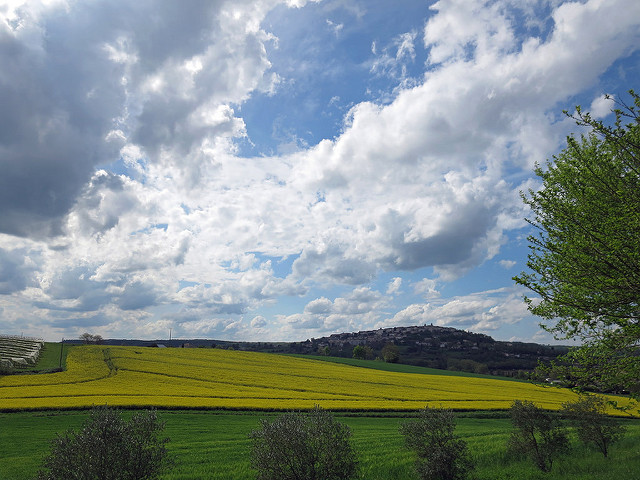
The view from Villa Venou, looking toward Lauzerte
We walked for more than two weeks, more than halfway across the French portion of the Camino, before we took our first rest day. We’d been talking about it for a week, and I was exhausted, but somehow the timing or the location was just never right. As we approached Lauzerte, we weren’t sure what to expect. It was a Saturday, and when a fellow pilgrim had offered his phone to make reservations for us earlier that morning, we’d found that the first three places in our destination town were already fully booked. Villa Venou was the fourth place we called. They advertised that they were a couple of kilometers off GR 65, the Camino path, but we could call when we got to a certain shopping center, and they would come pick us up. It all seemed complicated, and maybe even a little sketchy, but what choice did we have?
Getting off the beaten path turned out to be one of the best things we did.
Villa Venou is a centuries-old farmhouse in the country with a rolling lawn, several out buildings (including a tower with guest rooms), and a lovely, glassed-in porch where we could eat and rest, looking out over yellow fields of safflowers to Lauzerte rising on its hill. Our hosts, a Belgian woman named Frederique and her husband, provided Eric and I with a private room with a double bed, an absolute luxury after two weeks in twins and bunk beds. They opened their kitchen if we wanted to cook, or offered to make our meals if we preferred that. We knew right away that this was the perfect place for a rest day, and they were happy to let us stay an extra night. We spent a long, lazy, rainy Sunday napping, reading, and watching the light play off the city on the hill.
One of the realities of being a pilgrim is that every night is a surprise. Even if you plan a day or two ahead and make reservations, without TripAdvisor reviews or even websites with photos, the destination is no more than a name on a list. One of Eric’s favorite mantras of the trip was “sometimes you win, sometimes you lose,” and there was nowhere that’s more obvious than where we stayed.
In Auvillar, we won. The village is another of “France’s most beautiful villages,” set on a hill, with green fields and winding rivers (and two incongruous nuclear power plant towers) stretching all around it. The town really was lovely, all warm red cobblestones, bright murals, and red-tiled roofs. Late April flowers bloomed around the circular granary in the center of town, and people sat outside watching old French men playing petanque, a bocce-like game with balls and sand pits and lots of drinking.
The communal gite (run by the city) turned out to be the most luxurious municipal lodging of the entire trip. There was a two-story building made of stone, possibly an old rectory, with a full kitchen and sitting area, and a loft full of books. Outside was a walled yard with thick grass and lawn chairs. Across the courtyard was a more modern wing with double rooms (two twin beds in each) with real sheets, as well as curtains on the windows and antique cabinets and chairs. And then the real miracle: a washer and dryer that we could use for free (although all of the settings were in French and Celsius, and I accidentally somehow set my clothes on a scalding water cycle that would last two hours; but that’s another story…). I’ve stayed in hotels that weren’t nearly as lovely, and they charged a lot more than 14 euros.
Although there was room for eighteen, there were just five of us there that night, and after wandering the town and sorting out the wonder of the washing machine, we all shared the kitchen and made simple dinners from what we could find in the town’s tiny market. To have such a lovely space of our own was a total luxury.
Every so often along the Way, there’s a curious place that offers beds, food, and hospitality to pilgrims, but charges nothing in return. We’d stayed in a donativogite in Le Puy, run by the Friends of Saint James, and in another in Estaing, owned by the Catholic Church and run by two delightful nuns and a silent priest. But the heart and soul of the donativo experience, for me, was Gite Bethanieon the outskirts of Eauze, in a family’s home. Marcel and Pauline and their two small, adorable children welcomed us. Pauline, we learned, had worked for several years in the abbey in Conques, and she and Marcel had been part of the handful of residents who lived there in the off season. When they left (it’s hard to raise children in a town with only 17 year-round inhabitants, most of them monks), they wanted to continue to support pilgrims somehow. So they turned the second story of their home into a refuge, with a kitchen, dorm rooms, and bathrooms. “We want to treat everyone who passes through our home as if they’re Jesus,” he says, and my jaded heart melted a little.
There were three of us there that night—Eric, me, and our friend Amanda, who we’d been walking with for a week. Marcel brought us a simple, homemade dinner and ate with us while Pauline stayed downstairs with the kids. They alternated every night, he said, so tomorrow Pauline would visit with whatever pilgrims needed a place to stay, and he would eat with the children. He asked for our stories and shared his own.
I loved their honesty, their humility, and the simple way they lived out their faith. To them, this is still a holy pilgrimage.
Bonus (just a bit off the Way)
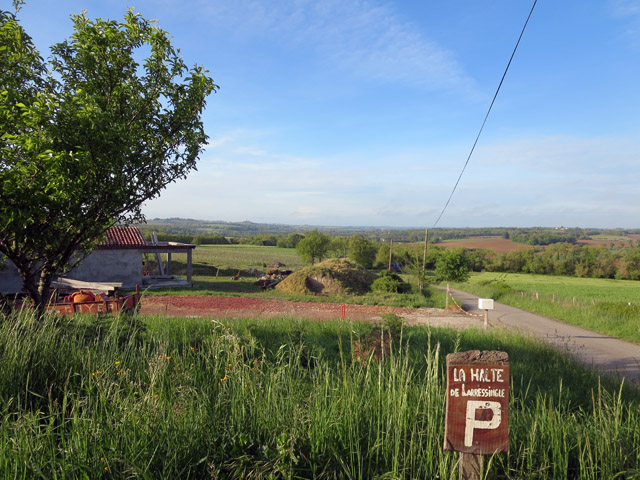
We arrived in a pouring rain, but the morning we left Larressingle was a beautiful blue.
Just past Condom (yes, that’s the name, and no, the French didn’t find it nearly as amusing as we did), there’s a variante route that will take you off GR 65 for five kilometers or so to Larresingle, which was the bishops’ fortress in times of war…or it was their country estate. My translation skills were weak, and it was pouring rain when we walked through the walled town right out of a Renaissance festival, so there was a lot that I missed. But it’s a worthwhile side trip.
In Larresingle there’s also a private gite, La Halte de Larressingle, owned by a chatty, organized, take-charge, fluent-in-English woman named Martine, who walked the Camino herself in the 1970s, long before there were designated hiking trails or pilgrim accommodations. A few years ago she bought an old ruin of a house and renovated it all herself. Now she runs it all herself.
Her home is in the country, far from services and a kilometer or two from the tourist attraction of the Larressingle castle. This was where we saw the Pyrenees for the first time, faint shadows on the horizon, still almost two weeks away on foot. Staying here is the quintessential Chemin du Puy experience, and what sets the French Camino experience apart from the more popular, and populated, Camino Frances. At most, Marine can probably host a dozen people.It’s remote and quiet, with every detail carefully thought through and every need met right there, and not much to do except talk to fellow pilgrims and play with the dog. Martine herself is a blur of words and energy, making multi-course dinners every day while also filling us with stories, advice, and welcome company. The night we were there, she made seven of us an incredible dinner, of which the crowning glory was a dessert cup of preserved prunes, creme fraiche, sugar, and a generous shot of armangac, the local alcoholic specialty.
Eric still talks about that dessert.
How about you? If you’ve walked the Chemin de Saint Jacques in France, what are the places you’ll never forget?



















 camino times two