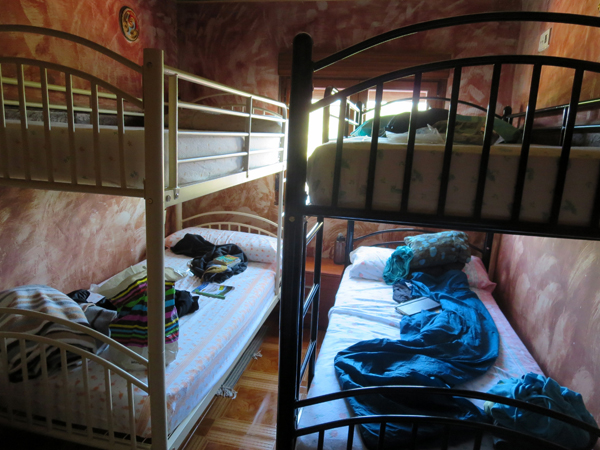
Here’s another question people ask when they hear that we spent almost all of our 79 Camino nights in shared rooms, sometimes with as many as 50 other people.
What do you do about the snoring?
I could make a joke here about how most of us who are married are used to sleeping a foot away from sonorous breathing, and a bunk bed actually moves it farther away, but that doesn’t really answer the question.
The answer is that you just live with it. Some lighter sleepers used ear plugs. Most of us found that we were so tired at the end of a day (and that’s 9 or 10 o’clock, by the way; no late-night partying here) that we could sleep through almost anything.
Here’s the thing. If you’re going to walk any portion of the Camino and plan to stay in albergues/gites/refugios, you will be sleeping in rooms with other people. I guarantee that someone is going to be making noises in the middle of the night. Often it’s multiple someones, in an asynchronous chorus coming from every direction.
That’s just part of the experience.
Most pilgrims are well north of our 30th (or 50th) years. We’re not kids in summer camp anymore. We ALL snore at some point. After one too many glasses of wine, or when the allergies set in, or when we sleep in certain positions, or when we hit a certain stage of deep sleep.
You are going to snore, too, and other people will hear you.
Sleeping in close quarters in Villacaval
Somewhere in Spain, I was talking about this with a woman I’d met a few times on the trail, but had never shared a room with. She was complaining about the snoring that had kept her awake the night before.
Just to be clear: she was complaining a LOT.
To try to neutralize her, I made my “everyone snores” argument.
“Not me,” she said. “I never snore.”
“Well…” This came from another pilgrim in earshot—a sweet, generous, always positive person who’d been traveling and staying with this woman for many days. “Actually, you do. Most nights, in fact, after you’ve been asleep for a while.”
The woman was aghast and defensive, but it was hard to dispute the testimony. She changed the subject shortly after.
So, future pilgrims, if you’re light sleepers, pack some good, reliable ear plugs. Or choose to stay in private accommodations, of which there are plenty. Then the only noise you’ll hear in the night is yourself. But think twice before you start complaining too much…somewhere on the trail, someone is complaining about you, too.
Also, if you’re worried about snoring, remember it could be (and might be) worse. My most uncomfortable night was spent two feet away from a man who not only snored, but he talked AND SANG in his sleep. Seriously. I think it was opera, but just a bar or two at a time. He’s the only person on the whole Camino who, after that one night, I would see entering an albergue and change my plans. I’d learned the hard way I can sleep through anything except an aria.
A few days into our Camino, as my feet were slowly, finally, maybe starting to adjust to long days and the extra weight of a pack, Eric’s turned against him. His shoes cut awkwardly into his Achilles tendon, causing pain. So he switched to sandals, but those caused a dreaded ampoule—a blister.
Wearing his sneakers protected his blister, but ate into his ankle. Wearing his sandals protected his ankle but rubbed the blister on his toe. He soaked his feet in an icy stream until they were numb one morning, but found little relief when we were moving.
He was miserable. I was always looking for a reason to cut a day short. So as the spires and towers of Saint-Come-d’Olt spread out in front of us, we decided to forget the reservation we’d made in a town still ten kilometers away. The guidebook said there was a gite communal here, and even indicated that they spoke English. If they had room, we would stay and be done for the day.
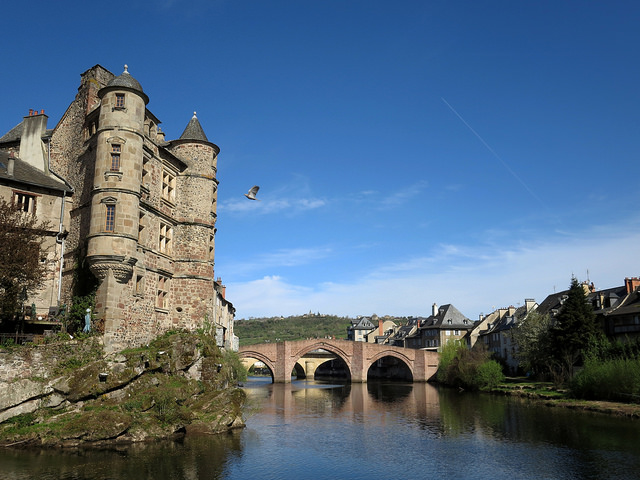
The heart of Saint-Come-d’Olt is round, walled, and gloriously medieval, dating back to the twelfth century.The gite is just inside the gate, set right inside the thick city walls. A door led us up a steep set of stone steps, deeply rutted by thousands of feet that had passed the same way. In a long, low-ceilinged kitchen, the gite host welcomed us in English.
“You’re the Americans! I heard you were coming!”
Wait, what?
“We didn’t know until ten minutes ago that we were coming,” I stammered. “How did you…who would have said…”
He laughed, and waved us to rest at the table.
“It’s Radio Camino,” he explained. “When pilgrims have all day with nothing to do but walk and gossip, there are no secrets along the Way.” A faster walker had seen us a few days before, then stayed here. It was a natural piece of conversation to tell the Canadian host about two Americans who were a day or two behind.
Radio Camino at work
That was just the beginning of Radio Camino. The host was right. Pilgrims talk about each other—where we stay, where we’re from, what we’ve seen, who we’ve met. Radio Camino warned us about the two French women with the bad habit of turning on overhead lights when they went to the bathroom in the middle of the night, and reassured us that our Dutch friend Jan—a solo walker with a particularly memorable gait—was still plodding along about half a day behind us. We heard that our English friend had found a “special someone” long before we saw them walking together, hand in hand.
In my experience, pilgrims rarely talk about world events or politics. We don’t brag about our jobs or what kinds of fancy grownup toys we have at home. None of that matters here.
Instead, Radio Camino focused on what mattered today:
Are you staying in Espalais, or will you walk on to Auvillar?
Remember that tomorrow is a holiday (or a Sunday, or a random Thursday) and the shops will be closed.
There are three albergues in this town; which one will you choose?
Do you know where the German couple is staying? I’d like to meet them again.
Do you see that man in the corner? He’s a terrible snorer; don’t get a bed near him if you can help it.
Radio Camino says that you are planning to cook a meal in the gite tonight. May we join you and share?
We knew who had a late start because they were hung over, who had terrible blisters, and who took shortcuts. When a stomach bug ripped through many of the pilgrims in Spain, we knew who had taken a rest day or two to recover.
Sometimes Radio Camino spread rumors and fear. We heard, early in our trip, that an older woman we’d met had been physically assaulted and robbed along the way. Two weeks later, we ran into her again, carrying all her belongings and with no such story to tell.
But mostly Radio Camino was kind. When my husband, blisters and tendon long healed, went charging up steep mountains like a mountain goat, Radio Camino buzzed. A friend we hadn’t seen for several days had us in hysterics one night describing how “women of a certain age” at dinner tables all along the Chemin du Puy were talking about “that American with the warm brown eyes.”
Some digitally-connected pilgrims used WhatsApp or Facebook Messages to stay connected. Those of us who were offline relied on the network of walkers, some faster and some not, to spread news up and down the line. In 79 days, I never once thought about plugging in headphones or tuning in to some other frequency. Radio Camino turned out to be better than any playlist or podcast to pass the time.
At one point or another, every Camino alum starts making Top Five list. The Best Albergues. The Best Meals. The Best Days.
I love reading these stories, because sometimes I recognize the places they describe…but more often I don’t. Pilgrims stop in different towns, or stay in different places, or the weather and the people just give them a different experience. There are a million ways to walk the Camino.
So I don’t claim that these five are “the best” albergues on the Camino Frances, but here are the five places that I’ll never forget, in the order I encountered them.
Despite the fact that I spent two lovely days here, I never took a single photo. Blame the stomach bug.
I’d picked up a nasty stomach bug as we walked across the Navarre region, and was still feeling weak and nauseous when we arrived in Viana. We stopped at the first albergue we saw,Izar, a spacious, clean, modern townhouse with a well-stocked, open kitchen area for preparing meals, and a sunny rooftop deck for lounging and napping. So much communal space encouraged pilgrims to relax and visit. The patriarch of the hostel was a grandfatherly man who spoke only Spanish, and who cooked for his family in the same kitchen the pilgrims used.
After a long nap, a mild dinner, and some good conversation, I was finally feeling better…but then Eric came down with the same bug that I was just getting over. Not to be graphic, but this meant we would need to stay off the trail and close to bathrooms for a day or two. So the next morning I approached our host and, in broken and terrible Spanish, explained the situation. Could we stay here for another day, perhaps move out of the dorm and into one of the private double rooms, so that Eric could rest? Of course, he said. No problem. Although it was only eight in the morning, they had a room cleaned and ready for us in 15 minutes, and Eric settled in to let his gut heal. That evening, the patriarch insisted on making us a “healing soup”—a salty broth with rice and bunches of his own fresh herbs. And when he found out we needed to be ten kilometers away in Logrono the next day to meet a friend, and the buses weren’t running, he arranged for someone to drive us there.
I’d struggled up to that point with the Camino Frances, as I tried to adjust to the flood of pilgrims who walk across Spain, compared to the intimacy and closer community of the Via Podensis. In France, most gites made us feel like welcome guests; in Spain, too often I was feeling like a transaction. But in Viana, I was more than just a few euros and another body in a bed. We were welcomed and cared for. (It was an important lesson, and for the rest of the trip, we usually chose to pay a euro or two more for a smaller, privately run albergue over the bigger, more institutional municipal.)
I’ve written aboutour night in Rabanal, the town of heavy stones and good soup,already. The Refugio Guacelmo, run by the British Confraternity of St James, is open only to unsupported walkers (no baggage service or bike teams here, and no reservations), and so at the end of a rainy day all of the pilgrims arrived with dripping backpacks and soggy sleeping bags, soaked to the skin after a long day of hiking in steady rain.
The volunteers welcomed our straggled, hungry group with humor and efficiency. They had piles of newspapers to dry our shoes, and lines sheltered under porches to air out our wet things. (They also had a huge, open lawn that I suspect is a lovely place for tired pilgrims on sunny days.) One of our hosts, a woman who bore more than a passing resemblance to Dame Judi Dench, watched Eric strip off his soggy socks. She didn’t comment on the mud he dragged in, but instead complimented, as only the British can, his “gorgeous-shaped toes.” They served tea at five, and of course the monks from next door dropped by. That evening, after more soup and wine, we made our way across the street to listen to those same monks sing vespers by candlelight in a humble and ancient church. The whole thing felt like my earliest dreams of what the Camino should feel like.
We walked to Villafranca de Bierzo, deep in the rolling hills between Leon, Castile and Galicia, without knowing where we wanted to stay. The guidebook mentioned two albergues on the edge of town, both which had mixed reviews. Neither felt right. Then, about five kilometers outside town, I noticed one of the ubiquitous fliers stuck to trees and fence posts, advertising the next town’s bars and lodgings. Albergue San Nicolas, it said, was a brand new albergue for pilgrims. It was the picture that caught my eye. Were those twin beds? Yes, the sign specifically bragged that there were no bunk beds. I was sold.
But where was Albergue San Nicolas? There was no address on the sign, and it was too new to be in our guidebook. At the end of a long day traversing rolling hills, the last thing I wanted to do was go wandering in circles all through a town. Should we just play it safe and stay in the place in the guidebook? But wait, there was a Convent San Nicolas here on the map, a historic monument dating back to the seventeenth century. Maybe Albergue San Nicolas would be near that?
The risk turned out to be worth it. To our surprise and delight, Albergue San Nicolas isn’t just NEAR the convent. It IS the convent. The Church has sold the building to private owners, who are converting it into a hotel and albergue. The building is cavernous and beautiful, with wide cloisters overlooking the courtyard, high ceilings, and bright murals on the walls.There’s a friendly bar with a good patio, and it’s just a few blocks from the main square, full of open-air restaurants and outdoor markets. For eight euros each, we had twin beds in a spacious corner room, shared with only one roommate. And a private bathroom! This was, by far, the most luxury we experienced in an albergue anywhere in Spain.
From Villafranca de Bierzo, most pilgrims hike along the road through the valley and then, at the end of the day, up a steep mountain to the popular tourist town of O’Cebreiro, at the edge of Galicia and one of the highest points of the Camino. But after we added few extra kilometers in the morning by taking a scenic detour along a quiet ridge line (completely worth it), we decided to break up the rocky mountain climb, made slick in an afternoon rain shower, by stopping in the tiny hamlet of La Faba, about five kilometers short of the summit.
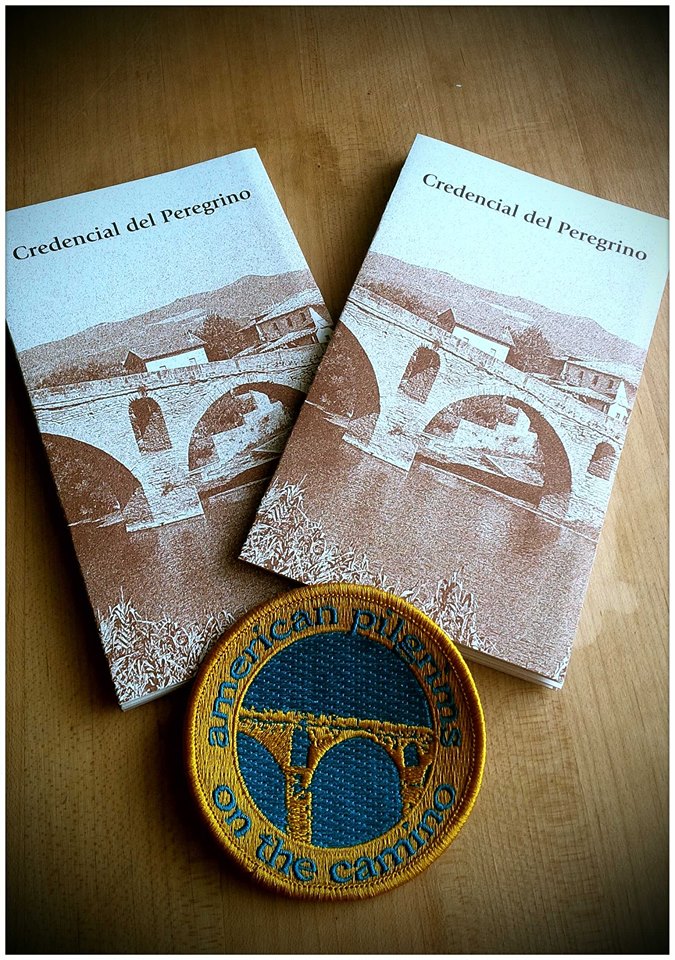
La Faba has maybe thirty residents, an equal number of cows, and an albergue run by the German Confraternity of Saint James. (The Germans chose to serve the Camino in La Faba because of an centuries-old German poem that eulogizes the German pilgrims and pious men who died on the way to Santiago. One of the lines basically reads, “The sons of Germany are buried in La Faba” — a phrase that they replicated, rather morbidly, in their credencial stamp.) The albergue is tucked at the end of an overgrown lane, built where the rectory once stood next to the local church. The rain left a chill in the air, even in late June, but inside the stone chapel a bank of prayer candles made the small space warmer. We lingered there in the dark for a long time…there wasn’t much to explore in a town with only one cafe and a shop the size of my sofa at home, and the albergue had quickly filled to capacity.
If Albergue San Nicolas had amazed me with its spaciousness and its easy access to the sights and conveniences of town, La Faba drew me into close quarters with my fellow pilgrims. There wasn’t much indoor communal space, and the rain kept falling all evening, so we crowded together in the kitchen and made a second batch of mulled wine. The volunteers were gracious and efficient, with a bit of humor and an obvious love for the Camino. (And as a bonus, the final climb into O’Cebreiro the next morning was a misty, dew-filled, peaceful walk…one of the most magical moments of the Camino for me.)
The predicted crowds descended on us in Sarria, as thousands of people join the Camino for the last 100 kilometers.We’d been traveling for 72 days, we’d had a rough night in Palais de Rei surrounded by nightlife-loving, hair dryer-using tourist pilgrims, and my “practice acceptance” zen was wearing thin. But then we stopped in Ribadiso.
It was a hot, sunny afternoon in late June, and the municipal albergue in this little village just short of Arzua is tucked on the bank of a stream that’s just the right depth forwading on a hot summer afternoon, in the shadow of one of the Camino’s perfect stone bridges. It’s unusually picturesque for a municipal, a cluster of stone buildings that was a pilgrim hospital centuries ago. The low ceilings and rough wooden floors in the sleeping area stayed cool against the sun, and there were nooks and corners everywhere to explore. Most of the crowds (especially the newcomers) went on to the bigger city of Arzua, and I spent a lovely, quiet, lazy afternoon lounging in the grass and watching the cows graze just a few feet from the bathroom pavilion, and then sipping sangrias on an outdoor patio at the only bar in town, while chickens pecked under the tableslike they were city pigeons. With just a few days left to Santiago, and in the warmth of the long summer evening, everyone was feeling festive and free. we caught up with friends we’d met a month before, and heard a few new stories, as well. As the sun went down a group of young pilgrims pulled out guitars and sang under the stars, on the banks of the stream.
How about you? Where are the albergues you’ll never forget?
We leave in 16 hours. The bags are too heavy. I don’t know the languages, and I’m told my accents are atrocious. I have barely trained. The house-sitting/pet-sitting plans are held together with thin threads that may snap. I am a messy ball of nerves.
And yet, I will walk, and it will be okay. Whatever this adventure is going to be has already begun as I peel my fingers, one by one, from my expectations.
It was so much better, and harder, and more than I ever expected.
My schedule has really ramped up over the past couple of weeks, and I’m feeling the pressure. Or at least I was, until I came across a link to this video in the Via Podiensis Facebook group.* And then I slipped back into the rolling hills and easy pace of the French countryside.
If you’re considering walking the Way from Le Puy, or if you just need a few minutes of daydreaming, check out these scenes from the Chemin du Puy (also known as the Via Podiensis or the Chemin vers Saint-Jacques-de-Compostelle) as it winds through the Aveyron region of France.
If you leave from Le Puy, this is what you’ll see in your first two weeks of walking, including France’s “most beautiful villages” of Saint Come d’Holt, Espalion, Estaing, and Conques, and the stunning high plateau pastures of L’Aubrac. Crumbling castles and curious cows abound, and the whole thing really does feel like a fairy tale.
*If you’re thinking about walking the Camino from Le Puy, this Facebook group is an invaluable resource. Not only can you ask questions of alumni pilgrims, but there are also pages of printable resources, including a list of gites in each town along the way that saved us time after time.
One of the wonderful things about following the Camino de Santiago (the Chemin de Saint Jacques) across France is that almost all of the churches and chapels are open, all the time.
In Spain, to my disappointment, most of the churches were locked, or charged entrance fees. The logical part of me understands; with a ten-fold or more flow of pilgrims, and a tough economy, the upkeep and maintenance of an open chapel along the Camino Frances would be much harder than along the Via Podiensis. But still, these are sacred spaces specifically built for pilgrims, and it’s rather un-church-like to charge admission.
However, that’s not the point here.
If you venture into the churches and cathedrals of the Camino, you’ll notice a lot of saints. They’re depicted in the windows, on the walls, and tucked into every spare corner. These men-and a surprising number of women-were the object lessons and moral guides of an earlier, pre-literate time.
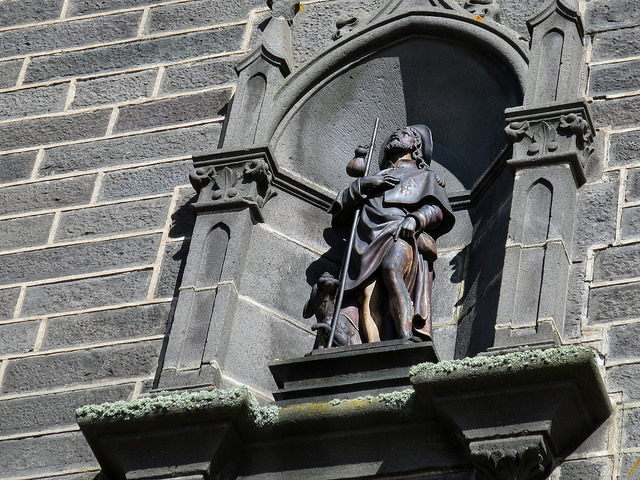
You may notice that a particular saint shows up often among the statues and the paintings. He’s dressed as a pilgrim, with a cloak and a floppy hat and often even the scallop shell of Saint James. But he’s not Saint James.
You can tell because this particular saint is always standing a certain way.
Saint Roch and his easily-recognizable thigh
“Why is he showing so much leg?” I asked Eric, early in our adventure.
Because no matter how simple or elaborate his presentation, Saint Roch is always, always hiking up his robe and showing off his (usually well-muscled) thigh.
The patron saint of burlesque, maybe?
It took a little time to get the story straight (and in English). Like many stories that are 800 years old, many of the details are inconsistent. But here’s how it goes:
Saint Roch was probably a French noble in the early fourteenth century. The legends say that he was marked from birth by a red cross on his chest, a sign of his piety even as a small child. When he was twenty, both his parents died, and Roch gave up his inheritance and his position in the community, sold all of his possessions, and set out on a pilgrimage to Rome. (hence his pilgrim garb) This being the Middle Ages, there were plagues and mysterious illnesses afflicting many of the towns along the way. Roch stopped often and cared for the sick and dying in Italy, often healing them miraculously either by touch or the sign of the cross.
But hanging around contagious people has its price. Eventually Roch contracted the plague himself, and he went to the woods to die. He built a shelter of branches, and a spring of water rose miraculously from the ground to provide him with a steady supply of fresh water. Then a dog—the hunting dog of a local nobleman—began to bring him bread. (okay,that explains why he’s always with a dog) The dog licked his plague wounds, which began to heal. (ah, he’s not flashing the audience; he’s showing off a plague wound on his leg, of course)
Miraculously cured, Roch returned to France, where he was arrested by his uncle, who did not recognize him and accused him of being a spy. Roch did not reveal his true identity, because he did not want to glorify himself or draw attention to himself. He died, still in prison, five years later.
I loved Saint Roch, and the quirky, illogical flow of his story. I looked for him everywhere we went. And he really was everywhere; Saint Roch is a favorite saint of pilgrims. Perhaps for this reason, or because of the floppy hat and walking stick, many people consider Saint Roch as the patron saint of pilgrims, although the reliable Church sources give that distinctionto Saint James himself.
Saint Roch is definitely a guy to keep around on your Camino, though, as the patron saintnot only of dogs (of course), but also of knee problems. So think of him every time you’re descending into one of those steep French valleys.
Or stop in one of his chapels and just admire that problem-free knee.
Saint Roche, his dog, and his fabulous thigh in the cloister museum of Santo Domingo de la Calzada
There’s a lot to love about the Camino. However, Spain’s pilgrim menu dinners are generally not high on anyone’s list.
Sure, they’re cheap (10 euro for three courses, plus wine). And it’s predictable, which can be comforting in a strange culture.
But it’s so, SO predictable.
There’s the first course: salad, complete with a dollop of tuna and a hard-boiled egg, or lentils.
There’s the second course: lomo and papas fritas. Or maybe chicken. When you’re really lucky, trout. But always,ALWAYS the fritas.
There’s dessert. Do you want flan, helado, or fruit?
But then, as we neared Galicia, something new started appearing on the Pilgrim Menu.
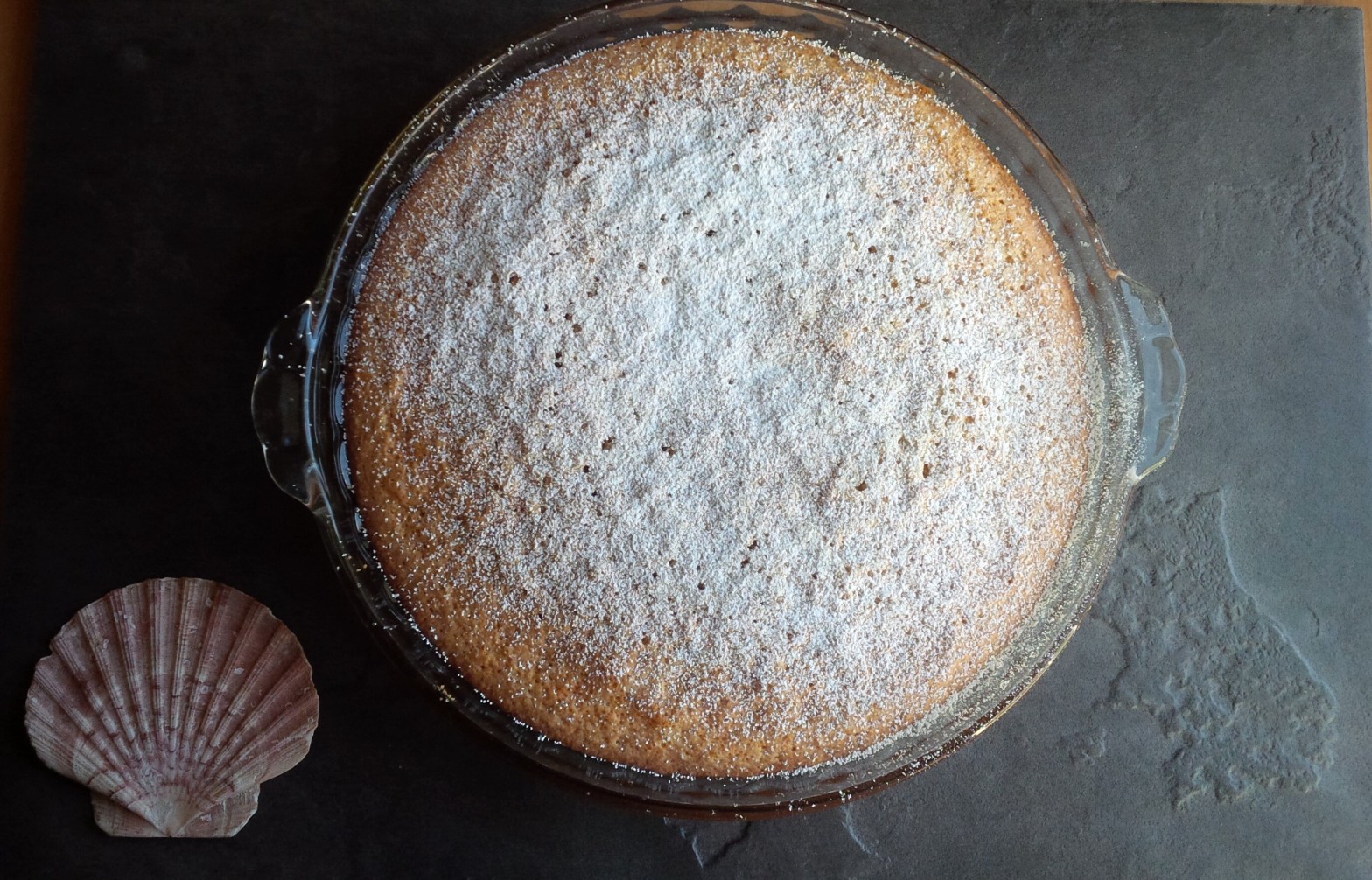
Tarta de Santiago.
A Santiago cake? Yes, please.
My tarta de Santiago
It was delicious. Simple and nutty, not too sweet.
Three weeks after we came home, I made Eric a tarta de Santiago for his birthday. And then this week, as I’ve been buried deep in writing and editing The Book, the urge appeared again. So here, for alumni pilgrims homesick for a taste of Spain, is a moment of (gluten free, protein rich) nostalgia. (Recipe slightly altered fromthis one at Epicurious)
Grated zest of 1 orange or 1 teaspoon of orange extract
Grated zest of 1 lemon or 1 1/2 teaspoons of lemon juice
4 drops almond extract
Dash of cinnamon (optional, but it makes it smell so good)
Confectioners’ sugar for dusting
To prepare:
Finely grind the almonds in a food processor. (Make sure they’re really, really ground.)
With an electric mixer, beat the egg yolks with the sugar to a smooth pale cream. Beat in the zests and almond extract. Add the ground almonds and mix well.
With clean beaters, beat the egg whites in a large bowl until stiff peaks form. (If you don’t have electric beaters and are trying this by hand, be prepared for it to take a while…and for some sore arm muscles). Fold them into the egg and almond mixture (the mixture is thick, so that you will need to turn it over quite a bit into the egg whites).
Grease an 11-inch springform pan or other round cake pan with butter and dust it with flour. Pour in the cake batter, and bake into a preheated 350°F for 40 minutes, or until it feels firm to the touch. Let cool before turning out.
Just before serving, dust the top of the cake with confectioners’ sugar.
Or, if you like, cut a St. James cross out of paper. Place it in the middle of the cake, and dust the cake with confectioners’ sugar, then remove the paper.
Serve with vino tinto, of course.
What foods did you start making after your Camino?
2. Did you get bed bugs after sleeping in all those places?
Again, nope.
In 79 days, we slept in 75 different beds. Most of those beds were in gites and albergues, in close quarters with plenty of other people who were also moving from bed to bed.
Yet we didn’t carry or use any special chemical treatments to avoid bed bugs. We weren’t particularly vigilant about inspecting a place before we settled in for the night. Really, we’re just not the overly cautious or concerned types.
And yet not only did we never get bed bug bites, I only remember meeting one person along the way who did.
Maybe it’s because we traveled early (April-June, before the real crowds descend).
Maybe we were just lucky.
Maybe the bed bug rumors and scares are bigger than the actual threat.*
I can attest that the gite and albergue owners and managers along the Camino take the bed bug threat seriously. There were literature and lectures almost everywhere we stayed, although the actual rules and procedures varied widely.
Some places required that we leave our packs in lockers outside the sleeping area, and gave us baskets to carry only the belongings we needed to our beds. (Yet they were fine with us putting sleeping bags or liners on the beds…???)
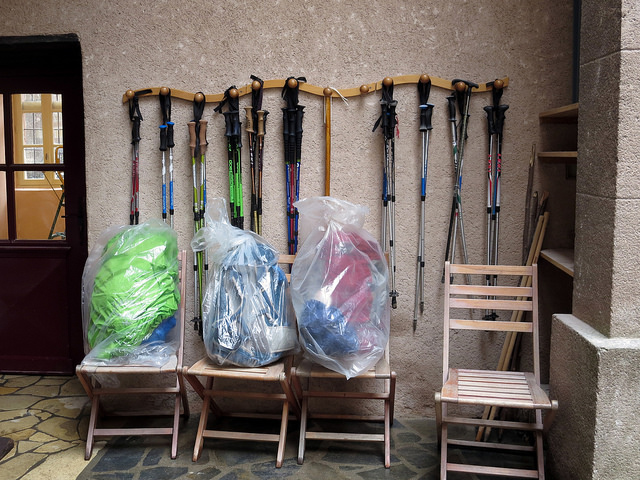
Some places required that we disinfect our bags on arrival, usually by putting the entire pack, and all its contents, into a chemically treated plastic bag. (It smelled terrible, and the resulting noise of a dozen or more people trying to root around in their plastic-encased sacks made my skin crawl as if there were bugs…)
Chemically quarantining our bags in Conques, along the Chemin du Puy
One albergue forbade us from using our own sleeping bags, and instead provided their own sheet sacks and blankets. (One less thing to pack in the morning? Well, okay. As long as they didn’t mind me using my own pillow.)
Mostly, the guest houses and hostels of the Camino ask that you pay attention. That if you see any sign of bed bugs you report it, and that if you have bugs you deal with them immediately, before you carry them into the next albergue.
As far as we could see, it appeared to be working.
Now, if we could only do away with all those plastic bags…
*According to the Confraternity of St James, who as far as I’m concerned are the ultimate English-language experts on the Camino, there was a serious bed bug problem a few years ago, beginning in about 2006. Since then, albergue owners and managers have stepped up prevention measures, and at least anecdotally, fewer people see to be reporting a problem.
I’ve been getting serious again about the book, and have (finally) been making some progress. Here’s a bit of Chapter Three, still tracing the early days of our walk from Le Puy.
I felt good that night, surrounded by a people from all corners of the globe, enjoying the wine, feeling secure that my basic needs of the next twenty-four hours were covered.
And I felt good the next day as the now-friendly and familiar faces gathered around the breakfast table. I was settling into the French routine: the bowls of coffee; the untoasted bread; the rhythm of getting the pack on, straps adjusted, shoes tied just so. Eric and I had left St Privat alone, but we left Sauges surrounded by what we called our first pod of pilgrims.
Together, we passed fruit vendors setting up for an outdoor market, and followed the red and white stripes that marked our path around corners and through town, to the bridge that sent us out into the countryside again.
The Belgian and the Smoker eventually outpaced us, waving goodbye as they set off briskly. Eric and I meandered along with Eugene, pausing to admire the stone crosses by the roadside, which had encouraged workers of another time to both piety and hard work.
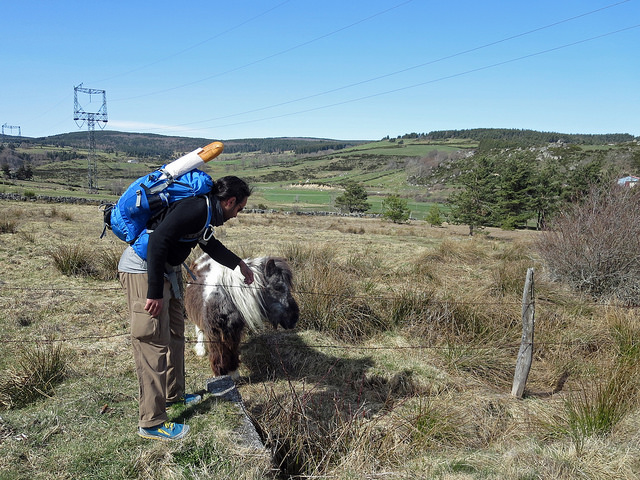
The wind did no favors to our baguette, which we’d unwisely left whole, sticking out of a side pocket of Eric’s backpack. Exposed to the air, by the time we stopped for lunch it was as dry as a crouton.
New Camino lesson: just because a baguette sticking out of the bag looks good in the pictures doesn’t mean it’s a good idea. You’ll end up with a giant crouton for lunch.
The nip in the air and the bite in my calves told me we were gaining altitude. The wind was steady and working against us, but the climb wasn’t as steep as the day before. We arrived at our destination, a tiny village set deep in a valley, hours before most gites even opened.
We tracked down our host, a sullen woman who managed both the local bar and the only pilgrim accommodation in town. She spoke no English, but took our money and pointed us to an empty room full of twin beds.
The long hours of the afternoon gave me plenty of room for doubts. Should we have kept walking? Tried to push ahead another fifteen kilometers?
Was I a wimp? Was I failing as a pilgrim?
It was hard to let go of those ideas as I watched figures trudging past us throughout the long afternoon. Hard to not make this a competition, or at least a comparison. Everyone we knew went farther that day. Why didn’t we?
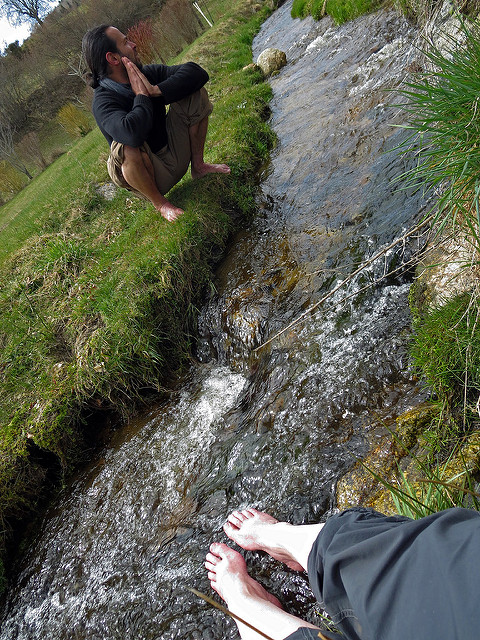
Cooling my heels in a mountain stream in Chanaleilles
I cooled my tender feet in a frigid mountain stream and reminded myself again and again that we didn’t have to rush, that most of the people we’d met were on a tighter timeline and were only walking for a few days or weeks. Eric and I were pacing for a marathon, not a sprint.
Then I told myself again that this wasn’t a race at all, that this was the only time I was going to be in this place, and if I rushed through, or if I pushed so hard that I really injured myself, I would miss something lovely, and for what? It was only April. Our flight home didn’t leave until July, regardless of when we reached Santiago.
I was where I should be.
Sometimes I even believed myself.
The question of distance plagued me, on and off, throughout the Camino. We met pilgrims who walked thirty or forty kilometers every day. For me, even after two-and-a-half months, thirty was pushing my limits. (Our record was thirty-five, but that was an accident, and another story for another day.)
I missed the pilgrims who pushed on, and who we never caught up with again.
And yet.
Looking back, there’s not a single day when I think “I wish we’d gone faster or farther,” but there are plenty of places I remember and think “I wish we’d lingered.” I would love to have a few more days in Aubrac, in Galicia, in Pais Basque. I’m glad that we walked only twelve kilometers on the Feast Day of Corpus Christi, and stopped in time to watch the residents of a small Spanish town parade with the statue of the Virgin Mary and some sketchy fireworks. I’m glad that we arrived most afternoons with time to share stories and beers with other pilgrims.
I know that every single day, whether we walked five kilometers or thirty-five, gave us what we needed.
And in the end, we all ended up in the same place.
So if you have the chance, take your time. Walk as few miles as you can each day, and give yourself time to soak your feet in the stream, or explore the abandoned-looking chapel. You won’t regret it.
I spent last week on vacation, the first that Eric and I have taken since we got back from our Camino adventure eight months ago.
Where did we go? To a place full of hiking trails, of course!
Hiking the Sunshine Coast Trail, British Columbia, Canada
The Sunshine Coast Trailis a 180-kilometer through-hiking trail in British Columbia, about seventy kilometers north of Vancouver. Despite it being so close to the city, it’s largely undeveloped (probably because there are few roads, and it takes two ferries to get there), full of old-growth forests and overgrown logging roads.
It’s February, it’s raining, and there are no pilgrim hostels along the trail, so we rented a cabin nearby and indulged in backpack-free day hikes through old growth forests and along rocky bluffs overlooking the Salish Sea. And I remembered that feeling that only comes when you unplug all electronic devices and go OUTSIDE, for hours at a time, through remote and stunning corners of the world.
As I was walking (or standing, breathless at the top of another steep hill, rewarded with a new view), this was the song on repeat in my head. It was one of my Camino regulars, too.
I see trees of green, red roses too
I see them bloom for me and you
And I think to myself
What a wonderful world
I see skies of blue and clouds of white
The bright blessed day and the dark sacred night
And I think to myself
What a wonderful world
It may be a while before I can get back to the Camino, but the experiences keep living on, and influencing every day.












 camino times two