Camino del Norte Packing List

I’m 36 hours from departure for the Camino del Norte, and so this afternoon I gathered all the things to see what I have.
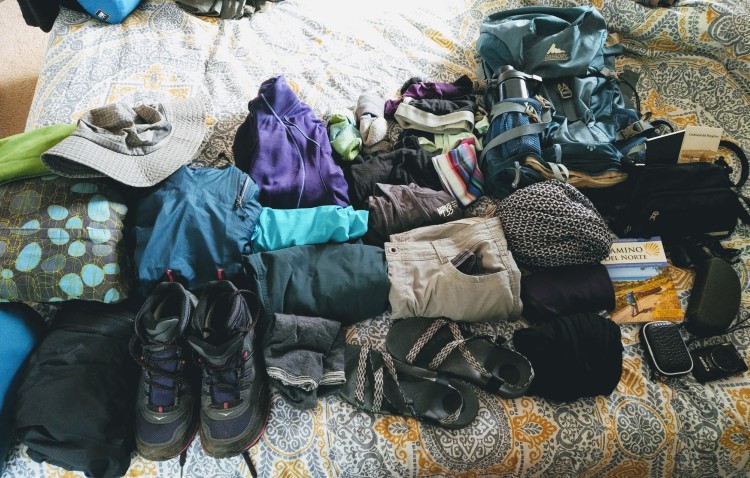
IMG_20180506_1703402

This is my third Camino, so certain things are familiar (same backpack, sleeping bag, pillow, towel, etc.)

But once again, “what to wear” was a question that needed some thought. In 2015, I packed for three months and temperatures that swung from “snow still on the ground” to “heat wave” (click here to see the list).  I was also gone for three months, so I gave myself latitude to splurge on a few extras. Last year, I was only going for 12 days in the heat of August, so I cut way back on the clothes (see Summer Packing List here).

This time? I’m somewhere in between. I have 17 days of walking, so I don’t need a lot of clothes. But the weather reports from Camino del Norte are full of rain and wind, so I’ve added some things I didn’t have before, like rain pants.

I’m still working out a few details, but here’s the plan, with brands listed and links to individual items where possible.

Supplies:

Clothes:

 IMG_20180506_1650074

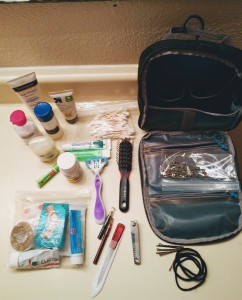
Cosmetic/Supply Bag:

  • Shower bag (REI with hook, no longer available)
  • Bar soap
  • Travel-sized toothbrush
  • Travel-sized toothpaste
  • Razor
  • Travel-size hairbrush
  • Travel-sized deodorant
  • Travel-sized conditioner
  • Travel-sized hair lotion
  • Safety pins
  • Hair elastics
  • Eyeliner pencil
  • Nail file
  • Toenail clippers
  • Q-Tips
  • Ibuprofen tablets
  • Feminine products
  • Lotion
  • Sunscreen

 Other:

  • Passport
  • Camino credential
  • Small nylon cross-body purse to keep cash/passport/credentials
  • Camera (Canon Powershot Elph)
  • Cell phone (with Kindle app for reading)
  • Journal and pen
  • Headphones
  • Charging cords for the phone and camera, plus a European outlet adapter
  • Quart and gallon-sized Ziploc bags to store food and keep valuables dry in rain
  • Tall kitchen trash bags to line inside of pack during heavy rain
  • First aid kit: Band-Aids, antibiotic ointment, tweezers, needles and thread (for puncturing blisters), disposable lighter (for sterilizing needles), athletic tape, massage ball
  • Granola bars (to get through the hangry moments in the first couple of days, until I get the rhythm of when and where to buy food).

When we arrive in Spain, we’ll buy a pocket knife and trekking poles, since we can’t carry those on a plane.

I haven’t weighed it yet, and probably won’t. These are the things I need and/or want, my luxuries are small (really, does an eyeliner pencil even weigh enough to register?), and I’m prepared to carry it.

But if you were me, is there anything you would add?


Walking “the Whole” Camino

I saw another article this morning that referred to “the Camino de Santiago, a 500-mile walk that stretches from the French border to the city of Santiago de Compostela.” The mistake was made by a reputable travel site, so I considered writing a polite letter to the editor, pointing out their error.

But if I tried to take on that kind of project, I’d be writing a lot of letters.

Is There a “Whole Camino?”

As my departure date for Camino del Norte draws near and my excitement (and incessant talking) increases, several people have asked me: “But I thought you already walked the whole Camino. Are you going back to do a section again?”

When a friend posted a note about my upcoming book, someone responded, “But she couldn’t walk a thousand miles. The whole Camino is only half that.”

Lots of people, when they tell our story, say that Eric and I walked “the whole Camino.”

But the thing is…there is no “whole” Camino.


Ways_of_St._James_in_Europe
By Manfred Zentgraf, Volkach, Germany (Manfred Zentgraf, Volkach, Germany) [CC BY-SA 2.5 (https://creativecommons.org/licenses/by-sa/2.5), GFDL (http://www.gnu.org/copyleft/fdl.html) or CC-BY-SA-3.0 (http://creativecommons.org/licenses/by-sa/3.0/)%5D, via Wikimedia Commons

A Network of Trails

The Camino de Santiago – the Way of Saint James – is not a single trail with a beginning and ending, like an American through-hiking trail. It is a network of marked routes leading from the four corners of Europe to the central hub of Santiago. (I’ve heard that this is actually one of the reasons for making the scallop shell the symbol of the way to Santiago, because the routes spread out in all directions like the lines on the shell, but I have no idea how accurate that is.)

This makes sense in the historical context: for the earliest pilgrims, journeying to the remains of Saint James for absolution or blessing, this wasn’t about a “starting point.” They couldn’t hop a train to Biarritz or a bus to Pamplona. Their Camino began the moment they stepped out their door. Over time, certain roads became popular, either because they led past other holy relics and shrines, or because they followed established trade routes, offering safer roads and more services.

Today, UNESCO recognizes four official routes in Spain:

  • Camino Francés, from St Jean Pied-de-Port to Santiago. This is the “500 mile/800 kilometer” path that most people refer to as “the” Camino. Last year, two-thirds of pilgrims arriving in Santiago came from the Francés. (Helpful stats compiled by the American Pilgrims of the Camino)
  • Camino Primitivo, the oldest recorded trail to Santiago, beginning in Oviedo and passing through the rugged, beautiful mountains.
  • Camino del Norte, following the northern coast of Spain along the Bay of Biscay.
  • Camino Vasco del Interiór, a little-known connector trail that links Irun to Burgos.

In addition, UNESCO acknowledges the four routes across France that “feed into” the Camino Frances, mentioned in the classic 12th century text Codex Calixtinus.

Leading to St Jean Pied-de-Port and the Camino Francés are routes that begin in Paris/Tours, Vézelay, and Le Puy-en-Velay. Branching off behind those are marked trails leading back even farther – Eric and I met pilgrims on the Le Puy route who had started in Switzerland. In his new book, Beyond Even the Stars, Father Kevin Codd (To the Field of Stars) describes how his second Compostela pilgrimage started in his hometown in Belgium.

And then there is a route that officially begins in Arles, France, and crosses a southern pass of the Pyrenees, linking with the Camino Francés near Puente La Reina. Pilgrims coming from Italy and other parts south would have filtered onto that path in order to safely cross the mountains.

But wait…there’s more!

There are at least 3 additional historic and marked Camino routes in Spain:

  • Via de la Plata – the longest Camino
  • Camino Inglés– the shortest Camino
  • Camino Finisterre and Muxia – the only Camino where Santiago is not the destination

Plus, there’s one that starts in Portugal: the Camino Portugués. This popular route travels north from Lisbon and Porto and draws the second-highest number of pilgrims to Santiago every year.

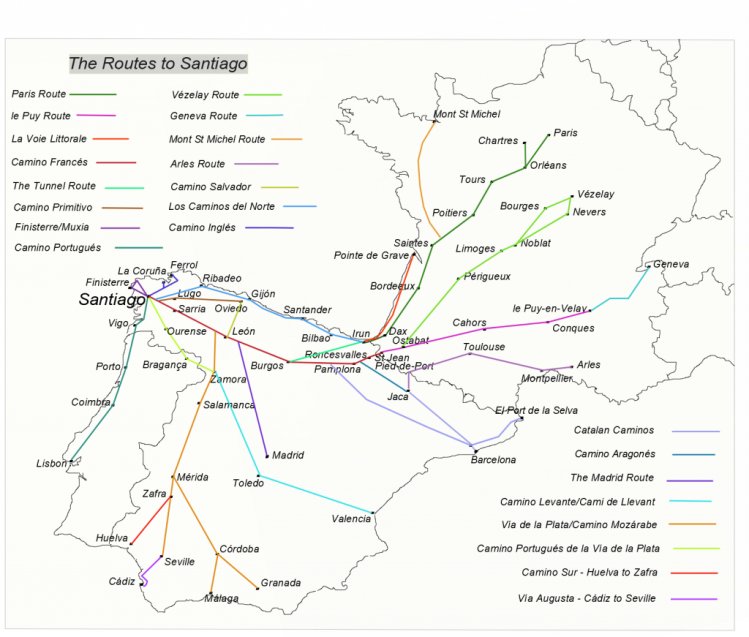
If that’s not enough, the Confraternity of St James has a map that shows 24(!) different marked and maintained routes that all, eventually, lead to Santiago. Some connect Camino routes together. Others stretch to every corner of Spain, and a few holy places in France.

Routes-to-Santiago-1024x871
The Routes to Santiago, as outlined by the Confraternity of Saint James

It can all get a bit mind-numbing to think about.

So for now, let’s just all agree that to walk “the whole” Camino would take a lot of time, a LOT of miles, and a lot of backtracking to start again from a new direction.

And when someone asks if I walked “the whole” Camino, I tell them that as far as I know, no one has ever done that. There’s always a new path waiting to be explored.


What’s your favorite Camino route? What’s the one you’re hoping to experience next?

A Camino Moment: The Deer

19962286085_572bd1d949_z

It was a cool morning in mid-April, and we set out across the French countryside through a thick mist that was almost rain. Eric walked ahead with the Brothers Grim, peppering them with questions and practicing his French. They loved him.

I lagged behind as we crossed a field of brilliant springtime green, so I was alone when two deer leapt gracefully across the dew-wet grass, chased by a black dog that seemed more determined than vicious.

The dog didn’t bark, and the whole scene was weirdly serene. They disappeared over a rise while I stood frozen, trying to remember the French word for “deer” to alert the others.

They never saw it. The moment was magic, and all mine.

Camino del Norte: To Plan or Not to Plan, That Is the Question

Three weeks from today, we’ll be on an airplane, flying (direct!) from Seattle to Paris.

Which means that right about now, I’m on that teetering seesaw between over-planning for the Camino del Norte and promising not to over-plan.

I’ve got all of the gear: I’ve spent hours stalking REI Garage bargains, buying all of the things while simultaneously promising to pack lighter this time. (Packing list forthcoming, once I get all of the things in the same room.)

I’ve got the big travel plans sorted out: train reservations to Irun despite the SNCF strikes (though we’ll have to wait a day and hang out in Paris…oh, darn!), and an evening flight from Bilbao to CDG the night before we fly home, and then reservations at an airport hotel.

I’ve got the training plan: I’m hiking every weekend up hills and through mud, testing both my shoes (so far, so great) and my resolve to walk in the rain. (This is Eric’s favorite part. When it hailed on us last week, he couldn’t stop giggling.)

Now it comes to the fun part of planning: the walk itself.

IMG_20180417_1251102
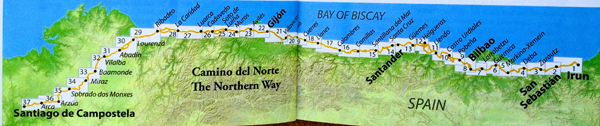
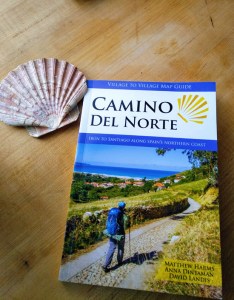
(c) Camino Del Norte guide by David Landis, Anna Dintaman, and Matthew Harms

What is the Camino del Norte?

The Camino del Norte is the branch of the Camino that hugs the northern coast of Spain, crossing Basque Country, Cantabria, Asturias, and Galicia.

While it doesn’t draw the attention of its cousin to the south, the Camino Francés, it has a history that’s just as long. Pilgrims have followed the coastal route toward Santiago since the 9th century, and they used it heavily during the the Moorish wars, when Navarre was under constant threat.

The entire Camino del Norte covers 817 km, but with just 21 days of vacation, we won’t have time to go all the way to Santiago. With travel and time zones, we’ll have about 16 or 17 days on the Camino itself.

How far will we go?

Well, we don’t really know yet. It depends on how far we walk every day, and I’m trying to be open-handed with that, which brings us back to the balance of planning and not over-planning. Our daily distances will depend on a lot of things I can’t predict, like weather (it’s been a brutal spring in Spain), terrain, and how our bodies will hold up. I’m trying not to make a schedule – something that’s not natural for a planner like me.

As a compromise between my typical Type-A, have-a-color-coded-spreadsheet approach to travel and my turn-off-electronic-devices-and-let-things-happen desire for a Camino walk, I let myself make detailed plans for the first two nights, including reservations for a hostel just outside San Sebastian (because going into a major tourist spot on a weekend without a reservation made me really nervous).

After that, I’ll wait until we’re there and see where the wind and the guidebook take me.IMG_20180404_1136586

Which guidebook?

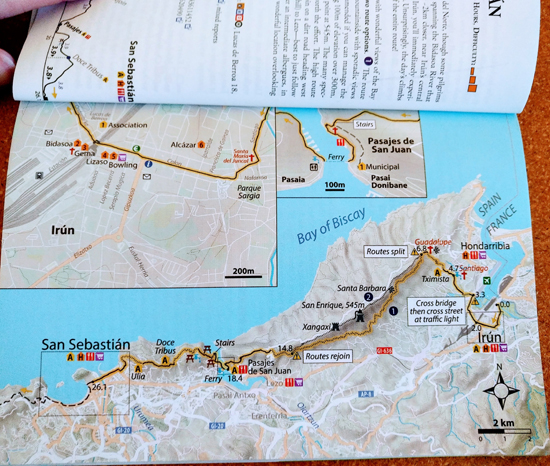
I’ve got a hot-off-the-press copy of Village-to-Village Map Guide’s Camino del Norte guidebook, and I’m excited about it. It’s got all of the essentials – basic maps, information about lodging and food, elevation charts, and some general instructions about tricky parts of the trail, all in a compact 96-page, full color booklet. It weighs almost nothing (especially compared to other popular Camino guides, which can carry a lot of commentary) and has guided me through the early planning easily.

IMG_20180417_1251431
Day 1 of the Camino del Norte, (c) Camino Del Norte guide by Matthew Harms, Anna Dintaman, and David Landis

(Disclosure: One of the authors of the guidebook, David Landis, sent me a complimentary copy when he found out that I was planning a Norte walk this spring. I’ll be back with a more thorough review after I’ve road-tested it.)

Looking at the maps and charts in this book, my best guess is that we’ll get past Santander, but not all the way to Villaviciosa, where a side trail takes some pilgrims down to the Camino Primitivo.

Then in another few years, we’ll pick up where we left off and start again.

At least, that’s the plan.


What about you? Do you make an agenda for every day of your Camino, or do you wing it?

Do you carry a guidebook, or trust the yellow arrows?

Book Cover Reveal!

Three years ago today, Eric and I woke before dawn, pulled on backpacks and hiking clothes that still felt awkward, and walked out of Le Puy, France, on what would be a 79-day, life-changing trip.

And so it’s particularly fitting that today is the day I get to introduce you to the face of Walking to the End of the World: A Thousand Miles on the Camino de Santiago.

WalkingtotheEnd


Yes, those are my real credential stamps on the cover. Every one of them tells a story that’s in the book. It’s all the creative genius of my publisher, Mountaineers Books. And if you think the cover is great, just wait until you see all of the surprises they’re planning for inside the book! (Maps! Photos! Lists!)  I’m grateful to partner with an independent press whose primary goal is to encourage more people to get outside.

download

We’re still a few months away from the October 1 release, but for those who just can’t wait, the paperback edition of Walking to the End of the World is available for pre-order online:

Amazon

IndieBound (independent local bookstores)

Barnes & Noble

For those who prefer ebooks or face-to-face shopping in your favorite local store, if you sign up for the Camino Times Two Book Club, I’ll send you updates and sneak previews through the summer, and will let you know just as soon as paperbacks hit the physical shelves and ebooks hit the readers.

button


For all of you: thanks for being part of the journey. The daily feedback and support I get from this blog has fueled the long-term, endurance-sport aspect of writing and publishing a whole book.

I can’t wait to share it with you!

Camino Shoes: Take 4

I’ve reached that part of my Camino planning when I’m buying all the things and simultaneously promising that I’ll pack lighter this time.

You’d think by now, prepping for my third visit to the Camino, I’d have everything I need. But a new hiking shirt (and matching Buff headband) seemed justified, and, well, those pants from 2015 don’t fit the way that they used to (when “they” say your body changes after 40, believe them). So it’s back to Kuhl for an updated fit.

But let’s be real: when it comes to Camino planning, it’s all about the shoes.

Ugh, the shoes. The most important piece of equipment for a through-hiker. And yet the one thing that no matter how much I research, and how many experts I talk to, I just can’t seem to get right.

For my third Camino, I’m putting my faith in a fourth pair of shoes.

IMG_20180404_1704527

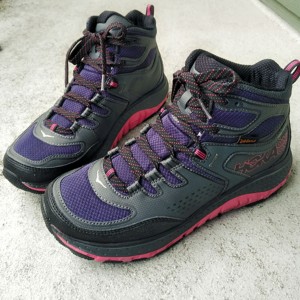
Camino friends, meet my new Hoka One One Tor Tech Mids.

The Back Story

My first Camino started in a pair of Merrell Bare Access trail runners. “This is what people who are walking the Pacific Crest Trail are wearing,” said the sales guy at REI. He never even mentioned arch supports, and I was too new and clueless to ask. I wanted to be a minimalist hiker. I wanted something lightweight. I wanted to think that a long hike was something I could do in my normal, around-the-city shoes.

I was wrong.

Those PCT hikers clearly didn’t have tender feet that fell apart at the first sign of a pebble on the road. I have high arches tendon issues, scar tissue from an old injury, and who knows what else. Those Merrells are fantastic for some people, I’m sure, but I am not those people. Bare Access broke me. I suffered and limped and swore and cried across half of France before Eric suggested that we replace the shoes.

A short cab ride back into civilization—well, a strip mall with a sporting goods store—brought me to:

My second Camino shoes, which were Salomons. I bought them in a hurry, from a salesperson who spoke only French, so I don’t know the specific model. But those substantial hiking shoes – plus the arch support inserts inside, and the hiking poles – got me across another 700 miles. They weren’t perfect, and they smelled so bad by the end that I threw them away in a Paris trash can before I got on the flight home. But they taught me a thing or two.

So last summer, after a brutal bout of plantar fasciitis, two podiatrists, one physical therapist, and one chiropractor, I started prepping for a short visit back to the Camino Frances in the dead of summer, and I went back to Salomon. Salomon X Ultra Mids, to be precise. They felt big and clunky, but also protective. I wasn’t in love with them, but they had great reviews. The sales guy at REI said everyone was wearing them.

By Day 3 on the Camino Frances, my feet revolted again. I got my first (and only) blister. My feet ached with every step, and I decided to stop two days early.

Take Four

Another podiatrist and a sports doctor later, it’s time for Camino 2.0. I’m planning for 18 days on Camino Norte, which is known for rugged climbs and descents along coastal cliffs, and also for rain.

My sports doc recommended I check out Hoka One One. (At least I’ve learned not to count on the REI guy.)

I bought the Hoka One One Speedgoat running shoes about 6 months ago, and they’ve been my in-the-city favorite for boot camps and longer walks. They seem comfortable. Lots of grip, decent cushioning.

So I took a plunge on Tor Tech Mid hiking boots.

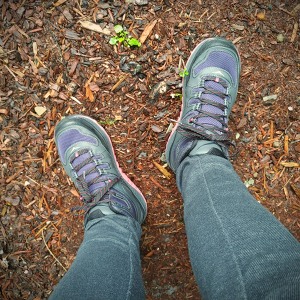
IMG shoes smallMy first impression is that they’re HUGE, with a wide toe box and enough padding on the bottom to make me almost 2 inches taller than I am. I feel a little like I’m clumping around in snow boots. Yet at the same time these boots weigh less than last year’s Salomons, and that wide toe box might save me from some of the tendon issues and cramping that happens to the muscles on top of my feet.
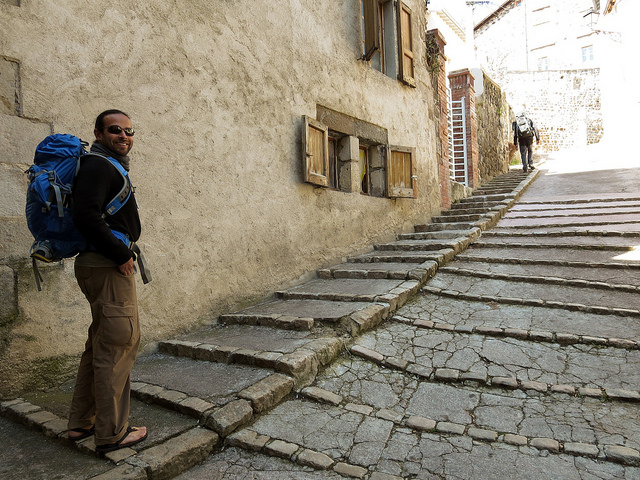
I’ve worn them a couple of times on city walks of 4-6 miles. The ankle support feels stiff, but the grip is fantastic. I glide silently above the sidewalks, rather than touching them.

The doc also recommended a new brand of arch support, cleverly named Arch Rival, which just arrived, and I’ll get them in the shoes before a longer hike in the woods this weekend.

So here I am, 6 weeks out, sending little messages of encouragement to Shoes #4.

Please, purple boots with a funny name, be the magic. Together, we’re going to cover some amazing territory.


Do you have a Camino shoe story? What worked for you? What didn’t?

Le Puy-En-Velay

On the Monday after Easter three years ago, Eric and I arrived in Paris after an overnight flight. We took a train to Lyon, and then another one to Le Puy-en-Velay, one of the oldest starting points of the Way of Saint James, according to the twelfth-century guide for pilgrims—considered one of the earliest travel guides ever written—the Codex Calixtinus.*

With a bit of trial and error, and the support of several friendly French pilgrims, we found our gite for the night and got settled. And then, curious and full of nerves, we wandered through the old section of Le Puy, taking in its steep angles and red roofs and black stone. Crooked houses made of black volcanic rock leaned over streets barely wide enough for the occasional car to pass. Old women in long dresses sat in doorways and watched us.

For two Americans coming from a city barely one hundred years old, it all seemed straight out of a movie set.

19560021542_b8e94c2d2e_z

The old section of Le Puy dates back well before the Camino ever existed. The cathedral of Le Puy was the most popular pilgrimage destination of France during the Middle Ages, boasting its own miracles and relics. Emperor Charlemagne visited twice, the first time in 772. Since then, the city has established itself as a commercial center known for its special lentils and artisan lace, but mostly, it thrives on its history.

Our meandering path brought us eventually to the heart of the town, the Cathédrale Notre-Dame du Puy.

19566861555_a11abc0328_z

The Romanesque cathedral dates to the early twelfth century, and it lacks the dramatic spires and outward ornaments of other, more famous structures along the Camino. The Le Puy cathedral sprawls rather than rises, its striped exterior of white sandstone and black volcanic rock spreading and twisting, until everywhere I went in the neighborhood seemed to end in some side entrance to the cathedral grounds.

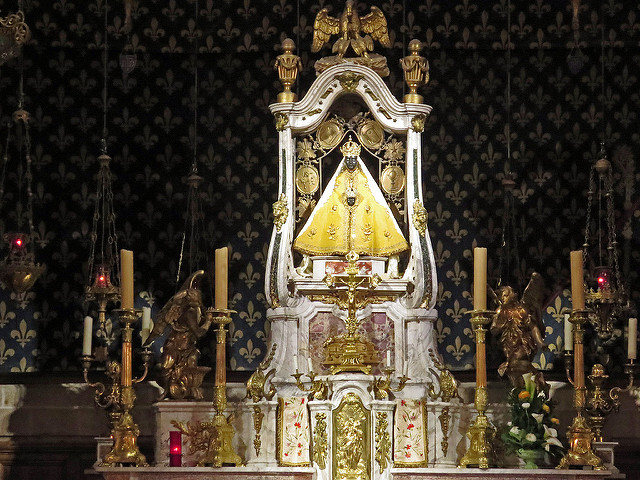
The church was unlocked, dark, and mostly empty in the quiet of midafternoon. We tiptoed through the echoing stone sanctuary and studied the elaborate altar, where the small face of the cathedral’s Black Virgin looked out from above a stiff, conical robe of gold brocade.

19378888198_913469ac7a_z

There are ebony statues like this of Mary and the Christ Child scattered across central Europe. Most date to medieval times—the Black Virgin in Le Puy is a replica of one given to the church by Louis IX as he returned from a Crusade in 1254 (the original was destroyed in the French Revolution)—but the symbolism behind their appearance has been lost to history and is still debated today.

The next day at the pilgrim’s blessing ceremony, we were given small medallions, stamped with the Madonna’s conical form. I wore it all the way to Finisterre.

After paying our respects at the altar, we stopped in the cathedral gift shop to get a credential stamp, and Eric picked out a French-language guidebook with detailed information about gîtes and other services along GR65, the French Grande Randonnée hiking route number for the Way of Saint James between Le Puy and Saint Jean Pied-de-Port. That book, Miam Miam Dodo (which translates to something like baby talk for “yum-yum sleep-sleep”), became our primary reference all the way to the Spanish border, despite its silly name.

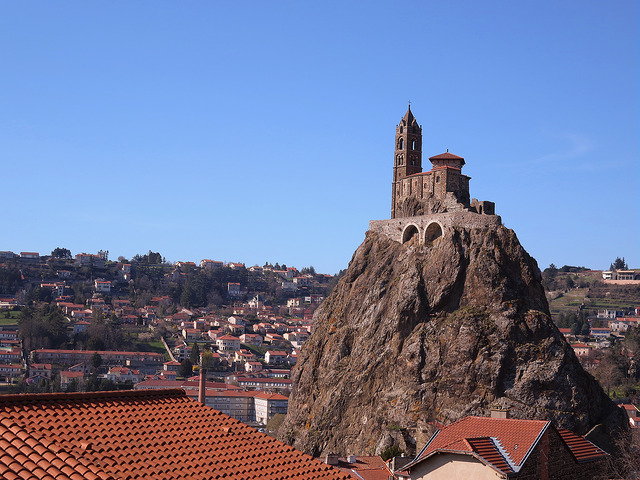
From the cathedral, we climbed toward the most visually familiar icon of Le Puy, the chapel of Saint-Michel d’Aiguilhe.

18945940603_99f000978d_z

The tenth-century structure rises improbably out of an almost vertical needle of volcanic rock three hundred feet—or, in France, eighty meters—high. At the base of the 268-step climb, a ticket collector warned us that the site would close in fifteen minutes. We could probably make the climb to the top, he said, but we wouldn’t be able to linger. And yes, we’d have to pay full price for the tickets.

Eric and I thanked him, but decided to pass, a decision I’ve regretted ever since.

Instead, figuring we needed all the help we could get on this adventure, we wound back to the pilgrim welcome center, just across the street from the cathedral, in time for the daily information session.

We found about a dozen people already there, sitting in an awkward circle in front of a fireplace. The volunteer hosts, who of course spoke only French, asked a question that set off a round of what seemed to be introductions.

When I told the group that my name was Beth, I saw a lot of furrowed brows. “Bett?” The host’s mouth twisted, as if he couldn’t quite get the syllable out. I remembered that Isidore, too, had trouble with my name.

“Elizabeth?” I offered.

Everyone relaxed and smiled. “Ah! Elisabet!” And just like that, I changed my name. For the next thirty-five days I was Elizabeth, a name no one but my immediate family had ever used before.

The adventure had begun.


* According to Codex Calixtinus, there were four primary pilgrim routes that developed in France to funnel pilgrims together and guide them past other holy sites on their way to Santiago: Vía Podiensis began in Le Puy, Vía Turonensis began in Paris, Vía Lemovicensis began in Vézelay, and Vía Tolosana began in Arles. Back then, St. Jean Pied-de-Port, which is now one of the most popular places to start a Camino, was just a small border town where pilgrims funneled after traveling for weeks or months.

A Day Alone in Burgos

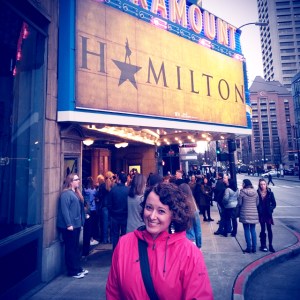
A couple of weeks ago (yeah, I’m behind with my writing) I did something I’d never done before. I went to a play by myself.

And not just any play. I went to THE play. Hamilton.

IMG_20180225_1725419

The story of how I got there is long and not very interesting. Short version: I have been geeking out on the cast album and Hamilton-themed books for more than a year, and when the traveling show came to Seattle and an opportunity for a last-minute ticket appeared, I did not throw away my shot. And it was fantastic. Totally worth it.

So why am I telling you this? Because as much as I wanted to be “in the room where it happens” I’m not sure that I would have jumped in if it wasn’t for another, Camino-related experience.

Last summer, I also found myself traveling alone in a sea of people. When my feet started acting up again on Camino 1.3, I decided to stop walking two days early and found myself alone in Burgos, with a day to kill before it was time to travel again.

My friend Laurel, who always intended to walk on to Santiago without me, hugged me goodbye before dawn and set out for the Meseta. I slept longer, but eventually gathered my belongings and left the municipal albergue at about 8.

To be honest, I felt a little lost.

What do I do in Spain if I’m not a pilgrim?

What do I do in Spain if I’m by myself???

These aren’t dramatic questions. Many, many people walk the Camino alone, and travel to new places alone, and they have a fantastic time doing it. In theory, I’m the introverted, independent type of person who should thrive traveling alone, as well. But for the past twenty years or so, that hasn’t been my story. I mostly travel with Eric, and even when he hasn’t been with me, I realized I’ve always had a traveling companion.

So this day in Burgos felt charged somehow. I could do whatever I wanted (as long as it didn’t involve a lot of walking). I could linger without worrying about anyone else’s pace, or boredom, or interest. At the same time, I couldn’t rely on anyone else’s skills for navigation or language, or abdicate responsibility with an “I don’t know; what do you want to do?” I owned this day completely, in a way that felt rare and special.

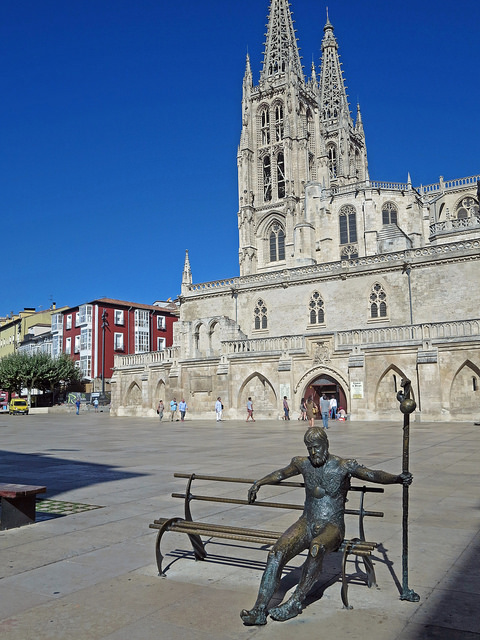
Burgos was still mostly asleep that early, the streets deserted and the cafes closed. I circled the cathedral a few times at first, looking at the details of the many, many Gothic carvings and the way the morning light played on the steeples.


I found a café on the square and ate a leisurely breakfast of croissant and coffee, catching up on my journal and watching the tourists start to fill the area. These weren’t Camino pilgrims – yesterday’s group was already on the trail, and it was too early for the new batch to start arriving. These were families on holiday, or people from around the world dragging wheeled luggage and wearing clothes that probably weren’t washed in a sink.

Finally, when the cathedral opened, I bought a ticket and went in. I concentrated on lingering. I paused everywhere, listening to the audio tour as it wound through dozens of chapels.


If I started to feel anxious, my mind pushing toward the next thing, I stopped. It was cool inside (and the heat of August was only rising outside), and there were plenty of places to sit and rest. Why rush? No one was waiting for me. I had nowhere else to be.

I considered every person buried under those Gothic domes, from the original architect to El Cid himself. I poked into corners and considered staircases that rose to showy doors, which in turn just led outside. I paused to study the carvings and paintings on the walls, and the light in the windows. I waited until the “fly catcher” clock chimed, the odd figure above it opening its mouth with each strike of the hour, as if to catch flies.


When I finally emerged, it was after noon. The albergue, where I was storing my backpack, would open soon. I went back to sit at the café across the street, greeting and watching the pilgrims arrive, but it felt strange to be among them. I was cool and comfortable in my after-walking sundress and sandals. They were tired, dusty, talking together about the things that they’d seen. It felt like this wasn’t my place any more.

I gathered my bag and set out for my hostal, which was still in the old city, but in a corner I’d never explored before. I followed a canal instead of the yellow arrows, and climbed a set of narrow stairs to a second-floor lobby, and then to a tiny orange room the size of an American closet, with a single bed and a tiny bathroom.

I napped, then ventured back into the city, wandering streets until my feet ached, and then sitting in parks and watching the people passing by while I recovered.

One of the things I love most about Spain is the way that everyone comes outside in the evenings. Kids careened around public squares, chasing soccer balls or each other. Parents and grandparents sat in clusters and visited, their hands gesturing broadly as they talked. I didn’t see a single cell phone. Even the teenagers were talking to each other (or sitting around looking bored).

I snacked on tapas here and there, and at 9:00 stopped for a final glass of wine at a café near my hostal. I may not be a pilgrim any more, but my body was still on pilgrim time. I sat at a table outside, next to a group of well-dressed women who’d obviously just come from the evening mass. An older nun was in the middle of the group. They sipped their drinks – still appetizers for them, with dinner at least another hour away – and gossiped about the crowd. Occasionally, I’d see their eyes rest on me.

I want to tell you that it was all magical and perfect, that I was content and happy to observe the busy city from my quiet corner. But to be honest? Parts of that day were hard. I was physically tired after 9 days of sleeping in albergues. I was culturally tired after almost two weeks of patching together my rusty Spanish.

Being alone in Spain wasn’t the same as being alone on the Camino, where people from around the world were used to reaching out. Those tapas snacks sometimes involved me walking around a block two or three times, gathering the courage and practicing the words to interact with a waiter. Sitting at the bar alone meant squaring my shoulders and being okay that I was the only person at a table alone.

37760350515_bcb908f374_z

But that doesn’t mean it didn’t have its own magic. Without the distraction of a companion, I formed much deeper memories of Burgos. I fell more in love with the cathedral, the streets, the people.

Author Shauna Niequist says, “When you’re traveling with someone else, you share each discovery, but when you are alone, you have to carry each experience with you like a secret, something you have to write on your heart, because there’s no other way to preserve it.”

Six months later, that day in Burgos is still written on my heart.

The International Women

Happy International Women’s Day!

IMG_20180308_183334

I woke up this morning to discover that it’s International Women’s Day, the day when we honor the movement for women’s rights around the world and celebrate the social, economic, cultural and political achievement of women.

Of course, for me there’s no more noteworthy achievement than a pilgrimage. And no group of international women I want to celebrate more than the dozens I’ve met on the Way of Saint James.

Today, I’m celebrating the community of international women (including many not pictured here) who came together on a thousand-year-old pilgrimage trail and changed my life. 

We came from at least a dozen countries and spanned at least 6 decades of age. We walked miles together, scrubbed underwear in sinks together, slept in the same rooms, shared bottles (and bottles) of wine, and most important, we told our stories. My world is bigger because of these strong, powerful women.


Speaking of Women on the Camino, did you know…

  • 51% of the pilgrims who arrived in Santiago de Compostela last year were women.
  • Camigas, the closed Facebook group that helps women walking the Camino find each other (for companionship and safety) has almost 7,000 members, and post almost 200 messages per day.
  • Most experienced pilgrims agree that women can safely hike the Camino de Santiago alone (Is the Camino safe for women?).
  • Women who set out to walk the Camino alone (including a lot of the women in the photo above) are rock stars and heroes.


The Train That Is Me

I had this whole other blog post planned for this week. (Actually, I had it planned for last week, too…)

But a few days ago my Camino friend Roy Howard posted this quote from Mark Nepo on his Instagram page, and every word of it just nailed me:

“Like most people I know, I struggle with taking too much on, with doing too many things, with moving too fast, with over committing. I’ve learned that I must move, quite simply, at the pace of what is real. While this pace may vary, life always seems diminished when I accelerate beyond my capacity to feel what is before me.

So no matter how many wonderful opportunities come my way, no matter the importance placed on these things by others who have my best interests at heart, I must somehow find a way to slow down the train-that-is-me until what I pass by is again seeable, touchable, feel-able. Otherwise, I will pass by everything – can put it all on my resume- but will have experienced and lived through nothing that is real.”

Three years ago, on a cold winter night at the end of a long week (at the end of a long month, at the end of a long year), I somewhat impulsively bought two tickets to Paris and announced that the Jusinos were taking a sabbatical for as long as Europe would let us stay (which turned out to be 90 days). At the time, I was fried to a crisp, my edges burned by that “moving too fast, over committing” pace, and I needed to just STOP for a while.

3429382325_30d0a957cc_z

My 79-day pilgrimage from Le Puy to Finisterre was life giving and life changing. It forced me to slow down…literally, to less than 3 miles an hour. It made me put down my phone, look away from my few thousand friends on social media, and focus on the things and the people right in front of me.

20943920910_966f0075bc_z


Three years later, though? I confess that the train-that-is-me is once again hurtling way too fast. 2018 has started with a vengeance; I was already overcommitted, professionally and personally, and then I got hit sideways by some stuff that I didn’t have any emotional or mental space left to deal with. For the past two months, I’ve had my head down and my shields up, barreling through encounters that required more patience and sensitivity than I could muster.

I knew it was bad when I realized I’d stopped walking. It’s faster to drive to the grocery store and the office. There’s no time for the park. Maybe I’ll just stay home and not go anywhere. People take too much time and energy.

Ouch. Okay, time to put some brakes on this train.

So you know what I did?

On a cold winter night at the end of a long week, I bought two tickets to Paris.

The Jusinos are Camino-bound once again.

We leave on May 8, and will be in Europe for just three weeks this time, rather than three months. (We’re still bound by the limits of American vacation plans.)

We’re headed for Camino Norte, that glorious stretch of trail along Spain’s northern coast. We’ll start in Irun, or maybe Biarritz, and go as far as we can before we need to turn around and go home.

There are still a lot of details to work out (I’m going to be spending a lot of time on this page at Nadine Walks), but just making the commitment and blocking the calendar feel like I’ve started to pull the emergency brake.

More to come, as the planning unfolds. As for today, I think it’s time for a walk.

5404898141_8f8994c07a_z