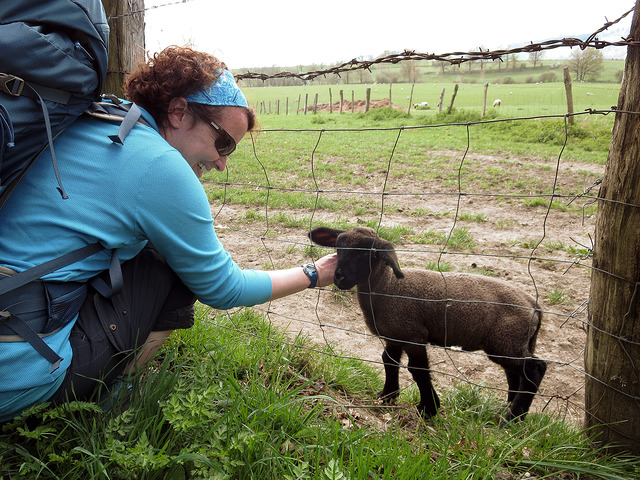
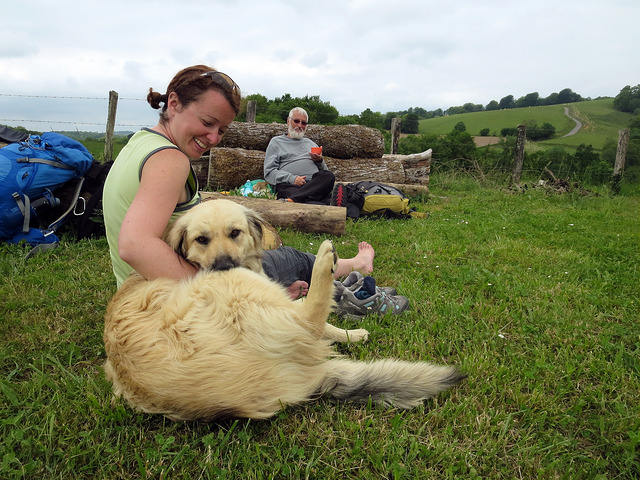
There aren’t many (okay, any) wild animals on the Camino de Santiago, but there are plenty of (mostly) domestic ones. I think every dog in France came up to Eric wanting to play or be petted, and for a while the Camino turned into a veritable petting zoo:
This little guy saw us coming down the path and scooted away from his mama and under a fence to come greet us. His mama was not happy.Why did the chicken cross the road? To find out if Eric was tasty.A windswept tiny horse on the plains of L’Aubrac.Tall horses demand attention (and maybe the sugar in Eric’s other hand) in Pais Basque.This farm dog was mostly interested in sharing our picnic lunch.Goats!The cats of Foncebadon.Wild, vicious dogs on the Camino? Not in our experience.
Seattle is well into the rainy season, which people in other parts of the world call winter. We had record amounts of rain in October, and November is its usual dark and puddle-filled self. So when, while editing, I came across this little piece in my Camino book-in-progress, I thought this would be a good time to share it.
People often ask, “You’re walking outside every day? What do you do when it rains?” The answer, of course, is that you walk.
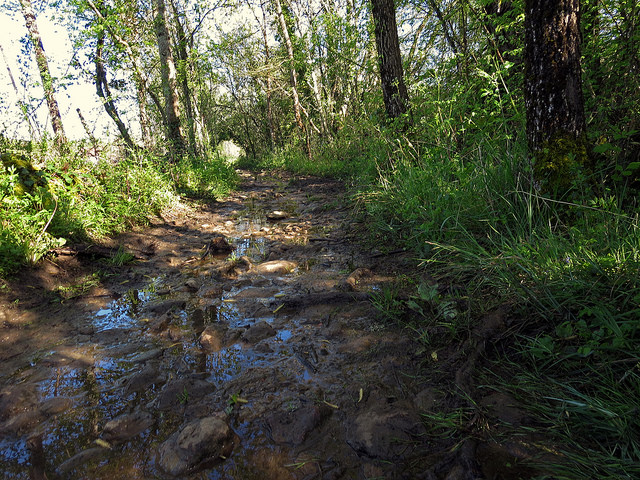
(Note: when it rained, I left my camera safely tucked away, deep in my backpack. The pics are all taken in the aftermath of the deluge, the next day.)
We woke the next morning to a sound we hadn’t heard since we arrived in France: rain.
Lots of rain.
Our pod of pilgrims got up reluctantly and geared up for wet weather. We lined the insides of our packs with plastic trash bags, hid all of our important (and water-sensitive) papers and gear deep in the middle, and then wrapped rain flies over the whole mess. We ate a subdued breakfast, glancing often out the window, while Claire (our host) clattered around us, telling us how to put jam on bread.
Finally, there was nothing else to do but put on our gear and set out.
Most pilgrims we met took the “more rain gear is better” approach. They had waterproof rain pants and ponchos and waterproof boots and deep hoods. At the first drop, they disappeared under a pile of Gore-Tex.
Eric and I had a different approach. Maybe it’s because we live in Seattle, where rain is a daily companion. Maybe it’s because we were naive and overconfident. But in order to keep our packs light and our bodies mobile, we opted for a “quick-dry” attitude instead of a waterproof one. We had rain jackets, and I had a brimmed hat to keep the rain out of my eyes, but beyond that, we just rolled up our pants and acknowledged that we were going to be wet.
Of course, “quick-dry” assumes that there’s some point where the rain stops long enough for drying to be possible.
At first, the rain was kind of fun, even as it soaked my pants and turned my shoes into swamps. We dodged mud puddles and sang nursery rhyme songs from childhood, changing the lyrics to make them dirty. We came upon Jan, plodding at his own, unique Jan pace under a giant poncho and hat. We slowed for a while to chat about where he’d camped the night before, and how heavy his tent was when it was water-logged. We made sure he had enough water and food for a long day of walking. But Jan’s pace was too slow even for me, and the rain was falling heavier, and so we kept moving.
Unfortunately, this was a day of dirt trails that wound through and behind farms. The well-worn paths quickly filled with mud, and then as more water poured in from the fields, became ponds. I tried to skirt the edges, sliding and inching awkwardly along, snagging clothes and skin on the thorn bushes that lined the path. It was slow, painful, and ultimately pointless. I was drenched and mud-covered no matter what I did.
We passed our two-hour mark, and my body started to ask for its mid-morning break. But there was no shelter, nowhere to rest that wasn’t just as wet and covered in mud as we were. We walked on.
At some point we stopped singing. Lunchtime came, but there was no shelter. Now we were both well and truly wet, and tired, and hungry. We walked on.
Finally, at the four-hour mark, and still in the middle of nowhere, we came to a cafe—really a barn filled with picnic tables in someone’s backyard. A sign out front advertised hot soup.
We were saved.
The barn was crowded with pilgrims seeking shelter. We were all wet and shivering in the unheated space, but our general attitude was that at least we had dry seats and a chance to air out a bit. Our hosts brought out gallons of soup, and coffee, and quiche, and anything else warm. We commiserated together about what a miserable day it was, and I marveled again at how much more French even I understood every day.
After an hour, fortified but chilly, Eric and I pulled on soggy socks and shoes, wrapped ourselves in jackets and packs, and set off again. It never stopped raining. It was still coming down, light but steady, when we limped down the last steep hill and into Figeac, the largest town we’d seen since we left Le Puy. There were ten thousand people here, and more than one crossroad.
Which created a dilemma. Once again, we had no reservation. But this time, we also had no idea where to go.
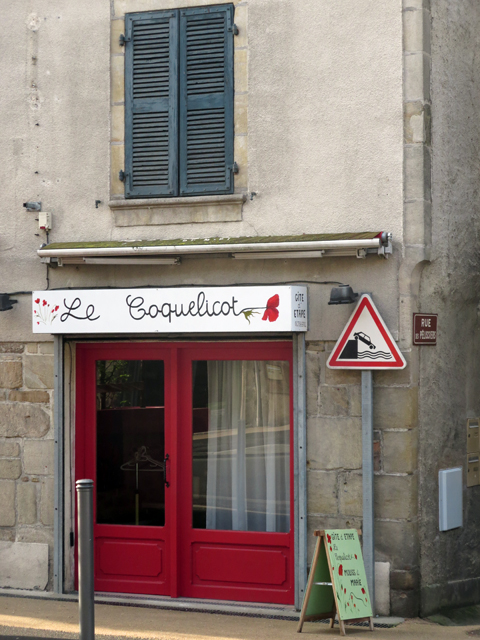
Tired and wet, we lost track of the red and white path markers, crossed the first bridge we found, and wandered down a street until we saw a friendly red door and a sign that said Gite d’etape.
Once again, the Camino provided, this time in the form of Le Coquelicot, The Poppy.
The best gite in Figeac. (Also, the street sign beside it cracks me up every time.)
Walking into the low, stone room felt like entering a cave, with the only windows at the front, looking out over the darkening street. It was probably another converted horse stable. But it was warm and dry, and the owners, a young couple from Morocco, welcomed us despite our mud, and offered us the last beds available, a double room with a private bathroom.
Done.
We draped clothes everywhere to dry, put our shoes by the electric heater, washed the mud off in long, blessedly hot showers, and curled into the common room to journal and wait for dinner. Our host was solicitous, generously offering us the smattering of English he knew and patient with our efforts to communicate. He had moved to France as an adult, he explained through pantomime and Frenglish, before he knew any French, so he knew what it was to be surrounded by words that didn’t make sense.
Strangers in a strange land…
We gathered at long tables and passed heaping plates of Mediterranean chicken and couscous and beans and vegetables. Our own pod was scattered and gone, and we didn’t know any of the pilgrims at the table, but they, too, had marched all day through the rain, and so were immediately strangers-who-were-friends. We’d been through the mud together.
What is the Chemin du Puy — the Camino route from Le Puy to St. Jean Pied-de-Port, like? See for yourself. Camino Ways has put together a video that highlights the towns and countryside along the way. I recognize almost every one of these places… “oh, we stopped for coffee in that town!” “We stayed in that gite!”
There are so many stories I could tell you about each picture…but really, you should just go and see it all for yourself.
In the US, it’s Veteran’s Day. We honor everyone who’s served in the military
In Europe, November 11 is a bit more specific. Armistice Daycelebrates the anniversary of the 1918 end of the Great War, World War I, on 11/11, at 11 in the morning.
To be honest, I’d never spent much time thinking about the First World War. The US was only part of it for a few months at the end, and it gets scant mention in our history books compared to the wars that followed. I had some vague impressions of men on horses charging men with automatic artillery. Gas attacks. Trench warfare. Millions of lives lost for a few feet of ground.
But until I went to France to walk the Way of Saint James, I didn’t have a context for it.
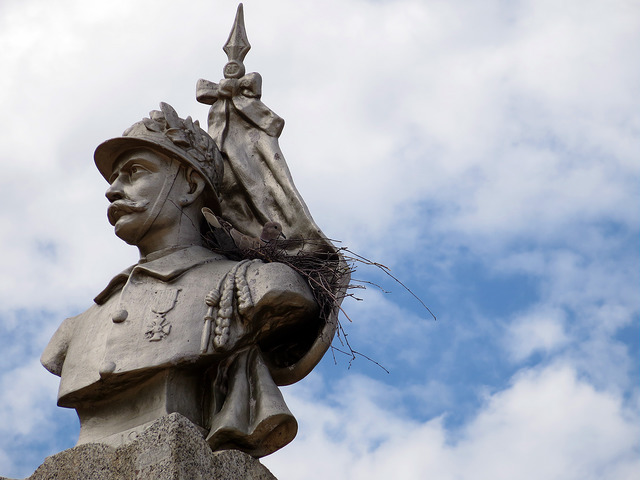
The dove nestled on the memorial soldier’s shoulder is a nice touch.
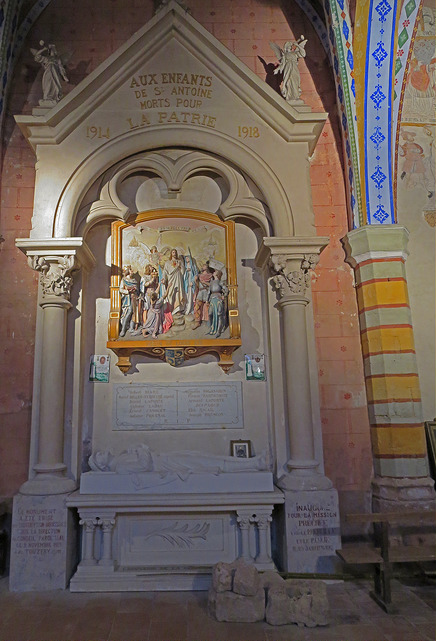
Every village we passed through alone the Chemin du Puy, from Le Puy to Saint James Pied-de-Port, had a prominent memorial to the fallen local heroes of the Great War. No matter how small or humble the towns were, they had recorded the names of their lost somewhere in the town center, or inside the local church, or in front of the Mairie (the city hall).
A typical memorial for the “enfants” lost in the Great War, found in almost every local French church
What struck me was that every town had lost people – there were dozens of names on most memorials, in towns of only a few hundred people. They were all young, usually eighteen to thirty.
They lost almost an entire generation.
There’s lots of time to think about things as you walk a pilgrimage, and I found myself thinking about those towns, and how much they must have missed the men who never came home. They lost brothers and teachers and fathers and friends. And they missed them deeply, and lovingly remembered each one of them by name.
They went with songs to the battle, they were young. Straight of limb, true of eye, steady and aglow. They were staunch to the end against odds uncounted, They fell with their faces to the foe.
…
A few weeks later, our Camino ended in Finisterre, and Eric and I found ourselves with a few days of extra time before our flight back to the States. We spent the time visiting a friend who lives in northeast France. Mostly we rested, recovered, and tried to avoid a brutal heat wave. But one day, our friend took us to Verdun.
The Battle of Verdunisn’t as well known as the battle of the Somme (commemorated last year with this incredible memorial). But it was just as deadly. In less than a year, on less than eight square miles, 700,000 men were killed, seriously wounded, or declared missing.
German and French troops hurled chemical weapons, artillery, and their own bodies at one another day after day, leaving the landscape still visibly scarred. Most of the park is still off limits for visitors because of the risk of unexploded mines.
We walked where we could, saw the remains of trenches that had been full of soldiers when they exploded, burying everyone alive.
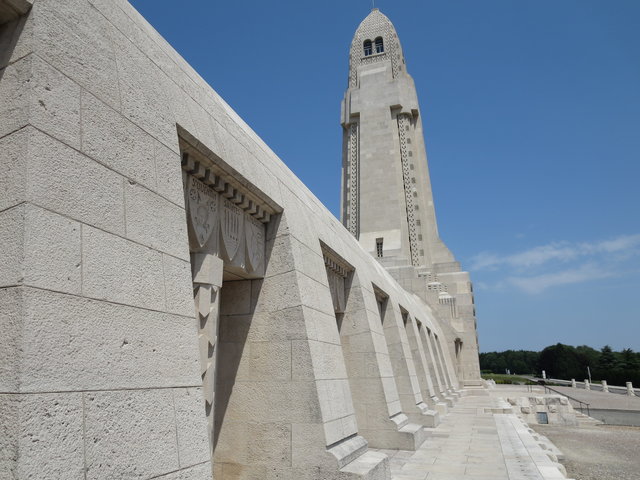
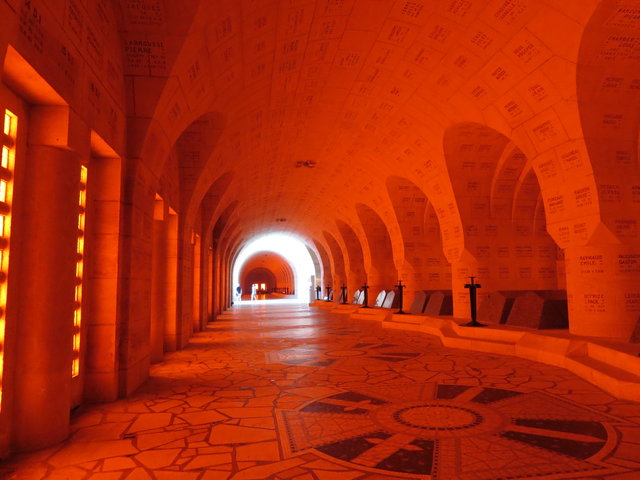
And then there was the Ossuary. Built in all the glory and grand scale of the Art Deco years, it’s tall and bold and geometric. The inside is what you’d expect, all marble and solemn tombs and eternal flames.
The Douaumont Ossuary
But outside, if you walk around the building and peer through the small, subtle windows near the ground, is where the real shock was. Because those are windows into the tombs themselves. If you crouch down and look in, which I innocently did, there are piles – PILES – of bones.
(No, there are no photos of the bones.)
It’s a shock to find yourself unexpectedly facing the messy human remains of 130,000 unidentified soldiers, both French and German. These are not artfully arranged memorials. They’re not even complete skeletons. They’re heaps of anonymous-but-very-human men, fractured and fragmented by guns and bombs and death.
The architects of the memorial, probably still reeling from their own losses (they broke ground for the ossuary less than two years after Armistice Day), refused to just hide them away, out of sight beneath the lovely marble tombs inside.
They shall grow not old, as we that are left grow old: Age shall not weary them, nor the years condemn. At the going down of the sun and in the morning, We will remember them.
– “Ode of Remembrance” by Laurence Binyon
The small towns of France who named their lost sons brought me the personal heartbreak of the Great War.
The anonymous mass graves of Verdun brought me the horrific scale of the Great War.
Both made me see November 11 in a way I’ll never forget.
Have you seen the news about the new wine fountain in Italy? It lies in a village along the Cammino di San Tommaso(oh my, another pilgrimage route to explore…and this one with Italian food!) and it inspired, in part, by its more famous pilgrim cousin, the Irache wine fountain along the Camino de Santiago.
The wine fountain is one of those things you hear about from other pilgrims, and that’s mentioned in all the books. I knew it was coming, but I was still surprised when we came across it just after eight o’clock in the morning. (It’s just a few kilometers past Estella, where we’d stayed the night before.)
Although we met plenty of pilgrims who enjoyed a beer with their desayuno, but in general, we saved our alcohol for the end of the day. Or, you know, at least until ten.
However, this was THE wine fountain. The wine of the Monastery of Nuestra Senora la Real de Irache has been part of the Camino experience since the twelfth century, when the Codex Calixtinus refers to Estella as the “land of Good Bread and Optimal Wine.” It was our sacred duty to support the history and culture of the pilgrimage.
Because hey, you don’t see the Appalachian Trail setting up free moonshine stills.
Still, though. With all the hype and history, I think that I expected “the wine fountain” to be a grotto in some ancient stone building with a freely flowing…well, fountain of wine.
Instead, we got a modern tap in the wall of a concrete wine warehouse.
The wine fountain of the Camino de Santiago
The current free fountain has existed only since 1991, and is run by a collection of local wineries. There’s a gate that’s locked overnight, and a webcam that broadcasts during the open hours, and I expect creates some social pressure not to overindulge. (There are also signs explaining that the foundation is not unlimited; only a certain amount of wine is provided each day.)
So it’s a marketing ploy or an homage to the long history of service to pilgrims that the monastery offered. Either way, of course we stopped, along with most of the other pilgrims we saw that day. Some used their scallop shells for a more “authentic” sip of wine. Eric and I stayed practical and used a water bottle.
The sign beside the fountain reads:
Pilgrim, if you wish to arrive at Santiago full of strength and vitality, have a drink of this great wine and make a toast to happiness.
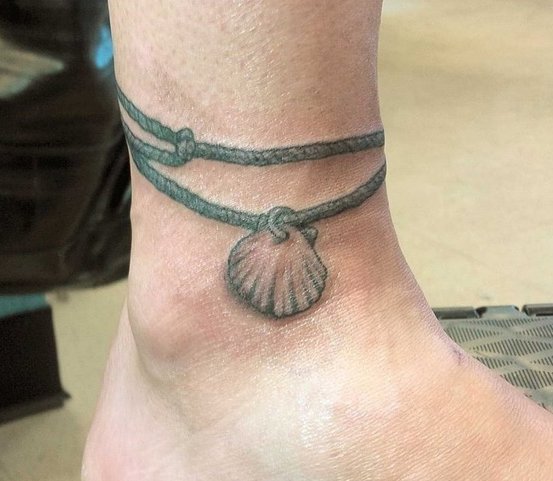
Facebook, in its infinite wisdom and memory, reminded me last week that it’s already been “one year ago” that I came home with my very first tattoo: my Camino shell.
My Camino tattoo
Why a tattoo?
I live in Seattle, where tattoos are practically a requirement for entry. And yet, whenever the subject would come up, I’d shrug. There was nothing I could imagine that I would want to commit to having on my body forever. Surely I would regret that quote/image/memory when I was 90.
But then I walked a thousand miles in a single spring. It was the biggest, hardest thing I’ve ever planned and completed.
I wanted to commit it to being part of me forever.
Why the shell?
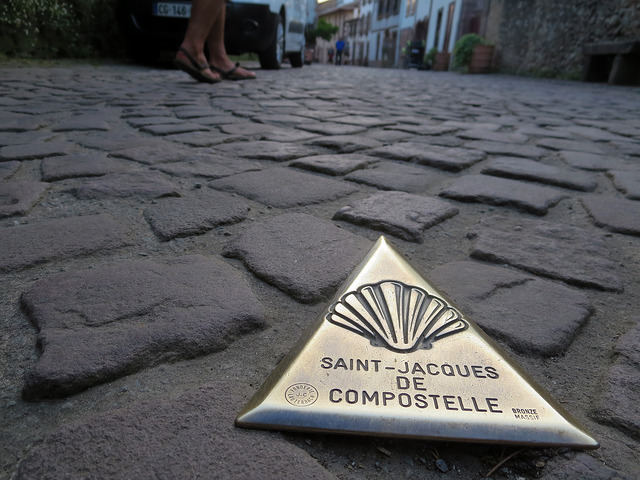
Historically, the scallop shell is the iconic symbol of the Camino de Santiago, the holy pilgrimage to Santiago. In fact, one of the legends involves Saint James’ body miraculously washing ashore on the coast of Spain, far from where he was martyred in Jerusalem covered in scallop shells. Another says that the scallop shell, with its ridges that fan out, represents the many different routes that pilgrims take, all coming together at the central point of Santiago.
Pointing the way in St. Jean Pied-de-Port
We know for sure that scallops are native to the coasts of Galicia. The earliest pilgrims, who trekked to the upstart holy city from their homes all over Europe without the benefits of Gore-Tex or Instagram, were given scallop shells when they arrived to prove that they’d made it. Or, again in another interpretation, they carried scallop shells with them on their journey, to use as a scoop for food or water along the way. Even today, I’m told “scallop shell” in French is called Coquille Saint Jacques, and in German scallops are called Jakobsmuscheln (James mussels).
Today, the scallop shell is everywhere on the Camino: sold in tourist shops, used as roadside markers to show the way, sewn as patches on backpacks and printed on those branded Camino Buff scarves.
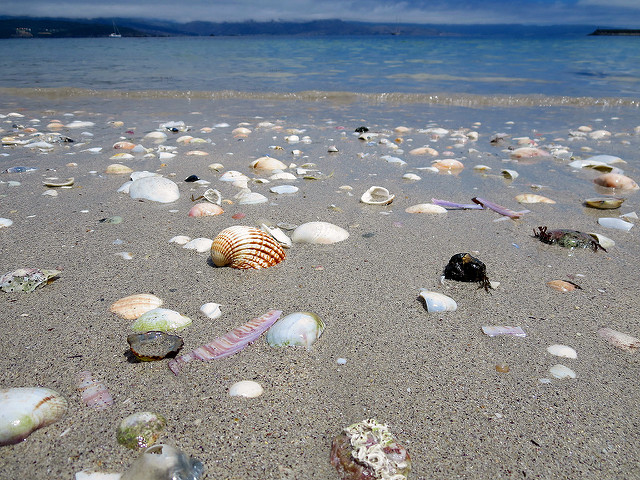
There was a scallop shell engraved on the medallion I was given in the Cathedral of Le Puy on the first morning of our walk. And 79 days later, when we arrived in Finisterre, the beach was covered with shells, including these curiously flat, fanned-out scallop shells that were so completely different than our Pacific Northwest scallops.
The beaches of Finisterre were pristine and littered with more beautiful shells than I’d ever seen.
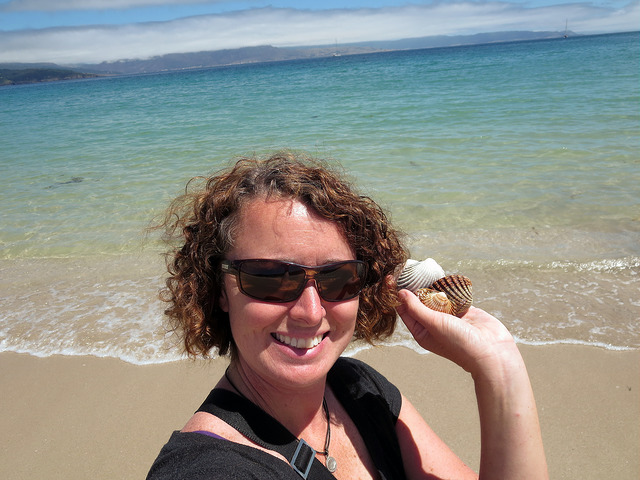
I collected those shells by the handful. After three months of judiciously leaving every memento behind (added pack weight!), I binged on shells and sea glass at the “end of the world.”
And when I came home, I took one of those specific shells to a tattoo artist, and she drew it for me.
That little shell in the front became the specific model for the shell now inked on my ankle. It matches the shell on the medallion around my neck.
There was also no question about where to get my tattoo—this was a walking trip, and my poor Princess feet had borne the brunt of the labor. It was only fair that the memento would be there.
(Shout out to Ashley at 522 Tattoo in Seattle for her creativity and realism in drawing. It’s my shell, but your vision that I get to wear every day for…forever.)
For the past couple of days, I’ve been feeling weighed down by the stress and the hostility that’s bouncing around the Web these days (can this election just be OVER already?). To counter it, here are a few things to make you smile.
The Camino isn’t just a walk across the countryside — it’s also a chance to see beautiful, spectacular, awe-inspiring art, most of it religious, collected over centuries. From the towering architecture of cathedrals to the details that separate Classicism from Baroque paintings, the Way of Saint James can become a long lesson in fine art.
But if you look carefully, not everything is majestic. Artists through the centuries have made some pretty quirky, comical (intentionally or not) things.
So here, in an (Almost) Wordless Wednesday style, are three of my favorite “wait, is that what I think it is?” pieces of religious art, seen along the Camino Frances (St. Jean Pied-de-Port to Santiago) and the Chemin du Puy (Le Puy to St. Jean Pied-de-Port).
Probably the strangest thing I saw was the gallery of dioramas, all using Playmobilfigures, depicting the Stations of the Cross. Yep, that’s Jesus, complete with a crown of thorns, being whipped by Roman soldiers. Many of my childhood memories are now officially ruined.
(Seen in theMonasterio de Santa Maria La Realin Najera, Spain. I think it was a temporary exhibit, mixed among the museum-like displays of much older relics and art. Which just made it stranger.)
The earliest stained glass windows of Christianity were usually designed to tell a story to an illiterate population. I’ve seen many images of Jesus and his miracles, and plenty of heroes from the Old Testament to the early church. But this is the only window I’ve ever seen that depicts a woman (Salome, daughter of Herodias) holding a man’s head in a basket.
(Found in a small chapel somewhere between Lascabanes and Lauzerte, France.)
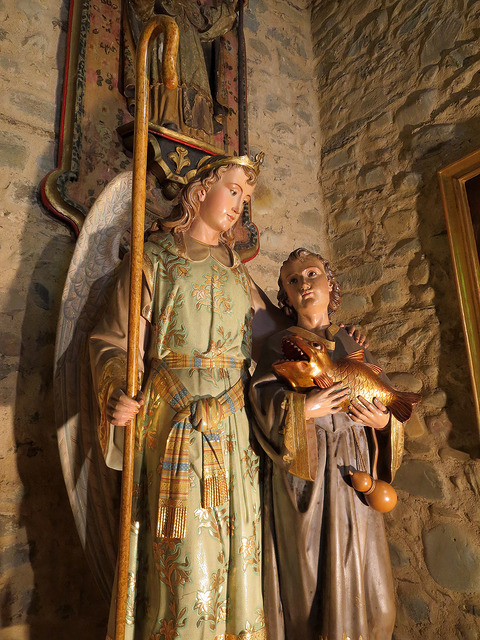
And finally, there’s this, which at first glance is a fairly typical religious statue of a guardian angel and child. But then look again. Is that a piranha? And is it smiling, or trying to eat the angel?
(Seen in a small, cluttered roadside chapel between Ponferrada and Villafranca de Bierzo, Spain.)
What about you? What were the strangest or most memorable bits of religious art that you found along the Way?
Have you read the stories about the English couple who were rescued after getting lost in the Pyrenees last month? It was their first day on the Camino, walking from St. Jean Pied-de-Port to Roncevalles over the Napoleon Route (the more popular route over the mountains and into Spain).
It’s a strange story: according to this interview, the couple intentionally left the marked trail, thinking they were taking an easier path (if there was an easier path, why wouldn’t everyone be taking it?), and then…they just kept going. For four days, they wandered the mountains (they were carrying a tent, so had a safe place to sleep) and managed to never see another person. They finally called 112 (the European equivalent of 911), and were found and rescued within an hour.
(And then they went on to finish the Camino, walking most of the way to Santiago.)
As the story shows, it’s possible to get lost on the Camino. I think most pilgrims have a story about “that time” that they took a wrong turn along the Way. But while getting lost on a wilderness trail like the Appalachian can be deadly, getting turned around on the Camino de Santiago is usually just an inconvenience.
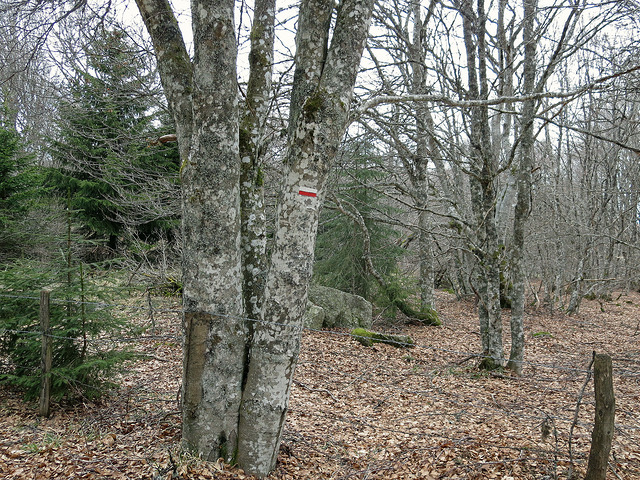
The Way of Saint James (the Chemin de Saint Jacques in France, and the Camino de Santiago in Spain) is well-marked and maintained. In France, you follow a system of red-and-white stripes. Two straight bars tell you that you’re going in the right direction. A third bar, making a flag, tells you to turn left or right. A great big X tells if you’re going the wrong direction. They’re painted onto fences, or the backs of signs, on trees, and even on rocks if the ground is flat. They aren’t always easy to spot—walking the Chemin de Saint Jacques often felt like an epic game of Where’s Waldo—but if you pay attention you’ll quickly know if you got off track.
The red-and-white stripes of the GR65, the Chemin de Saint Jacques, in France.
Eric and I only seriously lost the trail once, in our first week of walking and the last few kilometers of a long and painful day.
We hadn’t seen another human being for a while, and I was desperate for a distraction from my aching feet when a young woman with a backpack came striding out of what was clearly a driveway.
“That’s not the way,” she called cheerily, in English. She told us she’d taken the wrong turn and found herself, awkwardly, standing in a barnyard.
She mistook a driveway for the Camino. I should have paid more attention to that.
We chatted as we walked down a rutted farm road. At some point I noticed that we hadn’t seen any of the trail markers for a while, but our new Swiss friend brushed it aside. “Oh no, this is right. This feels like the Camino.”
Ten minutes later, we reached a dead end in the road. There were still no trail markers to tell us which way to turn, and the guidebook didn’t mention a dead end. We looked across a valley, with a river far below. It was lovely, but there was no sign of a town, or a road, or any civilization.
We were definitely lost, and this didn’t feel like the Camino anymore.
We dithered around, aching and tired, but in the end we had no choice but to turn and trudge, silently this time, at least three kilometers back up the long hill we’d just descended, to a junction we’d missed. And there, clear as day, was the red-and-white paint, showing where we should have turned off the road and onto a smaller footpath through the grass.
Lesson learned: pay attention. If you don’t see the markers, stop right away. Backtrack to the last place you know you were going the right way.
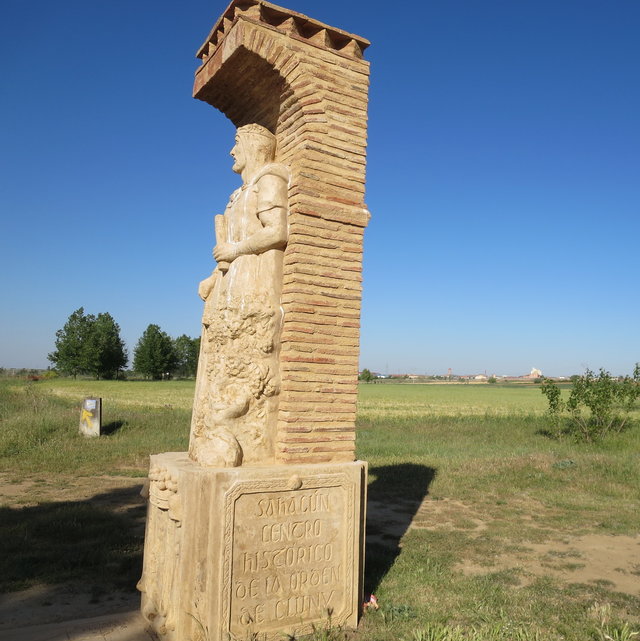
In Spain, the Way is marked with a mixture of yellow arrows, scallop shells, and municipal signs. Each region of Spain is responsible for their own trail markings, so things vary from place to place. Sometimes there are concrete bollards, and sometimes there are painted arrows, seemingly hastily scrawled. They’re almost always yellow.
See the yellow just past the Knight Templar?
But yes, you can lose track of the Camino even along the “crowded” Caminos. We met a Canadian woman who’d taken a wrong turn on her first day of walking, also on the Napoleon Route over the mountains. She’d climbed ten strenuous kilometers, but then after taking a break near the Vierge d’Orrisson, she took a farm road that took her back downhill…the way she’d come…still in France.
After a couple of hours of walking down a suspiciously empty road (there had been a crowd around her when she left St. Jean Pied-de-Port) she found herself in a small village that the locals assured her (in French) was definitely NOT part of the Camino.
She was too tired to re-climb the mountain, and the villagers were kind enough to let her stay the night. The next day she re-traced her steps, making the steep climb into the Pyrenees a second time, and re-joined the Camino route. (After that she was much more careful about watching the signs and the people around her.)
Lesson learned: if it seems like you’re off track, stop and ask. The locals probably know exactly where the trail is, and are generally happy to send you back there. And watch the crowd; if you’ve been surrounded by pilgrims all day and now there’s no one in sight, backtrack.
When in doubt, follow the crowd.
Getting lost is frustrating, especially when you’re already tired and don’t want to add more kilometers. But it’s nothing to worry too much about…and it will give you a great story to share with the other pilgrims as you linger over a well-earned vino tinto.
“On a hike, the days pass with the wind, the sun, the stars; movement is powered by a belly full of food and water, not a noxious tankful of fossil fuels. On a hike, you’re less a job title and more a human being….A periodic hike not only stretches the limbs but reminds us: Wow, there’s a big old world out there.”














 camino times two