Tinto de Verano

Today is the unofficial last day of summer. It’s also my birthday, so there are several reasons to kick back and enjoy a tinto de verano, the wine of summer.

rsz_img_2288

About halfway across Spain, Eric’s body mysteriously (and, it seems, permanently) decided to not like beer anymore. (No, it’s not a gluten thing.) But it was 90 degrees in the shade, and we were walking long(ish) days, so he needed something cold and refreshing to pick him up in the afternoon.

Something easy to sip, without the higher alcohol content of wine…

Enter tinto de verano, which is essentially red wine, ice, and a lemon-lime soda of some kind. A Spanish spritzer.

(Chowhound went to the trouble of posting a recipe, but really, all you have to do is mix equal parts bubbly soda and bold wine, and a lemon slice if you’re feeling fancy. San Pellegrino and Malbec are the preferred combination here.)

20691840854_c0223a6470_z

There was often a comical moment when a waiter would bring us the beer and drink we’d ordered, and would try to give Eric the beer and me the “girly drink.” (Just because his stomach turned against him didn’t mean I wasn’t going to enjoy a cerveza now and then…) It was good for a laugh, and also a new tag:

Tinto de verano: bebida para hombres!

21974786113_f1563701a4_z
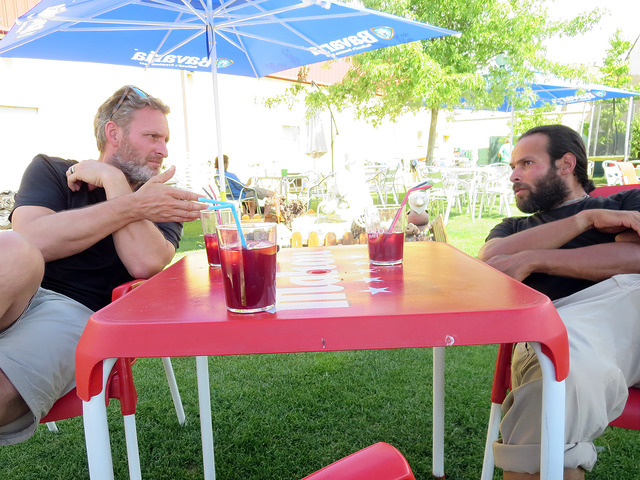
Notice the three beers and the one bebida para hombres

Here’s to the end of summer.

So, fellow Camino pilgrims, what was your after-walking drink of choice?


Is the Camino Safe for Women?

I was in a chapel in Leon the first time I heard Denise Thiem’s name.

“Did you hear about the American woman who disappeared?” our friend Rachel, a Canadian pilgrim walking alone, whispered, though not quietly enough for us to avoid the disapproving glare of a woman there to pray. “She was walking the Camino just ahead of us, and now she’s gone. The path near Astorga isn’t safe for women.”

My inner skeptic perked up. A pilgrim who was just missing? That sounded like a Radio Camino legend, passed along the pilgrim’s gossip network and getting bigger and more dramatic with every telling. (Early in our pilgrimage a fellow walker in France whispered to us that an elderly woman we’d met two days before had been beaten and robbed on the trail. We believed her, until we ran into the woman about a week later and saw she was fine.)

But Rachel was considering taking a bus past the section of trail she’d looked forward to hiking, which would mean she’d miss out on one of the most famous points of the Camino Frances, the Cruz de Ferro.

And she wasn’t alone. Overnight, it felt, everyone was looking over their shoulders, suspicious of every quiet stretch of trail. In the summer of 2015, Denise’s absence became a part of all of our journeys.

I broke my “no Internet” rule to do some reading, and learned that this time Radio Camino had it (mostly) right, and an American woman was indeed missing. She’d disappeared eight weeks before, on Easter Sunday, the same day that Eric and I flew from Seattle to Paris. She was single, a world traveler, and was last seen in Astorga. Then she’d just disappeared, and the media had jumped on the story. Two other women—one a Spanish local and one a German pilgrim—came forward with stories of being watched, or possibly chased, by unpleasant-looking men in separate incidents in the past few years. These, too, made international news, and the headlines made it sound like women were being accosted all the time.

As we got closer to Astorga, we met more pilgrims who were skipping sections, or delaying their own walks to join the search parties. We heard about a few people who’d abandoned the Way and gone home early, afraid for their safety.

This admittedly seems cold-hearted now,* but at the time I was underwhelmed. There had been no incidents since the disappearance, now months old, and even that was still wrapped in more questions than facts. I thought it was just as likely that Ms. Thiem had chosen to voluntarily disappear (I might read too many suspense novels), or there’d been some kind of accident. It felt like the media was hyping a danger that was no more than a possibility, and was scaring a lot of people unnecessarily.

Instead, the rumors persisted. I heard at least four times that a body had been found, an arrest made. Some of the rumors came with graphic details. None of them were true.

And when I came home, the fears followed me. I often heard, “I want to go, but I’m worried about walking alone/walking with other women/walking in a strange country. Is it safe?”

Here’s my simple, unequivocal answer:

Yes.

22569726266_f2b54c12a6_z


The stories are real, but they’re rare. There is, I’m told, occasional petty theft in albergues, and a handful of women have reported assaults over the past ten years. But when you take into account that a quarter of a million people will walk to Santiago this year, and almost half of them are women, by the numbers I am safer from violent crime on the Way of Saint James then I am in my own Seattle neighborhood.

There are no reliable, pilgrim-specific statistics to back me up on this, but their absence should also tell us something. My best googling efforts come up with only one or two individual crime reports from any given year. (The best collective source of information seems to be the Camino Crime Watch forum here.) France and Spain are first world countries, with responsible law enforcement and low crime rates.

I don’t say that to dismiss the concerns that people have. We all must walk our own Caminos, and that includes learning to listen to our instincts and address our fears. And it’s always a good idea, wherever you are, to live with a level of awareness. If something makes you uncomfortable, pay attention to it. If a stretch of road, or a person, makes the hairs on your neck stand up, slow down or speed up and join a larger group of walkers for a while. (On the Camino Frances at this time of year, you won’t have a hard time finding others.)

But fear isn’t the same as awareness. Awareness pushes us forward, and turns our senses on, but so often fear is the thing that makes us shut down and holds us back, in measures far out of proportion to the real risk.

Awareness says Pay attention.

Fear says I could never…

…walk alone.

…go to another country.

…trust people who are from another country.

…trust myself.

One of the reasons I went on a thousand-mile pilgrimage in the first place was because I didn’t want my fears of the unknown, and how I would react to the world outside my cultural comfort zone, to hold me back. Sure, there was a possibility I would be a one-in-a-million statistic, but that was a risk of being alive, wherever I was.

In 79 days I was never accosted or harassed, and I walked alone for a few hours of almost every day. None of the women I met along the Way were harassed or accosted. We walked through cities and wilderness, often relying on the grace and support of others.

And so now, when I hear people worrying about “what could happen,” all I can think is “what will happen is an adventure of a lifetime. Trust it.”
* In September 2015, a body was uncovered, and an arrest was made. Denise Thiem was a victim of a random, tragic act of violence, the kind that give us all nightmares. In light of that, I’ve considered and reconsidered writing about this, and about sharing my early reactions to the rumors. But at the same time, Denise’s story doesn’t change my conclusion. The amount of attention given to her death shows how unusual something like this is on the Camino. Denise Thiem was a woman who made a choice: to leave her job, to travel the world, to experience life. Honoring that, for me, means living as she did.

The Figeac Alley (Almost Wordless Wednesday)

Another one of those magical places that doesn’t make it into the guide books…

19339619394_4957be8315_z

This is an alley somewhere in Figeac, France, on a cloudy morning about 12 days into the Chemin du Puy (the Camino from Le Puy to St Jean Pied-de-Port).

Every time I look at this picture I find some new detail I hadn’t seen before. The books told me that Figeac has continuously existed as a way-stop for pilgrims since the 11th century, but that’s just a number on a page until I started to study the patchwork of construction techniques here in a corner that no one’s supposed to notice.

History here in southern France isn’t relegated to museums and tourist traps. It’s tucked into every alley, and provides the foundation for the entire way of life. For an American in a city that’s less than 150 years old, this long view of civilization and society was a somewhat mind-blowing part of my pilgrimage.

Plus, you know, there’s a chat.


The Church of the Sensory Overload

Sometimes the moments I remember are the quiet ones, when no one else was around. The mountaintop near San Rochegude. The tiny chapel past Miramont.

Then there are the moments that are the opposite—all noise and sensory overload and eight centuries of history piled on top of each other.

Like the Church of Santa Maria in Los Arcos.

We’d been walking for more than forty days. We were past the halfway point of our thousand-mile Camino, we’d had a week to adjust to the culture shock of Spain, and—though we didn’t know it—we were just a few hours from getting sick.

On the surface, it wasn’t the most exciting town. Tucked onto the edge of Navarre with a population of just over 1,000, it was neither the biggest nor the smallest place we’d seen. We found a pleasant private albergue in the center of town and settled in for a typical Camino afternoon of laundry and probably a cerveza.

The guidebook—or maybe it was our hospitalero—mentioned that the cathedral was open for visitors for a couple of hours in the afternoon.

This was a bit unusual in Spain. Unlike France, where churches were always unlocked, and usually unstaffed, in Spain we’d discovered mostly locked doors, or stern people sitting inside the door, charging an entrance fee. I have a thing against paying to visit a church, so we hadn’t seen much of the Spanish style yet. But Los Arcos was quiet, and we had arrived early, and we didn’t really have a pod of fellow pilgrim friends at that point, so…okay, let’s stop in and see what it’s like.

21127792179_ca2216d217_z

On the outside, it looked like most of the other churches we’d passed along the Way. (And the Way is designed to go past a lot of churches.) A 12th century building, under a stately tower with storks nesting on top. Plain walls. Not many windows.

But we’d barely walked through the doors before it was obvious that this was a cathedral like nothing we’d seen yet.

20691999414_6f131ca454_z (1)

We’d seen hints, in Puente La Reina especially, that the churches in Spain had a different aesthetic than the stark Romanesque and Gothic styles we’d mostly seen in France. The original bare marble and tall windows had been covered by heavy Baroque renovations and design. Ferdinand and Isabella’s gold from the New World had found its way to even the smallest of chapels.

IMG_2125

But nowhere and nothing we saw before or after was like the Church of Santa Maria.

Here, every single inch of every single surface was covered with something. Every pillar of wood and pew was carved. Every inch of wall had some kind of design.

IMG_2113

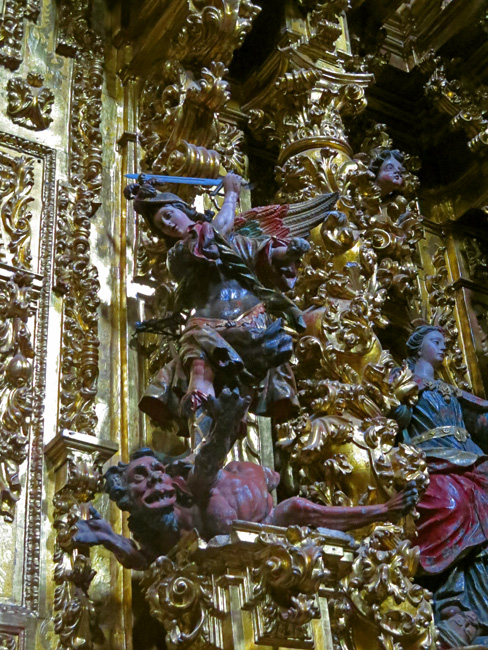
We wandered through this place for two hours, trying to take in the gilded wallpaper, elaborate carvings of saints, gaudy designs on the dome, paintings everywhere.

Nooks were filled with relics, statues, and a mannequin in a glass coffin that I still don’t understand.

21314698375_a80c8b6f9c_z

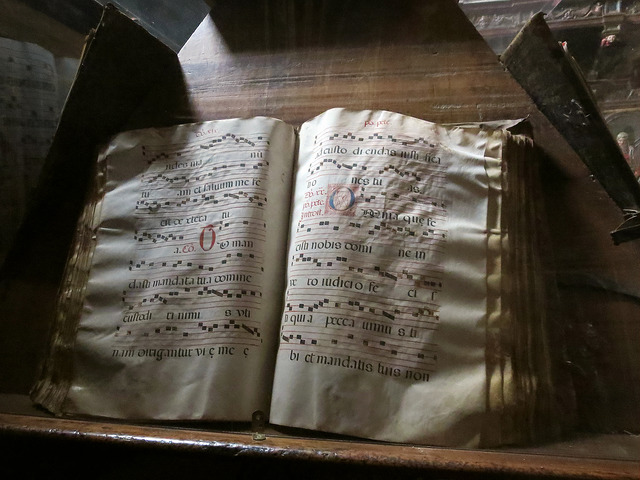
The choir loft was full of displays, including enormous old books illuminated on velum.

21127804139_b86f2e2ee3_z

The displays of saints around the room mostly depicted bloody battles and pious, serious saints.

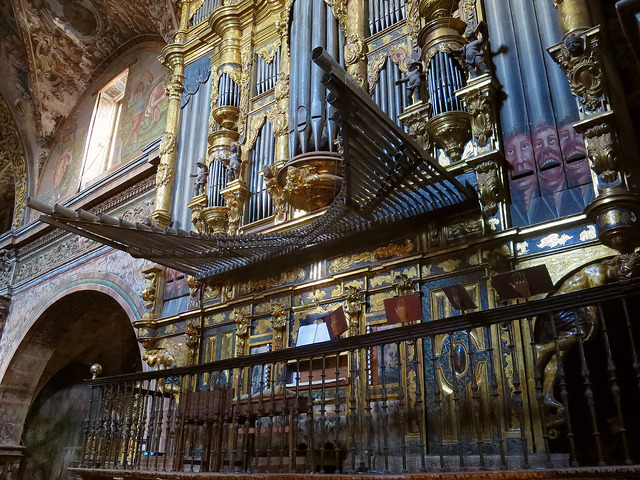
But then a pipe organ that had been added in the early 20th century was full of…cartoon faces?

21288438286_6c9d72040d_z

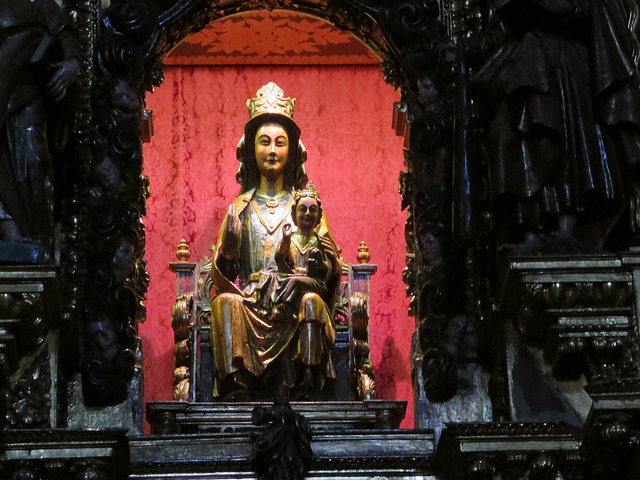
There was a pamphlet guide for visitors, roughly translated into different languages. It pointed us to one of the traditional (and mysterious) Black Virgins at the centerpiece of the altar. In 1947, during a renovation of the altar, it said “they removed her blackness.”

Umm….

21127805929_f4bf858d40_z

When the onslaught of images became too much, there were long shadows stretching  across a rose-filled cloister just outside.

21304042632_6004e832ac_z


The overall effect of the church left me a little stunned, my senses overloaded. But it also made me smile.

It was crazy more than beautiful, this visual representation of eight centuries of European Christianity, all in one giant room. It was like your grandmother’s overcrowded knick-knack cabinet, where everything from the antique china to the snow globe she bought in Vegas is crammed onto a shelf and threatening to topple out at any minute.

It was a bit like the Camino itself.

Shadows (Almost Wordless Wednesday)

“If you have no shadows then you’re not walking in the light.” -Lady Gaga

21126533030_7b160c6ab8_z

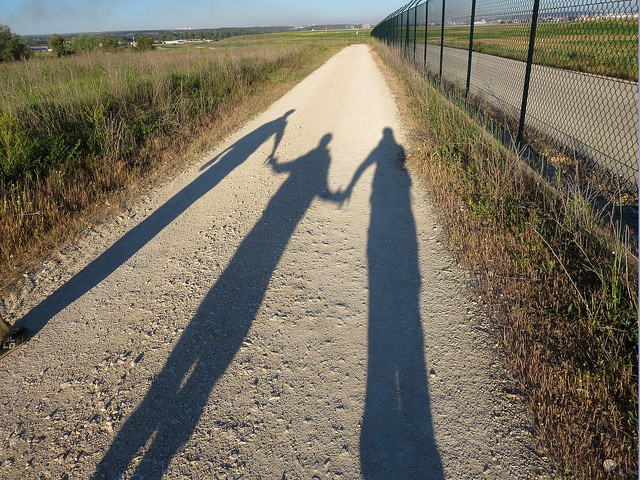
The shadow photo is an inevitable part of the Camino. When you’re walking west, day after day, and leaving early in the morning, day after day, it’s always there.

I played with our Camino shadows on the long, boring walk into Burgos. The Way skirts an airport and passes through the industrial suburbs…definitely not the most scenic or inspiring part of the journey. But it was also our last morning walking with Ian, our friend from Seattle who’d joined us on the Camino for a few days at the end of his own European vacation (touring Belgian abbey breweries…doesn’t that sound amazing?)

The sun was bright, the jokes were flowing, and our shadows showed us where to go.


PS. There are longer stories and more practical Camino tips coming, I promise. I taught my very first “Walking the Camino” class last weekend, and it was amazing…there’s so much excitement and interest in this. And I’ve got a backlog of things I want to share. But it’s also a busy work season, and deadlines loom. So hang in there…more good stuff is coming. 🙂


Afterlife (Camino Playlist)

A friend recently reminded me that I’ve been neglecting the Playlist here at Camino Times Two. Oops…

So here, for your listening enjoyment on a Wednesday…in the middle of what seems like a tough week…in the middle of a tough summer…in the middle of a tough year, is my absolute favorite playlist song for long walks, steep mountains, and rough terrain. I dare you to watch this and not smile.

Ingrid Michaelson’s “Afterlife” was my mantra song when I looked at the Pyrenees, and then when I tackled the even higher climb to O’ Cebreiro a few weeks after that. Those mountains looming up were my biggest fear going into the Camino…what if I just couldn’t do it? (I could, and I did, and so will you.)

What are you afraid of?

Setting out on your own?

That great big number of miles that you will walk before this is over?

Sharing space, and life, with strangers?

Traveling in a foreign country?

Don’t be…

You and me
We got this
You and me
We’re beautiful
Beautiful
We are
We are gonna be all right
We got
We got
We always got the fight in us


As always, you can view the whole Playlist in YouTube here. And if you have suggestions of the songs that meant the most to your Camino, share them in the comments.


The Chapel in the Middle of Nowhere

I had the luxury for the past couple of weeks of working on the book-in-progress almost every day. I’m slowly peeling away the layers of the story, and discovering more about my own journey as I try to share it.

One of the themes that’s coming out is that the most meaningful moments were not the ones I expected or planned for. The much-hyped towns (even Santiago itself) weren’t my favorites. Instead, what I remember are the nights when we stopped in a town that seemed less-than-inspiring, and then discovered it was full of friends.

Or the moments when in the middle of nowhere we turned a corner and stumbled on beauty…

From the book:

In the town of Miramont Sensaq, we stayed in a gite run by the local Amis de Saint Jacques—the Friends of Saint James—who serenaded us with folk songs and local instruments, and after a generous dinner led us in a rousing round of Ultreia before sending us off to our clean but crowded dorms.

The pilgrims around us that night all discussed the option of a shortcut in the next day’s walk. We could follow GR65 as it wound through the fields, they said, or we could cut three kilometers off our total path by following the road to the next village, and picking up the path there.

For the past three weeks, if anyone said “shortcut” I would jump at it. But there was something about this country, and about my hope for my new shoes, and the growing sense that our opening act on the Way of Saint James was drawing to a close. Whatever it was, when the crowd of pilgrims turned right the next morning, Eric and I followed the red and white arrows on the Way to Saint Jacques and turned left.

GR 65 crossed pastures and skirted hills, and we were far from any kind of road or village when we came across the chapel. Small and weathered, with tiles missing from the roof and patches of stone visible in the thick, unadorned walls. It didn’t look like anyone had visited, let alone worshiped here, for centuries.

20268413435_d9b23ef10b_z
The Elise de Sensacq

And yet of course it was unlocked.

This was one of the gifts of the Camino in France. Wherever we were, whether it was a famous cathedral or a tiny chapel by the side of the road, it was open. There was rarely anyone but us inside, but there was always a guest book, and we could skim through to see who had come before us.

The guidebook had a passing reference to this place, the Eglise de Sensacq. It had been a local place of worship eight hundred years ago, was rebuilt after the Wars of Religion, and wasn’t a major stop for the original pilgrims.

That’s for sure. This was not a cathedral built for show. There were no gilded altars, or icons of saints and martyrs. There was no stained glass. There was a Baroque plaster statue of the Madonna and child, but both were, kind of creepily, missing hands.

19647455703_3b8f426604_z

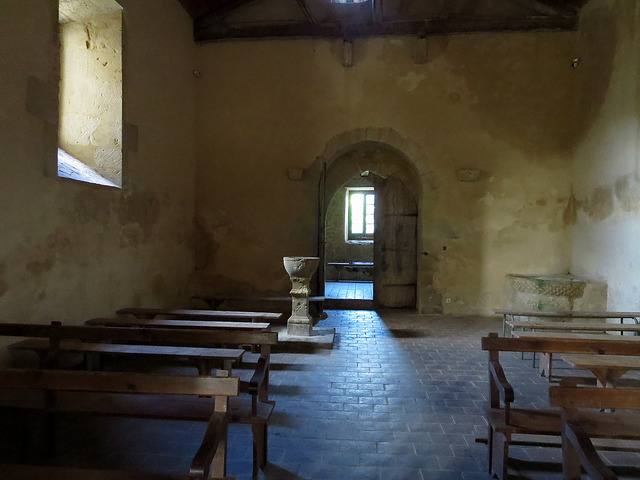
And yet the place pulled us in. We shed our packs and poked into the corners of the single room chapel, carefully navigating the uneven stone floors to look at the much used fireplace in the sacristy, and the dry stone basin by the door. We studied how the light coming through plain windows set into thick stone walls bounced off the exposed beams of the arched ceiling.

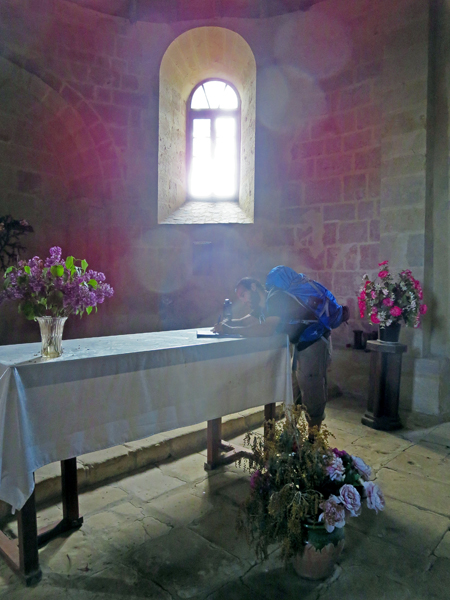
We noticed the flowers, both fresh and fake, scattered around the altar. Someone visited this place. Someone cared for it.

20268380225_e7930d7d9d_z

20260095342_3f9372f2ba_z


IMG_1662
Signing the guestbook
20274290551_a943f32830_z
A rough fireplace in the corner of the sacristy was well used.
20080388648_14695efa04_z
The stone step by the door is worn deep, touched by thousands of feet over hundreds of years.

Maybe it was the feeling that this was real, that there was no recreation or renovation here. This was how people lived and worshiped (and perhaps still do? Someone was caring for that altar…).

That peaceful little corner was one of the most beautiful places of my Camino.

And we would have missed it if we’d taken the shortcut.


Book update: the first half is drafted, and the proposal is (finally) done. Now things start getting serious. If you’d like to know more about what happens next, including the occasional chance to be beta readers for not-published-anywhere-else chapters, and be the first to know when there’s an actual publishing plan in place, please sign up for my “Book Club” mailing list here.


3 (Almost-Weightless) Camino Packing Hacks

Packing for the Camino? There are dozens of lists out there, and advice for what you should and shouldn’t take. Most of those conversations, though, revolve around the big stuff: what to wear, what to put on your feet, what kind of bag to carry, what kind of sleeping sack is best.

All of that matters, of course. But the small things also make a big difference, and I’m not just talking about the weight in your pack.

Here are the three small hacks I made to my Camino packing, based on the advice of pilgrims who went before me, that made a world of difference almost every day.

IMG_20160721_074611_edit

1. Mesh packing bags

Backpacks are great ways to get all of the stuff from one place to another, but when it comes to finding anything specific, they can seem like bottomless pits, where things get lost. There are plenty of expensive packing organizers, but I found that inexpensive mesh laundry bags (like these) worked just as well, or even better.

  • They’re lightweight, and it’s easy to see through to know what’s inside.(Mine also came in three different sizes, so it was easy to know what I was grabbing even in the dark.)
  • If I was sharing a washing machine with other pilgrims (most of us don’t have enough clothes to fill a whole load), I could throw my small things, like socks and underwear and Buff, into a bag and trust that they wouldn’t get lost or mixed up with someone else’s things.
  • And most important: mesh bags don’t crinkle or make noise!

Forget the challenge of sleeping through snoring. The bigger pet peeve of many gite/albergue pilgrims (ahem, me) is the noise of late-night or pre-dawn rustling through crinkly, NOISY plastic bags. (Please, I beg you, don’t use cheap plastic grocery bags to organize ANYTHING. Those are the worst.) If you’re worried about keeping things water-proof in the rain, bring plastic garbage bags and line the inside of your bag only on days when it’s raining.

I had three bags: one for the “evening clothes” that I could just grab and take with me every day to the showers, one for the “clean clothes” (extra socks, underwear, sleeping shirt, etc.) and one to corral the “rarely worn” (the rain jacket and hat, the cool-weather clothes when the weather was warm, etc.)


IMG_20160721_074251_edit_edit

2. Safety pins

Speaking of laundry, our daily “scrub filthy socks in the sink” routine was so much easier because we had a whole bag of giant-sized safety pins. (I’m told that diaper pins work even better.)

The humble safety pin has plenty of uses on the Camino:

  • Substitute for clothespins. Most gites/albergues have a limited number of clothespins on their outside lines, but stuff that’s not held down can blow away in a stiff breeze (or tired pilgrims not paying enough attention can accidentally grab the wrong clothes of the line). With safety pins, nothing disappeared or got lost.
  • Holding things to your backpack. There will be days when you’ll have wet clothes (that didn’t dry overnight, or that got rained on, or those sweaty socks you change mid-day—eew) while you’re walking. Instead of shoving them inside your pack, where they will mildew and smell, pin them to the outside. Pilgrims are wonderfully understanding about overlooking a pair of briefs swinging along there next to your Camino shell.
  • Mending tears. We never had a problem with this, but safety pins are good for temporary fixes to ripped clothes, backpacks, and more.


IMG_20160721_073401_edit

3. Shower bag with a hook

I owe a lot to the pilgrim who posted this advice before my first Camino: make sure your shower bag has a hook or some way to hang it from shower bars, as well as hooks. When you’re taking a shower in a new place every day, you’ll find yourself facing a variety of situations…and not a lot of amenities. Most gite/albergue showers along the Camino were single stalls with a curtain and three walls. You MAY get a single hook on the wall, but there’s almost never a shelf, bench, or other place to rest things…and the floor is always wet. So be prepared to hang everything you need to keep dry on a wall, or over a bar.

(This is another argument for mesh laundry bags, which often have hanging loops.)

I carried the REI Grande Shower Kit, which turned out to be more (size, weight, capacity) than anyone really needs for a 40 (or even 90) day Camino, but I was grateful for that hook every day.

**

Want more? I asked the members of the APOC (American Pilgrims of the Camino) Facebook group (the absolute BEST source for both information and inspiration) for their “almost weightless packing hacks.” Here’s what they said:

“I used hair ties to keep my rolled clothes together. Whatever hair tie was on what I wore that day went on my pony tail or braids.”

“I used my nano puff to cram in mini cotton pillow case.”

“I used a sarong as a skirt, a dress, a wrap, a purse and as a privacy curtain when I was on a bottom bunk.”

“I have a tiny and nearly weightless rolls-into-a-ball daypack that I used as a purse any time I was walking thru a town, out to dinner, buying groceries, etc.”

“A ChicoBag bottle sling. Virtually weightless. Holds bottle, guidebook, bananas, small camera, phone — all then readily accessible.”

“My shower bag was a thin fabric grocery sack. It was large enough to fit all my dry clothes and toiletries when I went into the bathroom, had long handles in case I lucked into a hook, but wasn’t fancy so it didn’t matter if I had to put it on the floor.”

“Instead of a sleeping bag, I made a me-size quilt from PrimaLoft and silk which weighs about 12oz. I switched from Crocs to Birkenstock’s new foam flip flops as my second pair of shoes and lost about 8oz.”

“My Buff! Besides keeping the sweat out of my eyes, it made a wonderful [night] mask that held in the ear plugs at the same time!”

“Cycling arm warmers for summer walking. That way I could skip a fleece.”

“Quick dry camp towel was medium to small in size and was all I needed. One bandanna served multiple purposes.”

“I had an s-clamp on my pack handle to hang it up.”

“If you wear glasses, use clip-on sunglasses instead of a separate pair of sunglasses.”


What are your Camino packing hacks?

“We’re All In The Same Boat Here” (Video)

I don’t know about you, but the news has been increasingly hard for me to watch recently..and equally hard to look away from. My heart feels like it’s already full to overflowing, and then something else happens.

I’ve been trying to take social media breaks and turn off the news after a certain hour every night. Instead, I’m re-exploring the Camino…the antithesis of all of this modern anger and fear-based behavior.

One of the YouTube series I love is the quirky Beyond the Way, which follows a young Australian’s Camino, beginning in Saint Jean Pied de Port. The whole series is worth checking out, with lovely images that will put you right back on the Camino Frances, and stories from people met along the way. But the most recent episode stands out for its timeliness:

This was one of the deepest, most fundamental truths of my own Camino:

“We’re all in the same boat here; we have to help each other.”

In a world that’s increasingly polarized between “us” and “them,” where “them” is often portrayed as an enemy not worthy of respect, the Camino is different.

When you’re a pilgrim, all of those “other” differences melt away. Wherever you’re from, whether you’re a conservative or liberal, whether you support closing the borders or opening them wider, whether you’re eighteen or eighty, whether you are the CEO of a company or an unemployed dishwasher, a police officer or an anarchist, you still have to put on your boots and walk. You’re going to get blisters, you’re going to get hot, and some part of your body is probably going to hurt. And if you’re lucky, there will be someone on the trail to share your journey. To carry your pack if you’re injured, or to buy you a drink to celebrate the day.

“When you are at your lowest, you will meet someone, who will lift you and get you back to where you were.”

Over and over, when we needed it people reached out…offering to translate, to make a phone call and arrange reservations, to share their food, or their knowledge, or their company. Often, we didn’t even understand one another. Yet with some simple phrases, and a lot of charades, we became friends. The world grew a little kinder.

Regardless of what happens on the news, this is my Camino truth: I can’t make the hills get flatter or make the path smoother to walk, but every day I have the opportunity to carry someone’s load, buy them a drink, and treat them like the valuable human beings they are.