Camino del Norte, Days 6-7: Basque Country

Zenarruza to Guernica: 18 km; Guernica to Larrabetzu: 17 km

41333074170_256b3c0580_z

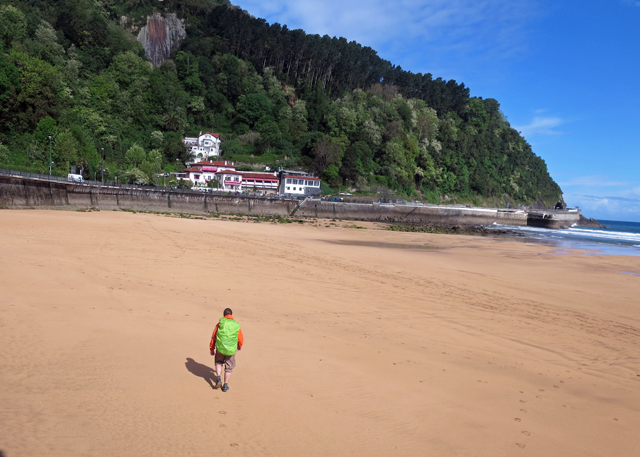
If I’m ever going to finish the stories of Camino del Norte, I need to start combining days. And actually, when I think about the end of our first week, these two shorter-distance Camino walks had a lot in common.

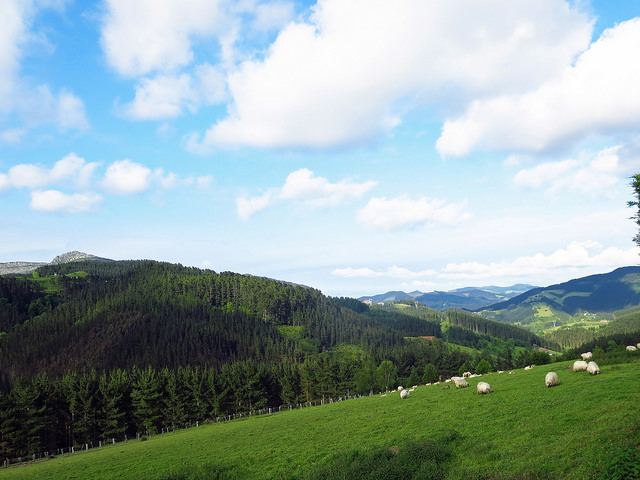
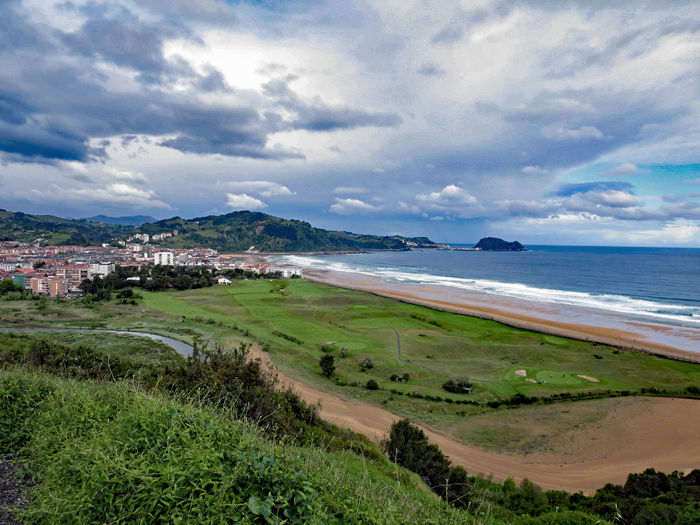
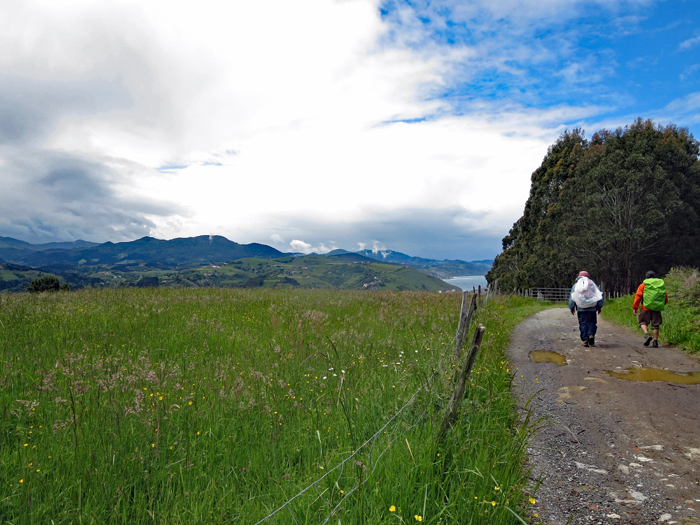
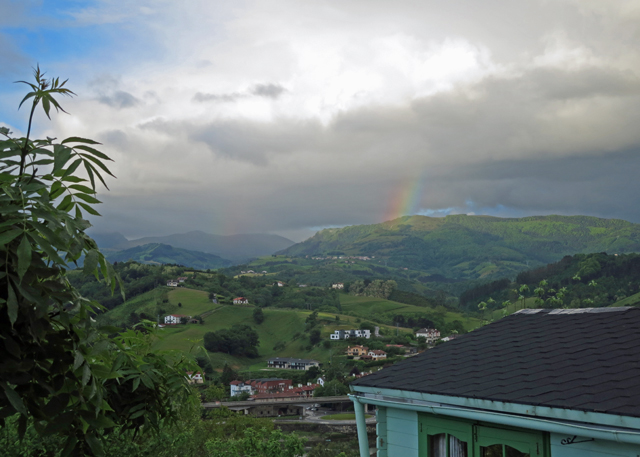
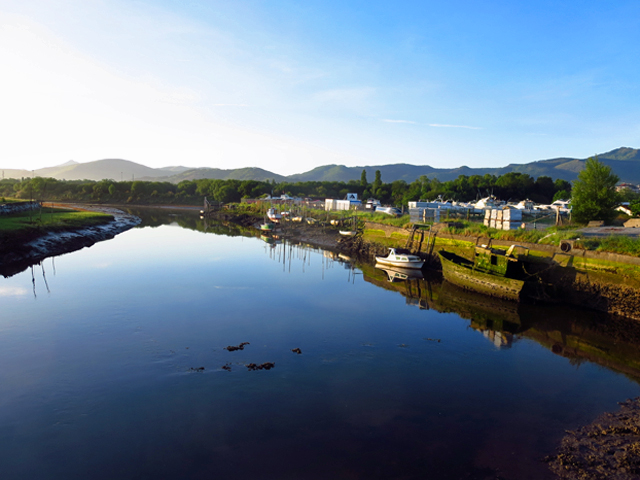
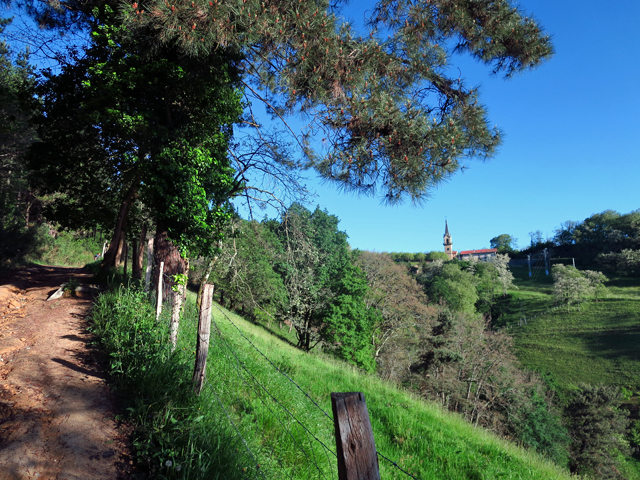
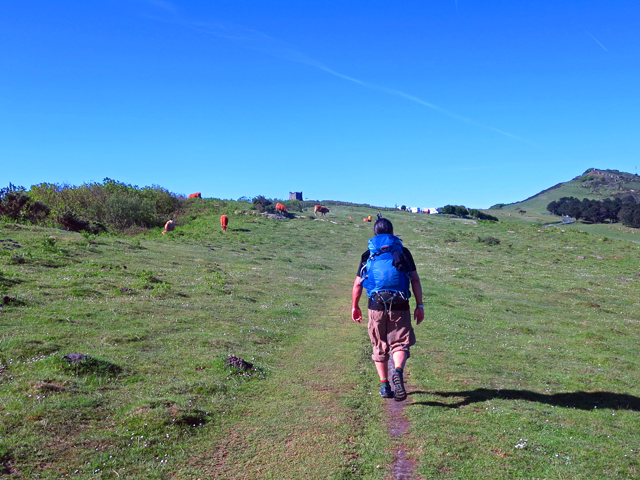
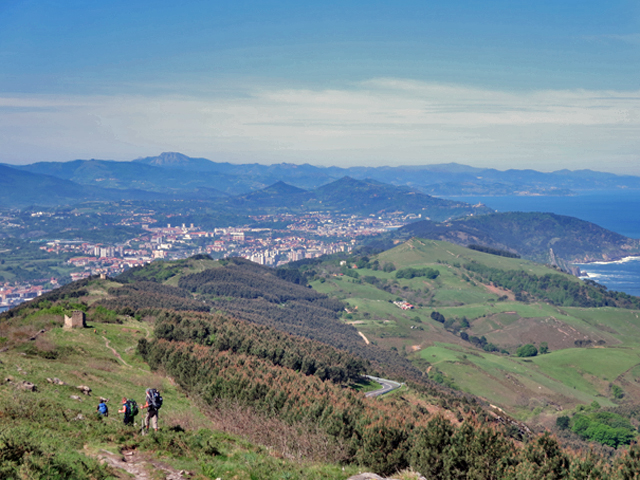
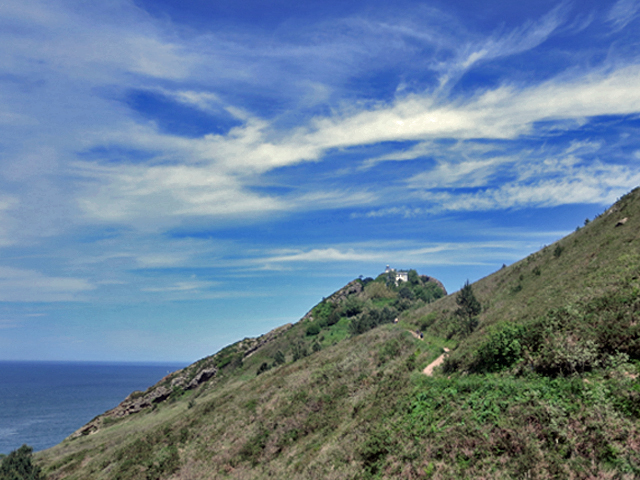
For thirty-five total kilometers, we were in the interior of Spain, one of the longest stretches of the whole trip that we were out of sight of the ocean. The countryside was hilly but dry, steadily ascending and descending through small Basque towns.

This was not Spain. This was Basque Country.

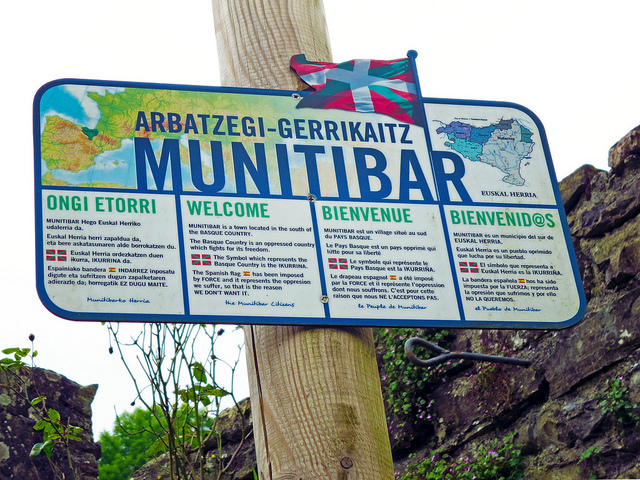
If we had any doubt, the sign welcoming us to Munitibar made it clear.
29272435928_21376cd6b0_z
“Welcome. Munitibar is a town located in the south of the BASQUE COUNTRY. The Basque Country is an oppressed country which fights for its freedom. The symbol which represents the Basque Country is the Ikurrina. The Spanish flag has been imposed by force, and it represents the oppression we suffer, so that it the reason WE DON’T WANT IT.”

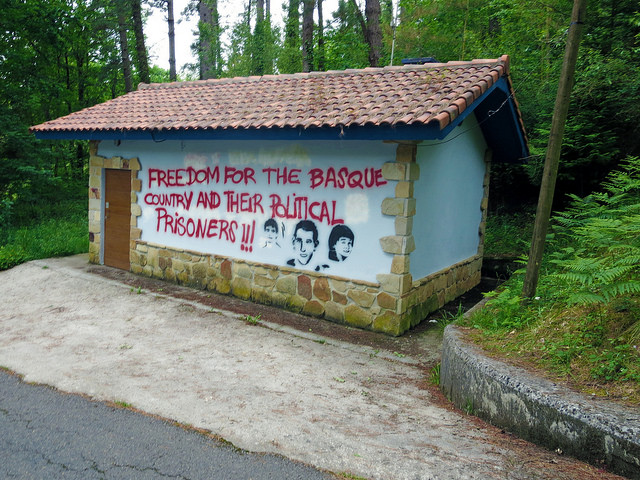
As did the graffiti (curiously, almost always in English).
41333078430_21450574a7_z

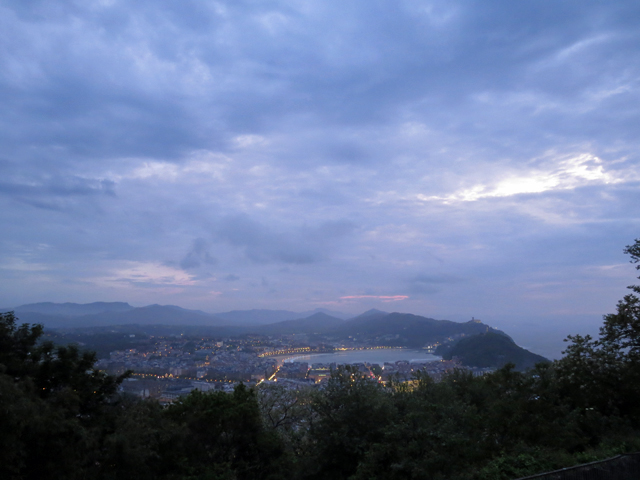
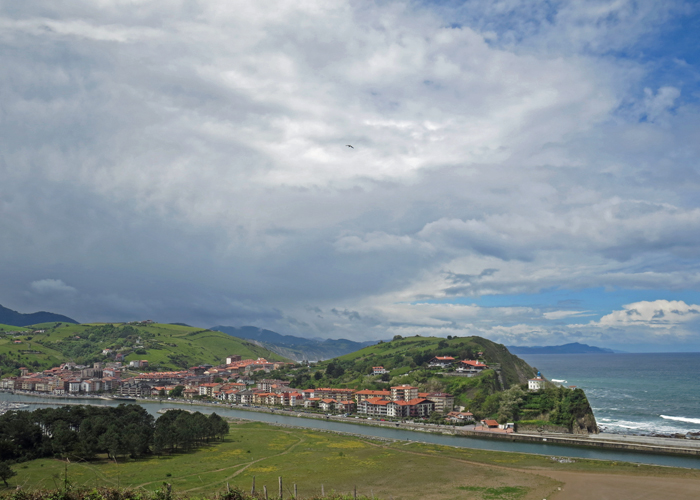
We stopped for the night in Guernica (Gernika in Basque), a city made tragically famous for its political opposition to those in power. The history of it fascinated me. In 1937, the Spanish Civil War was stalled. The dictator Franco wanted to defeat the Republicans in northern Spain. He had the support of Adolf Hitler’s German Lutwaffe, but not enough strength on the ground to conquer his fellow citizens. Guernica had not been involved in the war to date, but it was the spiritual center of Basque culture and an important transportation point for reaching Bilbao. So on April 26, a market day when everyone was outside and the city was crowded with visitors, the Lutwaffe swept down and bombed, and then strafed, civilians. It was one of the first acts of “terror bombing,” deliberately targeting civilians and non-combatants from the air in order to break the will of the enemy.

No one can agree on how many innocent people died in Guernica that day, but the devastation of the historic center of the city was immense, as was the outpouring of outrage from around the world. Picasso’s famous painting Guernica (which I saw, coincidentally, in Madrid last year) tried to capture the horror and has been called “modern art’s most powerful statement.”

29272441568_66a104ea39_z
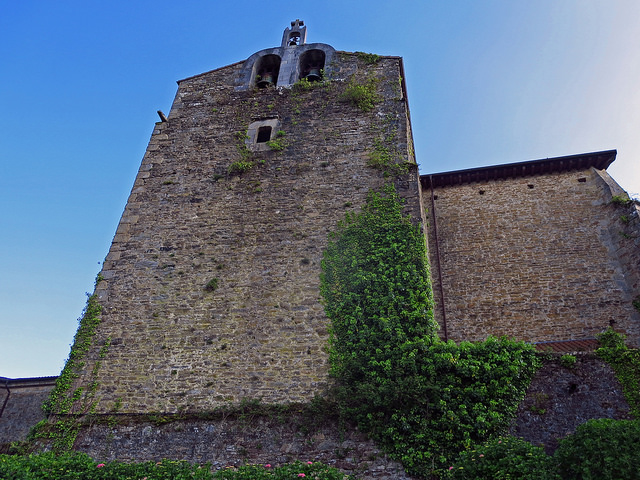
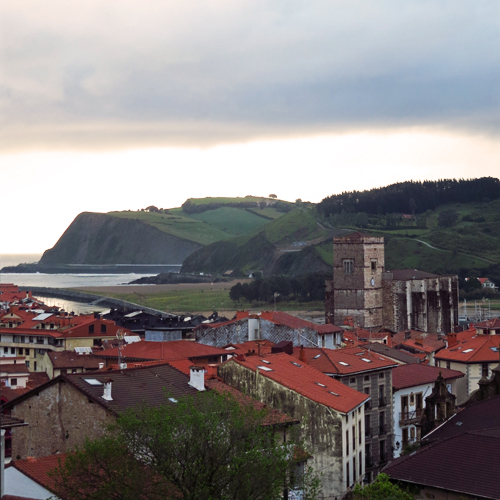
A tower left standing in Guernica

Today, Guernica is a thriving Basque center again. In fact, to be honest, I didn’t spend much time that afternoon exploring Guernica’s past. My feet were aching and swollen from the cumulative miles of the past week and the long walk to Zenarruza the day before, and so the best thing to do was rest, not try to tourist. Eric and I spent the afternoon in a sunny square with three pilgrim friends — Australian, Spanish, and French — sipping Crianza and watching kids play not far from the round market building that is one of the only structures left standing from that earlier time.

At least, that’s what I think the sign said.

Oh, the signs.

41333079920_432033153a_z
The incomprehensible, beautiful Basque language

The primary language of the Basque people is Euskara, a language that as far as I can tell, exists to take advantage of all of the X’s ignored by the rest of Europe. Linguistically unrelated to any other language in the world, it flourishes in Basque Country, where 93% of all Basques use it. Children learn Euskara as their first language at home and pick up Spanish only when they go to school.

Which leads me to what happened in Larrebetzu.

42239765565_f281f55811_z

We were enjoying a quiet afternoon in the small town on the outskirts of Bilbao, after another relatively easy walk. Eric and I had split up to find our own quiet corners to rest and journal. I landed on a bench in the center of the town square, which gradually filled with locals as they got out of work and school.

This is my favorite time of day in Spain, and perhaps my favorite thing about Spain in general. Every afternoon and evening, public spaces fill with families. Kids play and do homework. Adults sip drinks and gossip. Grandparents sit on benches and watch over it all. And here’s the crazy thing: no one plays with their phones. They are fully present and together.

Eric sat on the ground in another plaza, down a flight of steps and out of sight.

After a while, he noticed that a group of four small girls, all of them about five years old, was studying him curiously. They drew closer, and then closer again. He couldn’t understand what they were saying, but they were clearly talking about him.

Finally, the bravest one stepped forward and said, in English, “What are you doing?”

He looked up. “You speak English!”

They looked at him blankly. No, they didn’t speak English. They just happened to know one phrase. But now they were engaged.

The five of them spent the next hour patching together Spanish, as the girls tried to teach Eric Euskara words for whatever caught their attention, from balloons (globoak) to little brothers (anaia txiki). They took their responsibilities as tutors seriously. They corrected his pronunciation and quizzed him every few minutes to see what he remembered. This continued until their parents came to take them home.

Eric was exhausted from all the attention, but he still talks about that afternoon as one of his favorite memories. And we started being intentional about lingering in plazas and squares in the evenings, seeking the heart of each new place.
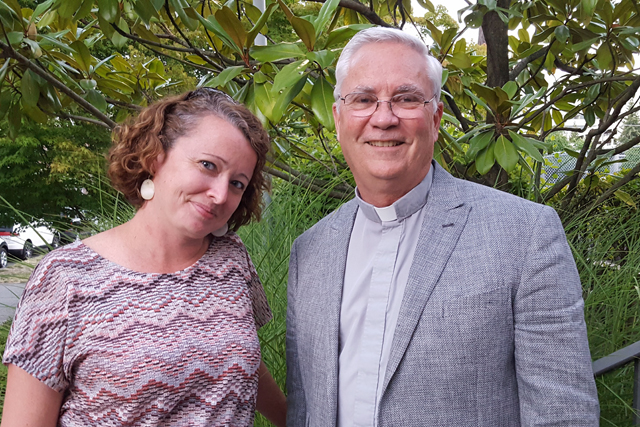
 

Beyond Even the Stars: A Visit With Kevin A. Codd

My summer is in its full “manic mode,” with work and pre-release book stuff and social engagements filling up every corner of the weeks, and travel every weekend, and my poor Camino del Norte story sitting neglected here on the blog. I’ll get back to it, I really will. But before that, I need to tell you what happened last week:

I had the opportunity to meet one of the people who first inspired me to walk to Camino.

2018-07-11 21.00.48

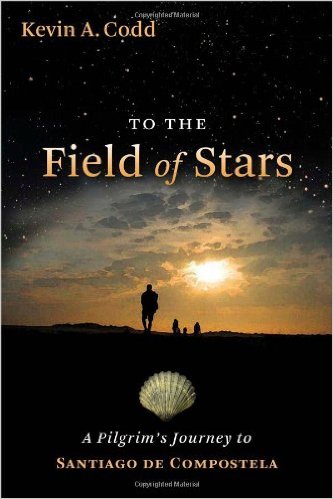
If you’re a reader who is interested in Camino stories and memoirs, you’ve probably come across Kevin Codd’s To the Field of Stars. (I first reviewed it a few years ago on this list of Camino Frances memoirs.) Published in 2008, Kevin’s whimsical, practical story of his long walk on the Camino Frances drew the attention of an English-language previously unfamiliar with the Way of Saint James.

51cODJMSvyL._SX331_BO1,204,203,200_

“I am about to share here a story about stars that dance. . . . If the very thought of seeing stars dance piques your curiosity at some deep level of your soul, then pay attention to what follows, for the walk to the Field of Stars, to Santiago de Compostela, is a journey that has the power to change lives forever.”

(Kevin A. Codd, To the Field of Stars)

Then, about a year ago, I heard rumors that there was going to be a sequel. Father Codd (yes, Kevin’s a priest) had returned to the Way, and this time he walked through France.

Kevin Codd on a French route? Sign me up.

I pre-ordered Beyond Even the Stars, which released in February, and took my time reading it, finishing it the night before we left for Camino del Norte.

51V1f7AyL5L._SX331_BO1,204,203,200_

This was a different kind of pilgrimage story – not as much the joyful, communal walk across the heat of central Spain, surrounded by memorable characters and plagued by blisters. Instead, this was a quieter, introspective story. This pilgrimage starts not with a train trip to a common gathering point, like most of us have, but right from Kevin’s front door in Belgium. There are no other pilgrims to keep him company here, far away from the marked, historical routes. There are no rushes for beds in albergues; in fact, Kevin is almost always the only pilgrim in the refugios that exist, scattered few and far between.

In the place of those familiar themes, though, Beyond Even the Stars is full of devotional contemplations about life, faith, nature, and family. And there are even deeper moments of loneliness.

There are setbacks on Kevin Codd’s long walk to Compostela…to say more would be a spoiler. But the honesty that he brings to his unexpected detours are what make the story worthwhile. The more I talk to people who walk The Way, the more I see that most pilgrimages don’t unfold quite as expected, but that doesn’t make those experiences less important…or less holy.

As I read, I found myself marking passage after passage.

“I hear a swelling swoosh; from the south a bullet train whizzes into view on the tracks, knives through the landscape in a matter of moments, then disappears with a whoosh. It has just covered in a few seconds what has taken me hours to walk. That very fast train reminds me that, as a pilgrim, travel is made holy in its slowness. I see things that neither the passengers of the train nor the drivers of the automobiles see. I feel things that they will never feel. I have time to ponder, imagine, daydream. I tire. I thirst. In my slow walking, I find me.”

(Kevin A. Codd, Beyond Even the Stars) 

When it was time to seek out endorsers for Walking to the End of the World, I approached Kevin with more than a little nervousness. I mean, this was THE Camino memoir writer! What if I did something embarrassing?

Well, Kevin was quick to respond and gracious enough to agree to endorse, even though, as he gently pointed out, I’d done SEVERAL embarrassing things, including a pretty major mistake in explaining the story of Saint James himself. (Which, thanks to Kevin and the quick work of Mountaineers Books to fix the page proofs, you’ll never see.)

Despite that, here’s what he said:

“Beth Jusino doesn’t pull any punches in her vivid and engaging account of the pilgrimage she and her husband made, but happily she also shares with us her small victories and the many lessons she learns about herself, her marriage, and just plain life. Perhaps most universal of those lessons is contained in her ‘Santiago Moment’ near the end of the book: gratitude!”

I’m all tingly just reading it.

In our exchange about the book, Kevin mentioned that he was going to be in Seattle in July, at the appropriately named St. James Cathedral, for a reading of Beyond Even the Stars, and would I like to come? Well, of course!

In person, Kevin is the same warm, funny, whimsical, faith-filled person that he is on the page. His audience filled the parish hall and peppered him with questions. He patiently stayed and signed books and chatted with visitors long past the time he should have gone off to dinner. And he did it all, it’s clear, because he loves the Camino.

So okay, maybe just one more quote:

“To feel the pull, the draw, the interior attraction, and to want to follow it, even if it has no name still, that is the ‘pilgrim spirit.’ The ‘why’ only becomes clear as time passes, only long after the walking is over.”

(Kevin A. Codd, Beyond Even the Stars)

If you’re curious about the idea of pilgrimage “off the beaten track,” or experiencing the history of pilgrimage through the eyes of someone who’s dedicated his life to God, this book is for you.

(It’s available online wherever books are sold, including Amazon, Barnes & Noble, and IndieBound.)

Camino del Norte, Day 5: The Monastery

Bario Ibiri to Monasterio de Zenarruza: 27 km

29164233318_e1e42ce292_z

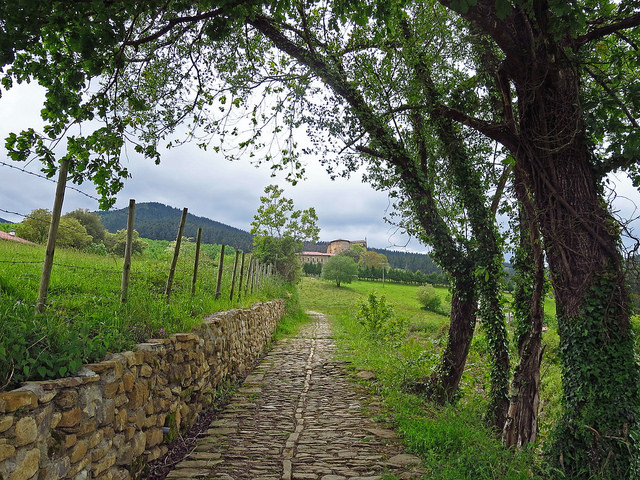
The final stretch of trail to Zenarruza was steep and paved in what’s called the “original road,” which may look pretty, but any Camino pilgrim will tell you is the absolute worst thing to walk on. Cobblestones are uneven, sinking over time into an ankle-breaking, knee-destroying obstacle course that not even my physical therapist would inflict on me. The stones are slippery in the rain, or in the shade where moss grows, or just in places where they’re worn smooth. It’s the kind of path where you have to watch every step, especially at the end of a long day.

42133962455_892892a15c_z

And Day 5 was long: a little over 27 kilometers (17 miles). The first 20 were remote, passing no towns or services. The sky was overcast but dry, leaving only patches of the miserable mud, and we mostly walked on logging roads through forests and past fields full of calves and lambs, the signs of spring. Walking with Peter, we climbed, and then descended, and then climbed again to a high point of about 425 meters (1400 feet) before the path dropped sharply all the way back to almost sea level in Markina-Xemein. Here, at last, we found a place to sit and refuel with tortilla patata and our refueling beverage of choice (coffee, beer, a shot of orujo…)

We were all tired, my feet were throbbing, and it was tempting to stay in the perfectly interesting-looking convent albergue right there on the square in Markina. Zenarruza was still almost two hours and another 320-meter climb away.

But the chance to stay in a remote monastery that dated back to the 9th century couldn’t be passed up. The Monasterio de Zenarruza was a key part of the Camino story along the northern coast. According to their website:

The existence of a hospital to accommodate walkers and pilgrims highlights the importance of Zenarruzas a place of passage since ancient times.

Shortly after starting its journey, the community had to ask for protection from King Juan I , before the assaults suffered by the two sides that fought in the area in the 14th century; the king agreed to this and made it a condition that a hospital or shelter be erected to receive all those who passed through the place . For their maintenance he granted them the rents of the Church of Bolívar .

And so Eric and I rallied, pulled on our packs, and set off again. Peter, uncertain whether to continue or not, wished us well and ordered another glass of wine. (He eventually decided to make the climb, and arrived not long before dinner.)

We climbed, driven by the rest, the meal, and the ever-present worry that an albergue would fill before we arrived. (That never actually happened; it’s just where my Type-A plan-ahead nature runs up against the take-each-day-as-it-comes nature of the Camino.)

42317505004_7c32dd3d9a_z

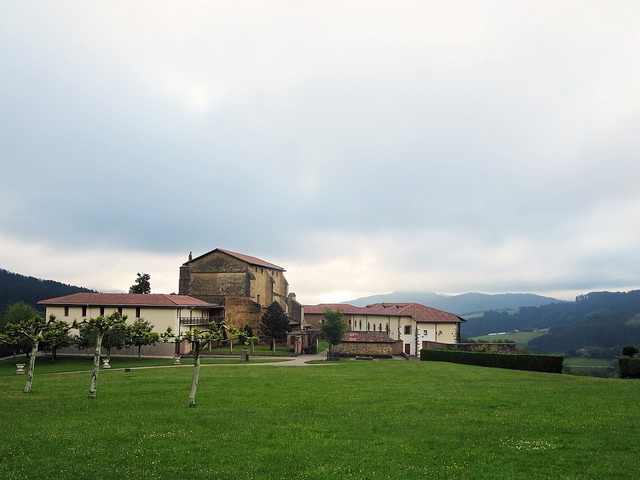
As soon as I saw the Monasterio de Zenarruza, I knew that the final push had been worth it. The sturdy collection of stone buildings, fashioned for protection against invaders as much as sacred rites, stood on a hill surrounded by rolling fields of green. At one time, this had been an important collegiate church, sitting at a key crossroad for trade. But in the 19th century, as the pilgrimage to Santiago had started to lose its pilgrims, the monastery declined. Other roads, leading to bigger towns, drew the traffic. A fire burned the original pilgrim hospital. The number of brothers joining the church dropped.

Today, things were quiet, the only sound coming from the low chimes of the livestock bells across the street.

42317513944_cb1f916e9a_z

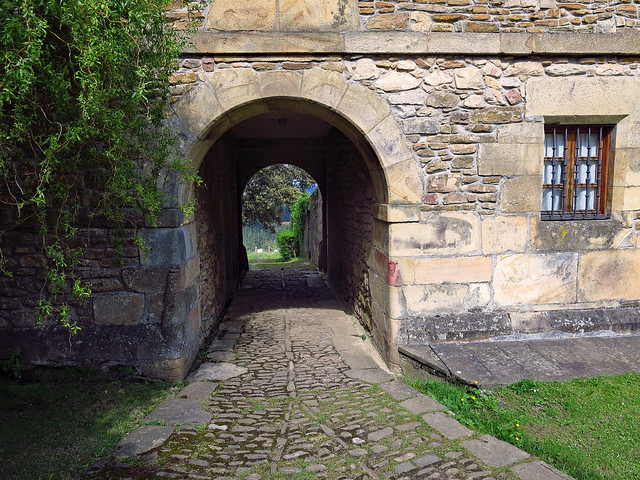
In fact, I realized as Eric and I passed under the arch and into the courtyard, there were NO other sounds. Where were the people? I knew that there were at least half a dozen other pilgrims here somewhere – a group of young Germans had stopped at our café table in Markina and said they were headed here. And surely there were monks, or monastery staff, or…someone to show us where to go?

43036425001_ff29fd68a4_z

But the courtyard was deserted. The small office/gift shop was locked and dark. I looked into the church and the cloister, but there was no one there.

Just as I was starting to worry, a monk came striding around a corner, his black robes swinging behind him and a calico cat close to his heels.

“I will be back,” he said, in a tone that might be brusque and might just be busy. “But first, the cat must eat.”

I was utterly charmed. (I’d see this same monk later, being followed by a different cat. “We have eight,” he’d explained with a roll of his eyes.)

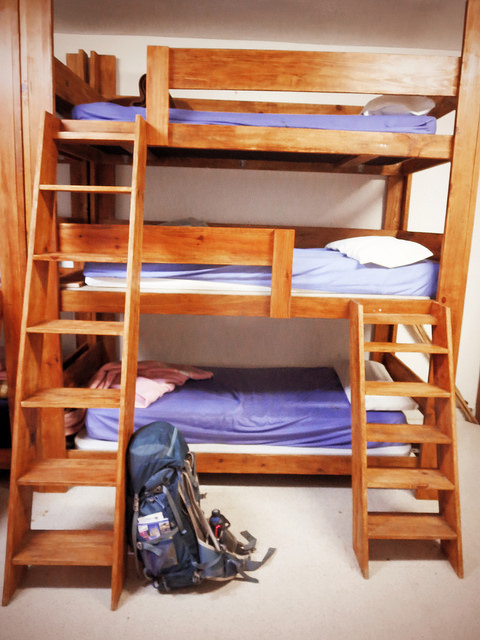
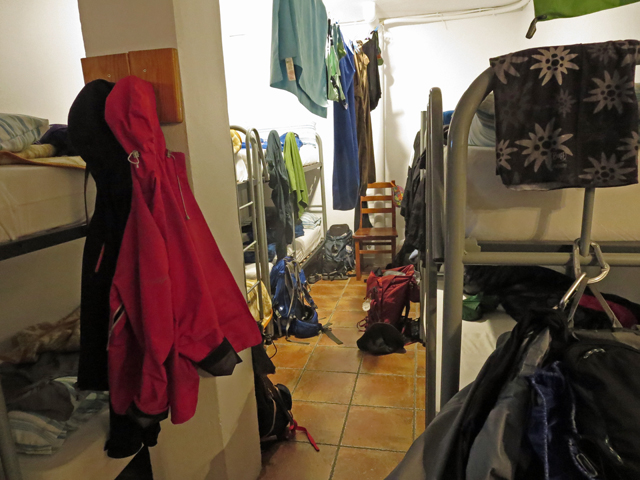
The next few hours were some of my happiest of the trip. The brother eventually came back and pointed to what probably used to be a storeroom built into the foundation of the complex, where a dozen beds stacked in triple bunks provided us shelter. The showers were warm, and I hung my towel on a railing with a view.

28167498417_16458d6bbb_z
My first triple bunk

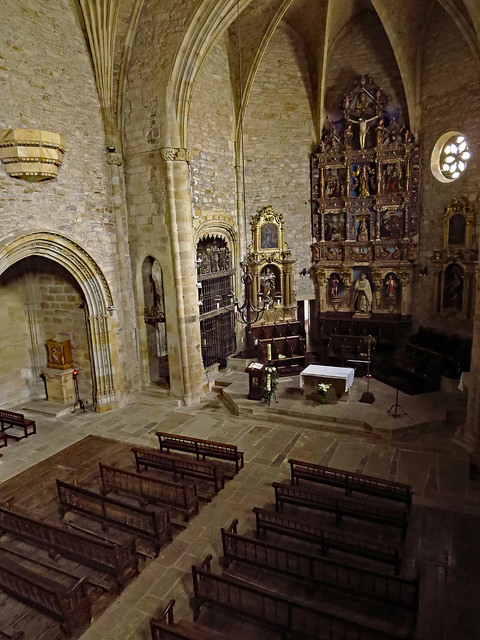
Once the daily tasks were over, I hobbled around, taking everything in. The 15th century church itself, Gothic and solid, reflected the austerity and simplicity that I’d come to appreciate from the Cistercians, relying on soaring ceilings and simple (by Spanish standards) altars instead of walls full of gaudy gold. I circled the building, touching rough walls and pausing before a cemetery.

28167582277_4fb61d3ce7_z

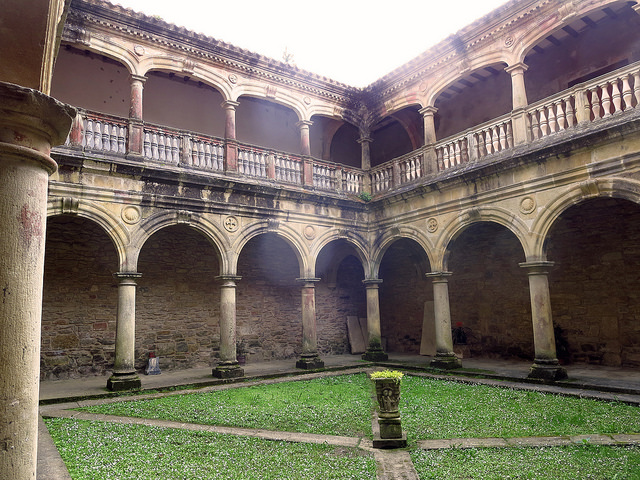
But it’s the cloister of Zenarruza that drew me, like almost everyone else who passes by. Old and moss-covered, the grass-filled courtyard reflected light onto delicate arches etched with the scallop shell and the cross of St James himself.

41226044500_deac0b4652_z

I sat on the stone floor of the cloister, my swollen feet soothed by the cool brick, the rest of me sheltered from the breeze outside. For a while, I just stopped. I pushed aside my plans for the next few days, or even hours, and I forced myself to just be. I listened to the echoes of my own voice as I hummed Ultreia. I imagined the abbots and brothers walking slowly along the balconies at the monastery’s peak of influence in the 13th century. I watched the shadows move across the stone.

“Learning how to be still, to really be still and let life happen – that stillness becomes a radiance,” says Morgan Freeman.


In that cloister, I found a moment of radiance.

The feeling followed me through the rest of the afternoon and evening. At 7:30, the pilgrims joined four monks, possibly the only ones still living in this fading place, for evening vespers. Their wavering voices echoed across the almost empty sanctuary.

When dinner was over, they directed us to an open window of the refectory, where they passed us a giant pot of hearty vegetable and pasta stew. The church, as it always has, cares for its pilgrims and asks nothing in return (although a small box on the wall was there for anyone who wanted to make a donation, to help support the care of pilgrims who followed us).

28167503637_e1660296af_z

And pilgrims care for one another. The Germans had bought some beer, brewed here at the monastery, from the abbots. A French pilgrim we’d met in Izarbide pulled out a bottle of wine. Those who were bilingual translated. Those of us who aren’t learned to speak slowly and listen intently.

As darkness descended, I made one final lap of the complex, a walking meditation of gratitude.

42317582324_c1ddd907a8_z

And then, while light still lingered on the horizon, I slept.

Camino del Norte Day 4: The Mud

Zumaia to Bario Ibiri: 18km

42317533394_359bf7b5fc_z
The benefit of all the rain on the Camino del Norte: stunning shades of green

“I seem to be on a road, walking, greeting the hedgerows, the rose hips, the apples and thorn. I seem to be on a road walking, familiar with the neighbors, high-handed with cattle, smelling the sea, and alone.” Annie Dillard

We woke to dry skies on Day 4, but the previous night’s soaking rain had left its mark.

The first bit of the walk was glorious. The fields were glowing and green. The sea on our right was a moody shade of grey.

43036392621_49c6cc1da7_z

The paved farm roads were smooth and empty, and we walked, on and off, with Peter and the two women we called The Giggling Germans (to distinguish them from The Tall German and The East Germans and The Young German…we met a lot of German pilgrims on the Norte.)

28167542527_b782c38d9b_z

A note about Camino nicknames: this is something everyone does. There are people you see every day, walking at about your pace. They’re on the trail, in the cafes, and often in the albergues. But for whatever reason—be it language differences or just lack of opportunity—you never formally introduce yourselves. Conversations on the Camino often skip over the mundane practicalities of normal life like What’s your name or what do you do for a living, and focus instead on the immediate experience – would you like more wine and wow, that was a steep hill to climb. And so we all develop private nicknames for one another. For many people we met, I know that Eric and I will always be simply “the Americans.” (Or, in Eric’s case, “the American with the warm brown eyes.” He had a fan club among women of a certain age.) On some level, we were all so close, sharing experiences and sleeping quarters and laundry lines for hand-washed underwear, that names were almost unnecessary.

Eventually, though, my pilgrim pack veered off the paved road and into The Mud.

41226005850_e3a5a14392_z
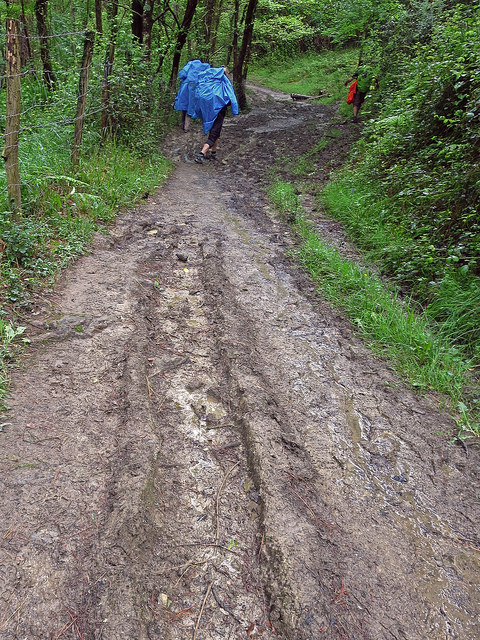
This photo doesn’t begin to show how deep and treacherous the Camino mud was

This is capital letter, proper noun Mud. Slick, slimy, and ankle-deep, tracking up and downhill, with barbed wire fences on either side. Serene goats and cows watched from the other sides of the fences, reminding us that the mud was likely not just dirt and rainwater.

Forget the steep climbs and the steeper descents on rough bricks. The real test of a Camino pilgrim happens when there’s standing, opaque, smelly water. Will they plow through? Step nimbly on rocks and branches? Fall face-first into the mire?

29164210118_0dfb349b04_z
Thanks, Hoka One One

Not for the first time, I said a blessing for my ankle-high, water-resistant, can-survive-anything Hoka One One boots, and another for my stabilizing trekking poles, and I plowed through. And while I had a few close calls, the boots held up, and I stayed up, and I emerged with dry feet and muddy rain pants.

Looking back at the maps, it was probably only about three kilometers of actual mud, but it seemed to go on forever. It was comically hard, and then just hard, and then downright frustrating. Would it never end? Finally, Eric, Peter and I emerged into the town of Deba exhausted and triumphant, and we were rewarded with another new Camino method of transport: an elevator.

29164214548_26e297ef81_z
The waymarked, Camino-approved elevator in Deba

Yes, there is a public elevator, waymarked with a yellow arrow so it’s “official,” that takes residents and visitors up and down the steep slope of the town. We dropped about three flights of stairs into the heart of town and rewarded ourselves with a hearty lunch of tortilla and Basque sidra (a light, very dry cider) before moving on for one final ascent of 300 meters, once again in the mud, to the tiny hamlet of Bario Ibiri and Albergue Izarbide.

Once again, we were back in what was probably a cow barn once upon a time, but it had been converted into a practical space for about 30 muddy pilgrims. There were big rooms of bunk beds, a modern bathroom, and lockers for our belongings. The outside space, like the albergue in San Martin, was spacious, looking out over spectacular views. But once again, the rain hit just as we arrived, and those cheerful picnic tables and lounge chairs were out of our reach.

29164217028_630f331978_z
Albergue Izarbide

So instead, I curled onto a corner of the couch, trying to stay out of everyone’s way as they moved through the daily routine of showers and clothes washing. I was tired and cranky, my body still trying to adjust to this new rhythm. I wanted a couple of hours alone to journal and think and, okay, to sulk a little. But Kiwi had other plans for me.

No, Kiwi isn’t a Camino nickname. It’s his real name.

41226025010_b08f391bd6_z
Kiwi vs. pig. My bet’s on Kiwi.

Kiwi is a small white dog who was walking one week of the Camino del Norte with his person, a young Madrileno named Gabriel. When we’d met them both in San Martin, I’d tried to keep my distance. I was a little judgmental of the whole “dogs on the Camino” idea. Most albergues wouldn’t allow dogs, for obvious reasons of hygiene and allergies in shared sleeping quarters, and Gabriel was having a hard time finding warm spaces for his muddy, smelly, damp canine friend.

But Kiwi was irrepressible and, it turned out, irresistible. On the trail, he was fearless and explored everything. (Which made him less of a white lap dog and more of a mud-colored, dreadlocked ball of wet fur.) He confused the sheep and challenged the alpacas and had to sniff everything. You couldn’t watch this perro peregrino and not smile.

In the albergue’s outer room that afternoon, Kiwi also seemed to be looking for a place to be out of the way. Preferably a warm, dry place. He chose me.
IMG_20180514_1732355

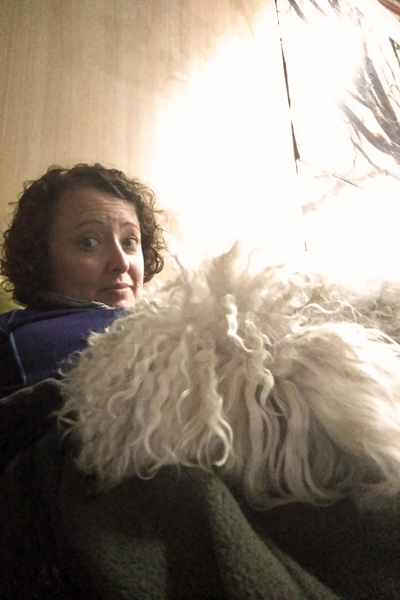
It was pretty much impossible to say no to that shaggy face, and so I scooped him up (in Gabriel’s sweatshirt, since I was wearing my only dry, cleanish clothes), and he settled into my lap for a long, twitchy nap (his, not mine). Eric and Peter kept me stocked with sidra, and for the rest of the afternoon I accepted my unexpected calling: dog lap.

A pilgrimage is always full of surprises.

IMG_20180514_1732039

Camino del Norte, Day 3: The First Beach and Convent

San Martín to Zumaia: 16 km

We woke up in a cow barn, walked on a beach, and fell asleep in a convent. Which, when I think about it, sums up a lot of the Camino del Norte in a single sentence.
IMG_4188

There are a lot of ways that pilgrims decide how far they will walk in a Camino day. Some people just follow the recommended stages of whatever guidebook they’re using. Others map it all in advance, making reservations for every night before they ever leave home. Then there are those who don’t know when they set out in the morning where they will stop that afternoon; they walk until they feel tired and then find a place to stay wherever they are. Still others decide the maximum distance their body can go in a day, and they push themselves to test their limits.
For me, every night I study my guidebook, check what my friends and fellow bloggers recommend, and pick a destination that sounds interesting. That’s how, when we set out on Day 3, I knew that it would be a short day, because I didn’t want to miss the chance to sleep in Convento San José. I’m a sucker for a historic building, especially one that promises two beds per room.

IMG_4100
Approaching Zarautz

The previous day’s rain had turned into passing showers, and we skirted the river near Orio and returned to the ocean, following the coast south past golf courses toward the modern, beachside resort town of Zarautz. This was our first chance to actually walk on a beach, and test how the weight of a pack changes the ways our feet sink in the sand.

IMG_4103
A beach shortcut

At the end of the beach, the path split. We could climb up the steep hill and experience what the guidebook promised were “wonderful views,” or we could follow the sea wall along the ocean. Still entranced by the sparkle of water and the sound of the waves, and conscious of the waves of ominous clouds, we opted for the low route. The path was crowded even with the threat of rain on the horizon, but after the past two remote days it was fun to people-watch, and there was a rowing race happening just beyond the rocks out on the choppy water. I spent a few years rowing crew when we moved to Seattle, and I couldn’t stop watching the smooth motions of the teams as they pulled over swells and against currents. (On further research, they were Basque traineru, originally fishing boats now used for competitive rowing. The videos of similar regattas are super cool.)

IMG_4121
A traineru regatta

We walked with Peter, the Australian we’d met the night before. He was on his first Camino at 74, carrying an enormous pack and relying only on a set of pages he’d printed from Gronze. I tried not to regale him with too many of my old stories and new advice.

We took a break in Getaria to wait out a passing shower and fuel up with tortilla patata and café con leche, and then it was back into the hills for the final stretch to Zumaia.

IMG_4147

Though the day’s walk had been short and easy, the final half hour seemed to take forever. We could see the old city, with the blocky cathedral rising on the hill, but it never seemed to get closer. We cut inland along an industrial river, crossed a bridge, followed the other side of the river down, and finally, finally reached the old city.

IMG_4153

The hovering clouds reflected my mood of growing impatience as we climbed narrow cobbled streets. The town was beautiful, but I was unsettled.

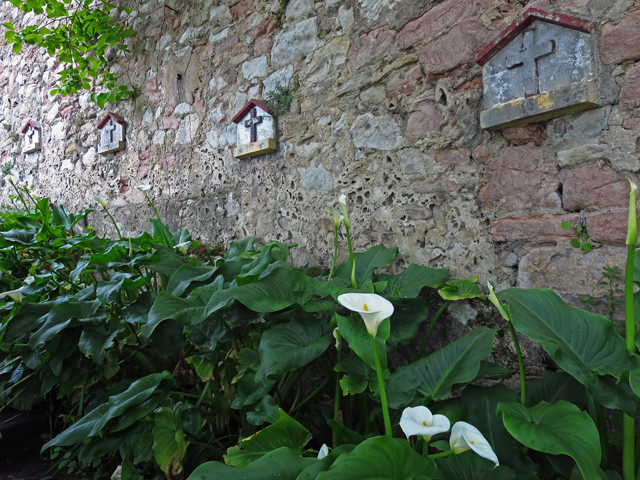
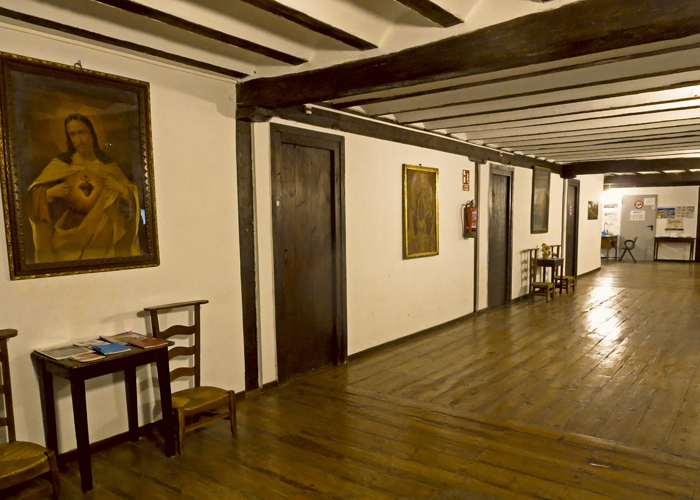
As soon as I passed through the sliding gate of the convent albergue, though, the peacefulness of the place surrounded and filled me. The sloping garden was a little shabby and overgrown, full of wildflowers and old religious icons. The building itself was spacious and spare, an enormous square of small rooms, each with just two cots and a pilgrim shell.

IMG_4169IMG_4159IMG_4156

I loved it.

The rain started again just after we arrived, and I spent the afternoon wandering the creaking halls, studying the artwork and listening to the echoes of history. Even more than the famous grand cathedrals, it’s in places like this—worn around the edges and dented by passing time—that I feel most connected to the Camino as something sacred. This pilgrimage is woven into some of the earliest expressions of the Christian faith, tended and guarded by generations of faithful believers who dedicate their lives to the story behind it.

IMG_4164IMG_4173IMG_4176IMG_4177

In fact, late that night, long after I’d gone to sleep in my echoing cell, Eric had one of his “top 3” moments of the whole trip. He and Peter had stayed outside talking, sheltered from the rain by the overhang of a small altar. As the 10:00 curfew hour approached, the albergue’s volunteer hospitalero found them, and Eric started asking questions about the building. The man, perhaps a little bored, pulled out his keys and offered to show them the rest of the building.

A secret tour of a sleeping convent? Who would say no to that?

The hospitalero took them into the shadowy chapel and along some narrow passageways. The building, set on a steep hill, descended several floors below what we’d thought was the ground floor. At one point, on a staircase, Eric’s guide paused to ring a bell. There were still nuns living on the lower floors of Convento San José, he explained, but they were cloistered and not allowed to see other people. He rang the bell to let them know he was there, so that they wouldn’t accidentally come into the hallway at just the wrong moment.

Those sacred whispers of history I’d heard? They were closer than I thought.


(And yes, I’m more than a little jealous that I missed the tour.)

Camino del Norte, Day 2: The Rain

Albergue Ulia to San Martín: 18 km

After the delightful surprise of a sunny first day on the Camino del Norte, we woke on Day 2 to the sound of rain. This wasn’t much of a surprise; the Norte is notoriously wet – the price they pay for all of the dense green colors and coastal views.

So after a hearty breakfast (shared again with French middle schoolers) We packed the electronics (including the camera) in the depths of our trash-bag-lined backpacks, stretched rain covers over the whole thing, geared ourselves up, and set out down the last 3 kilometers of the mountain, slipping on the mud and dodging very committed mountain bikers.

I had only fleeting glances of San Sebastian (called Donostia in the Basque language Euskera) as we blew—almost literally—through the famous city. The wind pushed the rain in almost horizontal sheets across the slippery promenade and mostly empty beaches, and we barely paused to watch the handful of intrepid surfers and mostly older bathers taking their morning swim, no matter what. Someday, this will be a lovely place to come back and linger for a few days, but this was not the day.

We climbed out of the city and back into the hills, and then, from San Sebastian to Orio, we were on our own. The rain kept falling, and there were no towns, no bars for coffee (or bathrooms), not even a picnic shelter to cover us for a few minutes of rest.

IMG_4726
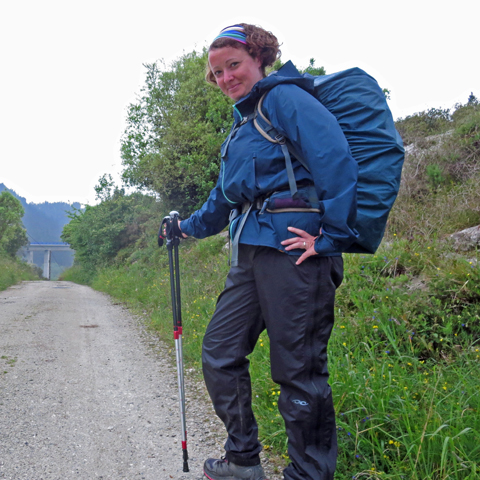
Waterproof from head to toe. Necessary rain gear for the Camino del Norte

The whole day could have been miserable, but I stayed surprisingly zen. This was only Day 2, and everything still felt fresh and exciting. My rain pants and trusty REI rain jacket stood up to the steady assault, and my feet stayed dry in my Hoka One Ones. (Eric was not so lucky, having opted for breathable trail runners and no rain pants.)

Camino Norte tip: if you’re debating your footwear, go for the waterproof option.

For most of the day, there were no other people in sight. Eric walked ahead of me, stopping to let me catch up every half hour or so, and I didn’t see other pilgrims until the very end. Without a camera or conversation to distract me, I let my mind rest and just walked.

And walked.

And walked.

We followed rural roads through dense woods and rolling fields, the ocean often in sight to our right. The views, even in the rain, were stunning. Red cows and white sheep dotted the fields on the edges of bluffs, and I was jealous of their views, even on a day like this.

Even on Day 2, though, when my feet are fresh and my attitude is good, 18 kilometers (11 miles) of walking without a single break is tough. As we started the long, steep descent toward Orio on what was quaintly called “an original Basque road” (which I translated as “uneven, rough, ankle-threatening, knee-destroying cobblestones that have settled over the years at odd angles, and become slippery and muddy in constant rain and are trying to kill you”), I was ready to be done. And just a few minutes later, I was.


IMG_4072
Albergue San Martin

The albergue in San Martín had been recommended by several people as one of their favorites on the Camino, and even in the rain and mud, I could see the appeal. The sleeping area itself was nothing special, with 20 beds tucked in what I assume was originally a cow barn on the windowless ground floor of an old Basque-style house. Because of the rain outside, we had to string our wet clothes from the lines hanging between beds, adding to the cramped feeling.

IMG_4079

But the three women who ran the place were warm and funny, and prone to hugs, and the outside lawn sloped down to a separate kitchen/social area with a lovely view over the river and to the green, green hills beyond. On a sunny day, this would indeed be paradise.

IMG_4073

On a rainy day, though, the yard was out of the question, and so 20 damp people spent a rather close afternoon trying to stay warm and out of each other’s way as we waited for dinner.

One of the reasons I’d decided to stop at Albergue San Martín was because they offer a communal dinner every night. This had been normal for us in France on the Via Podiensis (see Eating Our Way Across France), and I loved the sense of community that came with a shared meal. This is where stories come out and true bonds are formed. The Camino, always, is about the people just as much as the long walks and great views.

And so in San Martín at promptly seven o’clock, twenty people gathered around a long table in the chilly kitchen building, filling it with our own warmth. And here, without me consciously knowing it, my Camino family started to form.

The cheerful man who spoke French and Spanish fluently, smiling all the time even as he shivered in shorts while his hiking pants dried.

The young guy from Madrid who brought his small, white, long-haired dog to the Camino with him. The shivering Kiwi sought out Eric’s lap and stayed there for hours.*

The two older German women who told me about growing up in East Germany, learning Russian instead of English and then watching everything change when the Iron Curtain fell. One of them had four Compostelas already, and was back for a fifth.

Two younger (well, my age) German women who giggled and stayed mostly to themselves.

A very young Korean exchange student who spoke no Spanish at all, and was very confused why the hospitalera kept calling her guapa.

An older Australian who smoked cheroots in the rain and poured the wine liberally for us all.

It would take a few more days before I learned (or at least remembered) all of their names, but it’s because of them that I crawled into my bunk bed smiling, remembering why the discomforts are worth it.

And when we woke the next morning, there was a rainbow promising a new, hopefully drier, day.

IMG_4083
A rainbow over San Martin promises a break from the relentless rain


*No, dogs aren’t really allowed in albergues along the Camino, for obvious reasons (everyone sleeping in dorms, allergies, etc.). But some of the private albergues, like San Martin, were willing to let Kiwi sleep just outside, under sheltered porches and among the shoes and backpacks.

Camino del Norte, Day 1: Irun to San Sebastian

There are some days on the Camino de Santiago that, when you look back, seem to fill a week’s worth of experiences and stories. First days are often like this – the trail is new and every yellow arrow or red-and-white marking is exciting, every hilltop view or medieval town is a surprise.

The first day of the Camino del Norte was so full that it’s hard to remember that it was just a single day. There were tough climbs and ridgeline walks, crumbling fortresses and paths through fields of cows, our first look at the ocean, tough descents, our first ferry ride, more ascents, more ocean, and finally, a bed in the woods.

IMG_3963

We set out from the donativo albergue in Irun after a generous breakfast of strong coffee and the local bakery’s day-old pastries, served by our gregarious volunteer hospitalero with a generous helping of friendly advice. To one person, he said their bag is too heavy. To another, he warned that they would need warmer clothes for when the rains came. For me, he stopped and wrote down the five phrases that I should know in the Basque language Euskara. Only one – eskerrikasko, or thank you – stuck.

Though the pilgrims and weather reports were full of rumors and stories of rain, the morning was clear, and the early light glowed. The path was relatively flat for the first 5 kilometers before it began a gentle, and then steeper, climb to the Sanctuario de Guadalupe.

IMG_3975

The church appeared to usually be locked, but there was a woman there preparing for mass, so we slipped in and paid our respects before we faced the first split in the route.

IMG_3984

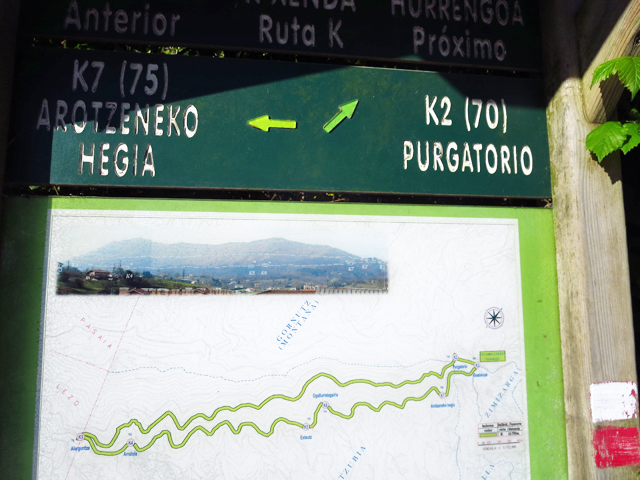
The lower path, which would stay relatively flat for the next 8 kilometers, promised “sporadic views of the Basque interior.” The higher path would climb sharply (100 meters of elevation in 300 meters, which is less an uphill walk and more a hold-onto-tree-branches-to-pull-yourself-up ascent), but then promised spectacular ocean views, as well as crumbling towers. It was called “Purgatorio,” perhaps to scare away those who weren’t prepared, but on a clear, sunny day, and this early in the walk, we were feeling strong and optimistic, and decided it was totally worth the scramble.

We were right.

IMG_3987

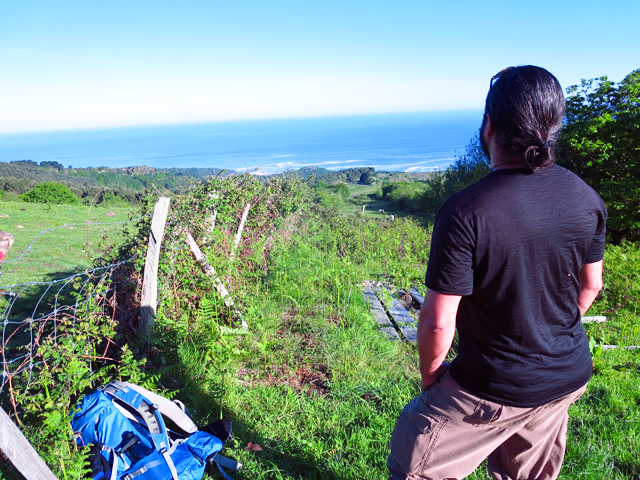
Because as we emerged from the trees after that first steep-as-a-ladder climb, all of a sudden there was the ocean behind us, blue and vast and beautiful.

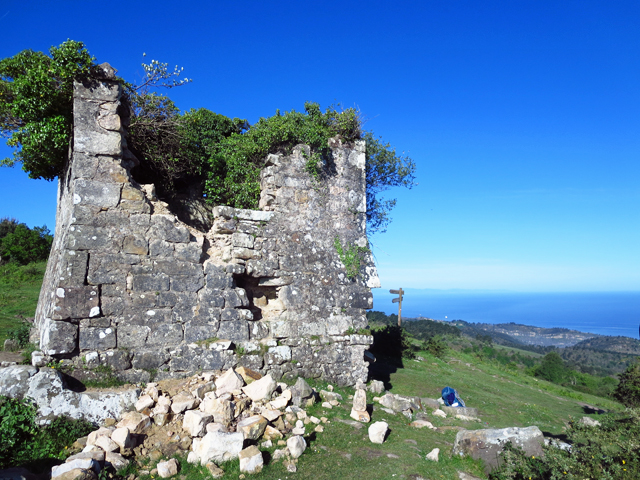
And in front of us (still another hundred meters of up), a crumbling watch tower.

The Cicerone guidebook says that they were watch towers built during the 19th century Carlist Wars. A hiker on the trail told us they were remains of earlier Basque towers where scouts would scan the ocean for whales and direct the whale-hunting ships.

IMG_3998

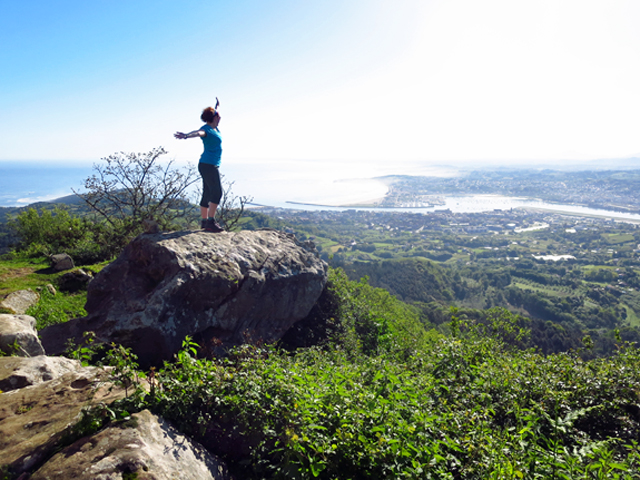
Whatever it was, the people who used to hang out up here had a heck of a view, with Irun and Hondarribia on one side of the ridge and the ocean on the other.

IMG_4004

The trail continued along the top of the ridge, passing five more watchtowers. It was a new experience for us to be traversing through, rather than around, cow pastures, but the animals basically just ignored us, and we learned to watch where we walked.

IMG_4009

Eventually, what goes up must come down, and so after the highest point of San Enrique at 545 meters (about 1800 feet) elevation, we started the steep, unrelenting descent back to sea level.

IMG_4045

San Sebastian glowed in the distance, but before we would get there, we needed to pass through Pasajes de San Juan, a small village clinging to a hillside at the mouth of a narrow river that had become a major shipping channel.

IMG_4056

The only way across the water was via a foot ferry, which cost 80 cents and ran every 15 minutes or so. Ferries are an unique part of the official Camino del Norte route, and something I hadn’t encountered on the inland Camino Frances or Via Podiensis. I’d been a little concerned when we set out about how we’d know where to go and what to do when we got there, but the arrows led us right to the dock, and it was easy enough to follow the lead of the people in front of us.

IMG_4054

On the other side of the river, there was an unsigned detour up through the town when the seaside road was blocked and under construction, and another short but steep climb back up to the bluffs. My legs and feet were starting to complain as we skirted the ocean for the last few kilometers toward San Sebastian, along trails that were well used not only by Camino pilgrims, but also plenty of local tourists.


IMG_4059

Before we left the States, I’d decided that I didn’t want to worry about finding a place to stay in a city as big and popular as San Sebastian, especially on a Friday night and after a long, hard day of walking. I looked for a place that I could book online, but the albergues in the city were all expensive (by albergue standards), and as much as I wanted to try the famed pintxos (tapas) of the Basque region, it just wasn’t working out.

So sight unseen, I decided a better choice would be to stop on the outskirts, at the Ulia Youth Hostel. Two kilometers before (and above) the seaside city, the hostel is tucked into the woods as a center for local mountain sports. It turned out to be a good choice. We arrived just as the clouds started to roll in, and a light rain started not long after.

I was exhausted, still a little jetlagged, and footsore by the time we arrived, and happy to postpone the final descent into the city until the next day. Our room was spare (a Murphy bed and easy-to-hose-down tile floors) but private and quiet, and the patio overlooking the city had a view of the harbor that I could stare at for hours.

IMG_4068

Which, in fact, is what we did. All of the other adult guests that night took cabs into the city to explore, but Eric and I were content to bundle up and sit outside, journaling and watching the people. The kitchen at Ulia doesn’t typically provide individual meals, but they were cooking for a youth group of French middle-school students and agreed to give us what they were having. A plain hamburger patty (no bun), pea soup, and French fries never tasted so good.

With detours and alternate routes, we’d covered about 25 kilometers (15.5 miles) in a day, plus all the climbing. It’s no surprise, then, that we were asleep by 9, like good Camino pilgrims.

Notre Dame Cathedral and the First Camino Stamp

When we bought round-trip tickets to Paris as the launching point of our Camino del Norte trip, the rolling SNCF strike had not yet been announced. (Or if it had, I didn’t know about it.) I assumed that once we landed it would be an easy train ride from Paris to Irún, just as three years ago we’d been able to hop a train directly from the airport to Lyon, and then on to Le Puy.

But as Eric has told me more than once, sometimes we win and sometimes we lose.

The trains in France are currently running three days out of every five, and we were scheduled to land on a “strike” day. After nervously reading dozens of websites, I realized the best thing to do was to sit tight in the city for a day, let our bodies adjust to the time changes (nine hours difference from Seattle), and see a bit of the City of Lights.

This would be our first time in Paris, and we would be seriously jetlagged (an “overnight” flight that landed when the clock said 8am and our bodies said 11pm). Where should we even start?

I sought the opinions of my more travel-experienced friends and made a way-too-long list of “must see” activities.

And then I saw a post on social media from another pilgrim, who mentioned that she got a Camino stamp at the Cathedral of Notre Dame.

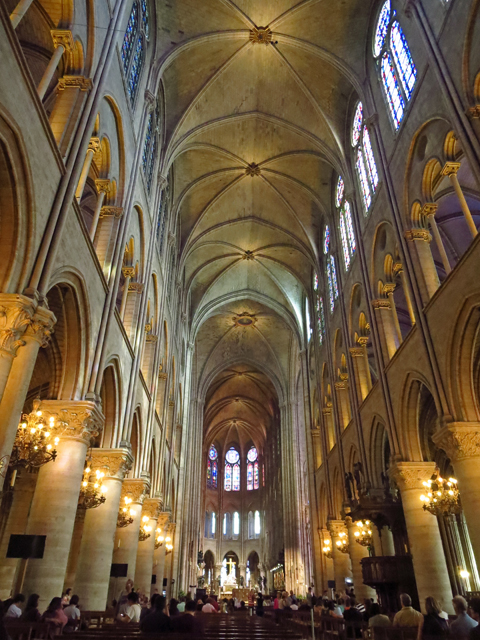
It made sense. Paris, after all, was one of the four main gathering points for Camino pilgrims, as recorded in the 12th century Codex Calixtinus. For hundreds of years, pilgrims came from the Low Countries and northern points of Europe to the Church of Saint-Jacques, just a few blocks away from Notre Dame, to begin their journey along the Vía Turonensis. Notre Dame, the medieval “parish church of the kings of Europe” with its famous relics and history going back to the fourth century, was part of that pilgrimage story.

Notre Dame suddenly became the center of my Paris plans.

IMG_3911

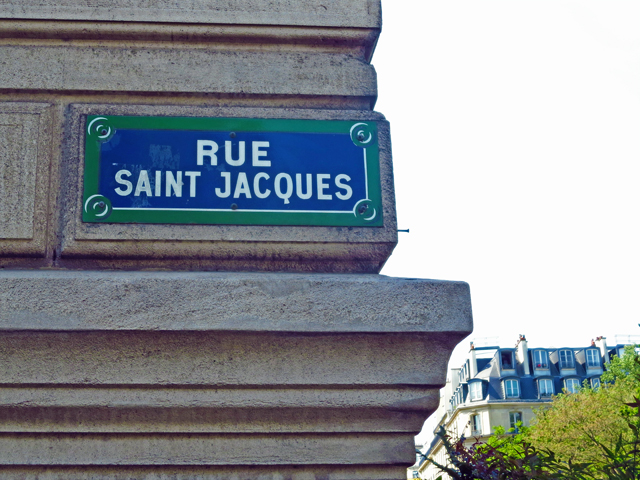
From our hotel near the Gare Montparnasse, we meandered (which is the nice way of saying I dragged Eric) through the Luxembourg Gardens and up the Rue Saint Jacques (of course) to the Île de la Cité, and deep into the throngs of tourists who gathered around one of the most famous structures in Paris.

It was a sunny May afternoon, and there was a festival of some sort happening in giant tents across from the cathedral. Which is to say, there were people everywhere, in lines and posing for selfies and bumping into each other.

IMG_3913

I started to doubt my plan a little at that point. This was a lot for two weary Americans just off an overnight flight to take in.

But the smart people on the Facebook forums had also mentioned something important: as a pilgrim of Saint Jacques, I didn’t have to stand in line to get into the famous cathedral.

I scooted up to the edge of the rope line, a skeptical Eric in tow, and held my (so far empty) credential out to the guard. He immediately recognized it.

Pèlerin?”

Oui, I agreed. It was good to wear that identity again.

He slid open the rope and waved me inside. “Bon chemin,” he said solemnly.

We made our way around the line of curious tourists and to the information desk just inside the church, where two bored-looking employees perked up at the sight of credentials. They pulled out a stamp pad, apologized because the ink was running dry, and then proceeded to very carefully mark our presence in this place of pilgrimage.

IMG_20180509_2054084

Grateful and a little dazed, we wandered through the cathedral. Mostly, we looked for signs of Saint James or my personal favorite, Saint Roche. Alas, neither had a chapel, although the sacred place was big enough to honor plenty of other heroes and leaders and martyrs.

IMG_3920

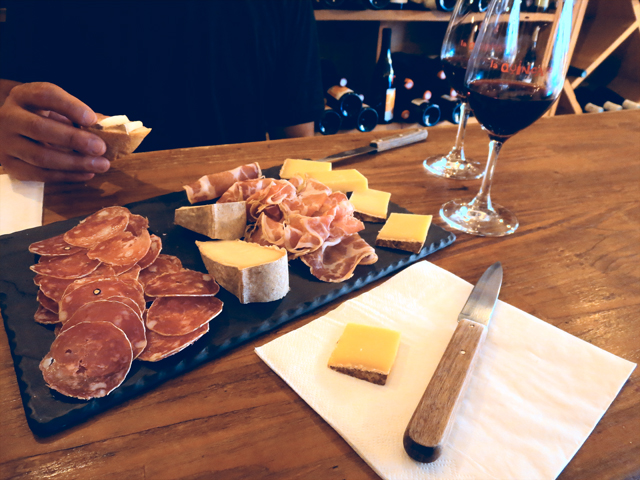
When we left, we should have continued north, to the Tour Saint-Jacques, the tower that is the only still-standing part of the original church. But to be honest, we were exhausted and “peopled out,” and in serious need of rest and refreshment. So we paused on the Pont Neuf to see it from a distance, and then went in search of a good bottle of Bordeaux and a charcuterie plate.

IMG_3943

Because pilgrims, after all, need sustenance even more than credential stamps.

By the time we were done eating, even I had to admit that the jetlag had won, and I skipped my plan to visit the Eiffel Tower at night. But next time, I promised, there would be more time in Paris. Because this, too, is part of the story.

Camino del Norte: First Impressions

After 21 days (and 21 beds) of travel, I’m home from my third trip to the Camino de Santiago, this time along the Camino del Norte.

I’m brutally jetlagged after the 10-hour flight from Paris, but wanted to share some initial impressions before I get lost in the madness of re-entry. (I also need a motivation to stay awake until at least 7pm, to try to get myself on the right side of the Seattle clock.)

IMG_3962
A map of the Camino del Norte that hangs in an albergue in Irun

By the numbers:

Over 17 days, Eric and I walked from Hendaye (on the French border) to Llanes, in Asturias.

Our total Camino trail distance was just over 400 kilometers (250 miles). Of that, we walked about 350 and bussed/trained the rest (more on that another time).

My feet mostly held up. I still have an unusually high amount of foot pain after walking, which makes it hard to reach the same distances as many (we averaged about 21 kilometers a day, and never crossed the 30 mark), but I can still plod along.

In fact, this week marked my 100th day of walking Camino trails.

So in honor of that, here are a few other random observations:

IMG_4528
Walking the Camino del Norte is an experience in breathtaking beauty (especially if you’re just a little afraid of heights)

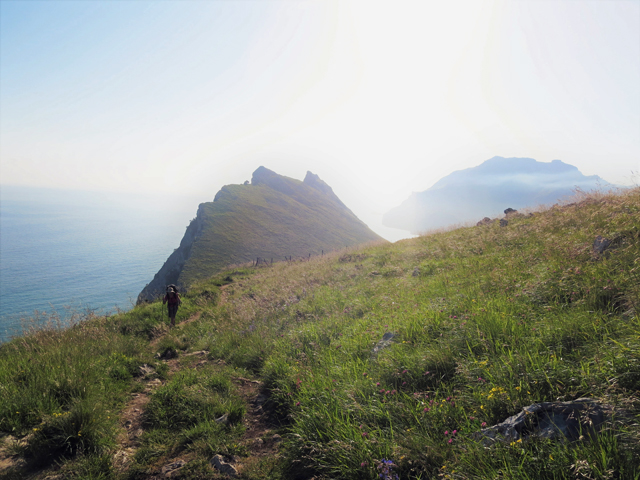
The geography and scenery of the Camino del Norte are the most dramatic I’ve encountered on a Camino trail. The combination of coastal walking and lush, green inland hills make every day spectacular. The Norte mostly hugs the ocean along the northern coast, so that you don’t go more than a day or two without at least seeing the ocean, and often walking on beaches. It’s consistently beautiful…and also brutal. I walked along unfenced cliffs and through (not around) fields of livestock that demanded my attention.

I have great Camino weather luck. For months, I’ve been hearing about the miserable wet and stormy spring that’s affecting Europe. Parts of the Camino Francés and Le Puy route were still getting snow in May. I’ve been following women who blogged about walking Camino del Norte in pounding rain and heavy wind every day for weeks on end, finishing just days before I set out.

Me? I came home sunburned. We had two days of light but steady rain in the beginning and two afternoons of heavy showers at the end, but the rest was mostly cool, overcast, dry weather (perfect for hiking) in the morning, and sunny afternoons. The wind was never heavier than a breeze. Really, it was lovely.

dav
Some of this “pilgrim pod,” here on the dock of Santander, had been together since the second day of walking.

Most people who walk the Camino del Norte have walked some other Camino trail before. Of the many people we met from around the world, few were Camino first-timers. Most had walked Camino Francés at some point. Several had come to the Camino del Norte directly from walking in France from Le Puy, Arles, or Bordeaux. It made for a strong base community of experienced, passionate pilgrims.

The number of pilgrims in May was, for me, just about perfect. There’s a lot to love about the Camino Francés, but the sheer numbers of pilgrims on the road every day was always a challenge for me. With hundreds of people streaming through small towns and villages, it was easy to feel anonymous, and also like the pilgrims were overpowering the Spanish culture. I met a lot of fantastic people along the popular Francés route, but sometimes I felt like I wasn’t seeing Spain.

The Norte, on the other hand, felt like I remember the Via Podiensis, as the Le Puy Camino is officially known. We saw (and developed nicknames for) the people who we saw every day: the three “French boys” (all retired or nearing retirement), the “Catalan caballeros,” the laughing German women, etc. We ran into them in albergues and throughout the day on the trail, but I never felt like I was just part of a line of people. Municipal albergues were small, often with only 20 beds, but I didn’t typically feel a “bed race” rush during the day; people started late and walked until 3 or 4, and still almost always found a spot.

Size, of course, is subjective. Some people love the Francés specifically because there are so many people. But for me, it was good to be back at communal dinner tables and small dorms.

IMG_4514

There’s less of a historical and/or spiritual emphasis on Camino del Norte. This is something that my fellow pilgrims brought up long before I noticed it, but they were right. The attention of Norte is mostly directed to the sea. The Camino path doesn’t go out of its way to pass in front of every church, and most of the ones we did see were locked. There is little Camino lore (like the legends and stories that pepper the Camino Francés), or chapels open for reflection and prayer. The coastal towns we visited had suffered centuries of wars and attacks that destroyed their older parts and left only modern city centers.

There were exceptions, which I’ll write about another time, but overall, for me this felt more like a beautiful hike and less like a thousand-year-old tradition.


How do all of those pieces fit together? I’m not sure yet. My plan is to provide a day-by-day account, as well as some thematic pieces, here, and I’m always interested to know what your experiences have been. Stay tuned: it will take me a while (at least two consecutive nights of sleep in the same bed) to piece it all together.

Why I Won’t Be Posting Updates From the Camino del Norte

For months now, I’ve been following the Facebook pages and Instagram feeds of pilgrims who are walking various portions of the Camino de Santiago. From them, I’ve gathered information about the weather, about where to stay, about what to expect. I’m grateful for them all.

And yet, when I leave tomorrow morning, I won’t be joining them. When I get to the airport, I’ll turn my phone off, and as much as possible, I’ll leave it off for 21 days. I won’t post daily reports here on the blog, nor will I post pics on any of my social media channels. I’ll write my thoughts on paper and take pictures with an old-school digital camera. For 21 days, this experience will belong only to me.

19774277400_aeac87afb3_z

That may seem counter-intuitive, or even selfish. After all, one of the things that sets the Camino apart is our community (and our easy access to Wi-Fi). And I fully intend to share the stories and photos when I get back. I appreciate the chance to process what I saw and learned with you all.

And yet, I’m still going to unplug while I’m there.

I explained it all here on the blog a long time ago, and it’s still a good summary of what I learned.

Mostly, it comes down to this:

“I wanted to be present on the Camino in a way that I knew I couldn’t be if I had a pocket full of distractions. If I was constantly thinking about faraway people, I reasoned, I would lose precious moments with the ones who were with me.”

I’m not a natural traveler (and I’m definitely not a natural backpacker). I’m going into a place that demands all of my senses. I need to listen intently to others who don’t share my language. I need to look and smell and feel intently the places that I pass through only once. Being present takes all of my attention, and I want to experience it fully.

That’s the only way I know how to bring it home to you all in its purest and best form.

So thanks for being part of Camino Times Two, and I’ll see you all again in a month, with lots of news and thoughts and stories from the northern coast of Spain.

Buen Camino!


In the meantime, if you’re interested in pictures, notes, and real-time news from the trail, these Facebook groups are full of incredible people:

American Pilgrims on the Camino

CAMIGAS

Camino del Norte

Via Podiensis/Chemin du Puy-en-Velay